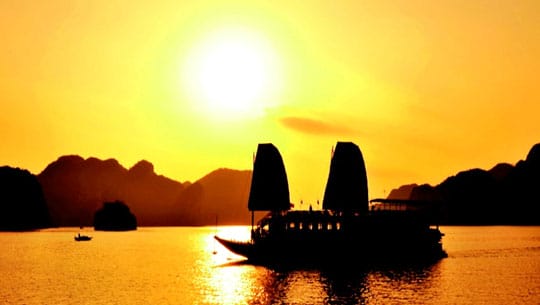
There are sunsets that politely end the day. And then there are sunsets that stop time.
Ha Long Bay belongs to the second category. According to CNN, it stands among the five most beautiful tropical island sunset destinations in Asia, a distinction shared with the Anambas Islands in Indonesia, Langkawi in Malaysia, Koh Chang and the Similan Islands in Thailand. Yet statistics and rankings dissolve the moment you are actually there. When the light begins to tilt and the sky loosens its grip on blue, Ha Long Bay performs a quiet act of persuasion. You are no longer a visitor. You are a witness.
Set in northern Vietnam, Ha Long Bay unfolds across roughly fifteen hundred square kilometers of water and stone, scattered with nearly two thousand limestone islands. Each one rises sharply from the sea, abrupt and theatrical, as if the earth itself decided to interrupt the horizon. By day, these islands are impressive. By sunset, they are transformed. The edges soften. Shadows lengthen. The bay exhales.
CNN’s selection was not casual. The ranking drew upon assessments from respected travel experts, scholars, and journalists across Asia. Among them was Stuart McDonald, editor and founder of the influential travel website travelfish.org, who described Ha Long Bay as a destination best experienced by cruise, where the sea and sky perform day and night with a beauty unmatched anywhere else on earth. He was not exaggerating. He was economizing language.
The ideal way to encounter Ha Long Bay is from the water, moving slowly. A cruise does not rush. It glides. As the boat leaves the harbor, the noise of land recedes. Fishing villages appear first, floating houses tethered like thoughts not yet finished. Nets drape the water. Children wave. Dogs doze. Then the islands arrive, one after another, until you realize you are surrounded.
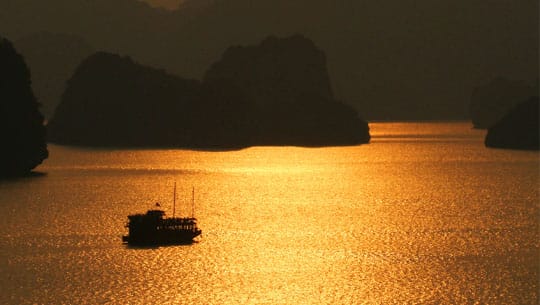
As afternoon fades, the air cools slightly. The sun begins its descent behind the limestone silhouettes. This is when Ha Long Bay earns its reputation. The light turns amber, then copper, then something almost unreal, a molten gold that seems poured rather than reflected. The islands become dark calligraphy against a luminous sky. Water mirrors everything. Even sound feels quieter.
Guests on deck fall silent without instruction. Cameras rise, then lower. No image quite captures it. The sunset here is not a single moment. It is a sequence. A slow unraveling. Clouds catch fire briefly, then release it. The sun disappears, but the glow lingers, as if reluctant to leave.
Nature has been extravagantly generous to this corner of Vietnam. The bay’s vastness ensures that no two evenings look the same. Some nights are clear and precise, the horizon sharp as a blade. Others arrive wrapped in mist, where islands emerge and vanish like half remembered dreams. In every version, the effect is intimate. You feel addressed.
Yet Ha Long Bay is not content with surface beauty. Beneath the water, calm reigns. The sea here remains tranquil throughout the year, inviting swimming, kayaking, and quiet exploration. To slip into the water at dusk, surrounded by stone and sky, is to feel briefly untethered from time.
McDonald’s second recommendation for visitors is equally persuasive. Explore the limestone caves. Ha Long Bay’s islands are honeycombed with chambers shaped by millions of years of patient erosion. By day, these caves are impressive. By late afternoon, as the light angles low, they become theatrical. Stalactites glow faintly. Shadows deepen. The silence inside feels ceremonial. Emerging from a cave just as sunset begins is an experience that recalibrates expectation. Darkness gives way to gold. Enclosure opens into immensity.
A Ha Long Bay tour product understands this choreography. The best cruises are not simply floating hotels. They are curated journeys. Cabins face the water. Decks are wide and inviting. Meals are timed to coincide with twilight. Staff know when to speak and when to step back. The benefit is not luxury alone. It is alignment. Everything exists to serve the moment when day tips into night.
Overnight cruises offer something rarer still. As day trippers depart, the bay empties. Engines quiet. Stars appear, surprisingly bright. The islands remain, now hulking and mysterious. Morning arrives softly, mist curling around stone pillars, the bay reborn in pale light. Guests wake to silence and the faint sound of water against the hull. This rhythm is addictive.
Accommodation onshore complements the experience. Hotels in Ha Long City range from comfortable mid range properties to international standard luxury hotels overlooking the bay. The finest understand orientation. Sea view rooms matter. Balconies matter. Restaurants positioned to catch the evening light matter. After a day on the water, returning to a room where the sunset continues its performance is a privilege that lingers.
The benefits of staying well positioned are practical as well as poetic. Easy access to cruise terminals reduces stress. Concierge services arrange private transfers and guided tours to caves and islands. Dining options blend local seafood with international technique. The decision to stay longer becomes effortless.
Beyond the cruise, Ha Long Bay invites immersion. Kayaking allows access to hidden lagoons, reachable only through narrow arches in the rock. The water here is glassy, reflective, almost ceremonial. Floating villages reveal a way of life tuned to tide rather than clock. Conversations unfold slowly. Gestures replace urgency.
The islands themselves vary wildly. Some are sheer and forbidding. Others cradle beaches of pale sand. Each one adds a note to the bay’s vast composition. At sunset, distinctions blur. Everything submits to light.
CNN’s recognition placed Ha Long Bay alongside other Southeast Asian icons, yet there is something singular here. The density of islands. The proximity of drama. The way myth and geology coexist without apology. Legend speaks of dragons descending to protect the land, their jeweled breath forming the islands. Watching the sunset ignite those stones, belief feels optional but understandable.
Ha Long Bay is not a place to check off. It is a place to absorb. The sunset is not an accessory. It is the axis. Schedules soften around it. Conversations pause. Even seasoned travelers find themselves recalibrated.
There is a moment, just after the sun disappears, when the bay holds its breath. The light dims. The islands darken. And then the day releases you.
That moment is why CNN noticed. It is why experts agree. It is why travelers return.
You can read about Ha Long Bay. You can admire photographs. But the sunset does not transmit fully through screens. It requires your presence. Your stillness.
Once you have seen it, the idea of postponing feels unreasonable.
The bay is waiting. Evening is coming.
Ha Long Bay sunset tour, Ha Long Bay luxury cruise, Ha Long Bay travel blog, Ha Long Bay island tour, Ha Long Bay Vietnam travel, Ha Long Bay sunset cruise, Ha Long Bay overnight cruise, Ha Long Bay best time to visit, Ha Long Bay scenic tour, Ha Long Bay photography sunset, Ha Long Bay travel experience, Ha Long Bay world heritage travel, Ha Long Bay sea view hotel, Ha Long Bay romantic cruise, Ha Long Bay things to do