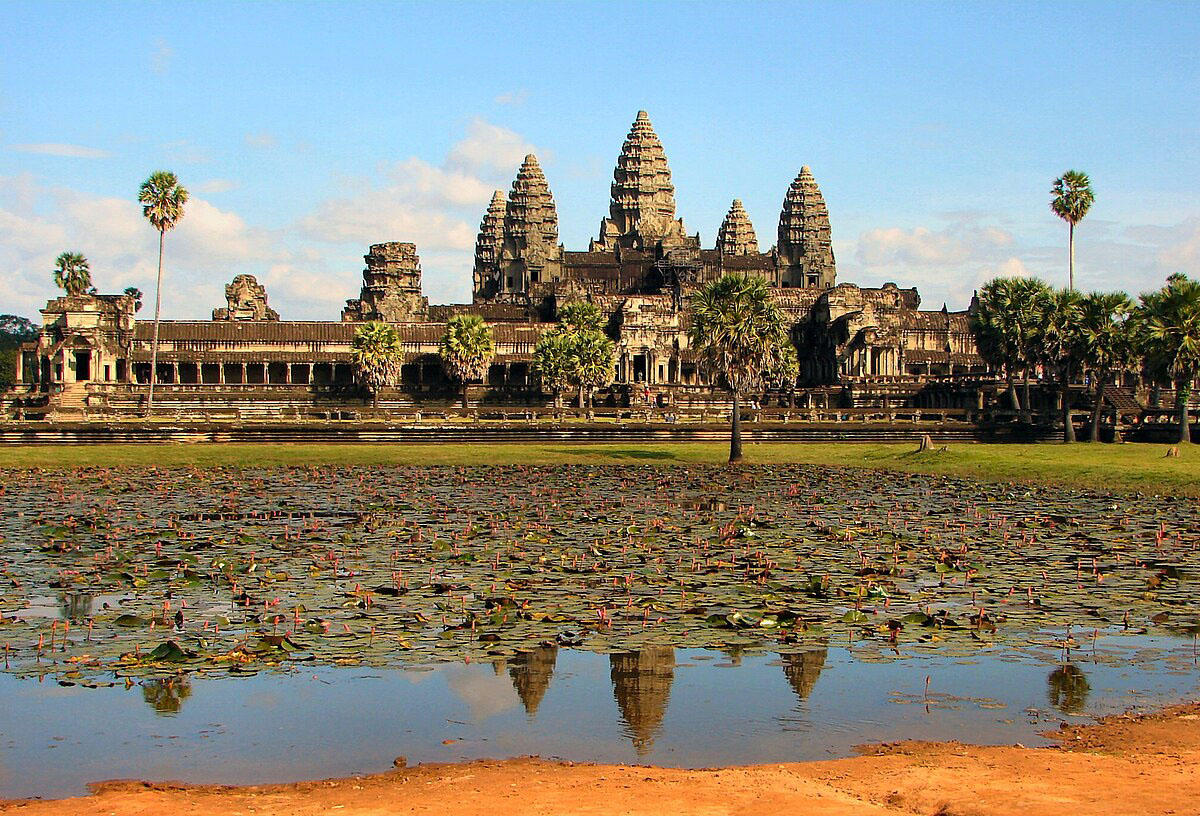
Angkor Wat may be the name that echoes across postcards and bucket lists, but Cambodia does not end there. It barely begins.
Step away from the crowds funneling through the grand galleries of Angkor, and the country reveals a deeper register. Quieter. Older. More intimate. These temples do not announce themselves with symmetry or scale alone. They whisper. They wait. They reward those willing to travel a little farther, sweat a little more, and listen carefully.
Cambodia is a land where stone remembers. Outside Siem Reap’s celebrated monuments lie four temple complexes that feel less curated, less mediated, and more honest in their ruin. Visiting them is not sightseeing. It is an act of discovery.
Sambor Prei Kuk feels like the prologue to Angkor, written centuries earlier in brick rather than sandstone. Built in the seventh century, this former capital of the Chenla Kingdom predates Angkor by hundreds of years. Set deep within Kampong Thom Province, Sambor Prei Kuk emerges from forest and farmland with almost no warning. One moment you are passing rice fields. The next, towers appear among the trees.
The site contains more than one hundred forty temple structures, most cylindrical in form, their proportions unfamiliar to travelers used to Angkor’s geometry. This is early Khmer architecture, raw and confident, influenced only lightly by Indian design. Brick walls are etched with faded carvings. Doorways stand open to birds and vines. The Lion Temple, once the spiritual heart of the capital, still holds a solemn gravity.
Sambor Prei Kuk does not overwhelm. It unsettles gently. There are no crowds pressing forward. You walk alone between ruins that have endured weather, war, and centuries of neglect. The power here is restraint. History feels close enough to touch.
Reaching Sambor Prei Kuk requires intention. It lies north of Kampong Thom, roughly thirty kilometers from the town center, positioned along the route between Phnom Penh and Siem Reap. From Kampong Thom market, local transport carries you onward, slow and dusty. The effort is part of the experience. Arrival feels earned.
Phnom Chisor takes a different approach. It challenges first, then rewards.
South of Phnom Penh, rising abruptly from the plains, Phnom Chisor Hill is crowned by the remains of a Hindu temple dating to the reign of King Suryavarman I. Dedicated to Shiva and Vishnu, the temple once commanded views across an ancient landscape of reservoirs and settlements. Today, it commands your breath.
To reach the summit, you climb five hundred three stone steps. The staircase is long, exposed, and unapologetic. Some visitors turn back. Others slow down. Those who persist arrive not only at the temple ruins, but at a panoramic silence that makes the climb feel inevitable.
From the top, the Cambodian countryside spreads out in every direction. Fields. Villages. Sky. The temple itself stands weathered and incomplete, its stones warmed by sun, its walls open to wind. Phnom Chisor does not feel restored. It feels remembered.
Travel here from Phnom Penh is straightforward. A half day taxi trip suffices, or a rented motorbike offers independence for those comfortable on Cambodian roads. The entrance fee is modest. The real cost is energy. The return is perspective.
If Sambor Prei Kuk is a beginning and Phnom Chisor a test, Koh Ker is an audacity.
Once the capital of the Angkor Empire under King Jayavarman IV, Koh Ker lies far to the north of Siem Reap, remote enough to feel forgotten. It was here that the empire briefly turned its back on Angkor and built something radically different. The result is astonishing.
The Koh Ker complex sprawls across forested land, its temples scattered rather than clustered. At its heart rises Prasat Thom, a seven tiered pyramid temple standing sixty five meters high. Often referred to as the Angkor Pyramid, it more closely resembles Mesoamerican structures than anything else in Southeast Asia. It was designed to represent Mount Meru, the sacred axis of the universe.
Climbing Prasat Thom is a visceral experience. The steps are steep. The stone is rough. From the summit, the jungle stretches endlessly, broken only by the tops of other temples peeking through foliage. The scale is humbling. The ambition unmistakable.
Koh Ker is not polished. Many structures remain partially collapsed, reclaimed by vegetation. That rawness is its strength. You are not observing history from behind ropes. You are walking through it.
The site sits roughly one hundred thirty kilometers north of Siem Reap. A day trip by taxi is possible, though long. Many travelers combine Koh Ker with nearby Beng Mealea, making a full circuit of lesser known Angkorian sites. Food options near Prasat Thom are limited. Preparation matters here. Water matters more.
Then there is Preah Vihear. No temple in Cambodia occupies a more dramatic position.
Perched atop the Dangrek Mountains along the Cambodian Thai border, Preah Vihear clings to the edge of a cliff, commanding views that seem to dissolve into distance. Built primarily between the ninth and twelfth centuries, the temple complex unfolds along a long axis, ascending gradually toward its highest sanctuary. Each level feels deliberate, ceremonial, earned.
Preah Vihear is dedicated to Shiva, and its carvings reflect a refined confidence. Red sandstone panels display intricate reliefs, floral motifs, and mythological scenes, executed with precision and restraint. The architecture here shares affinities with Banteay Srei, but the setting elevates it beyond comparison.
Standing at Preah Vihear, the wind is constant. The air is thinner. The land drops away suddenly. It is impossible not to feel the temple’s spiritual logic. This was meant to be a place apart.
Reaching Preah Vihear requires commitment. The site lies about two hundred kilometers north of Siem Reap. Roads are long, and travel is best broken with an overnight stay in Anlong Veng. Access is currently only from the Cambodian side, with the Thai border entrance closed. The entrance fee remains reasonable. The memory is not.
Traveling to these temples transforms how you understand Cambodia. Angkor Wat becomes context rather than centerpiece. The country’s architectural story expands outward, backward, upward.
Accommodation plays a supporting role in these journeys. Hotels in Siem Reap, Phnom Penh, and regional towns provide the necessary base. The best properties understand early departures, late returns, and the need for quiet rest between long days. Benefits include reliable transport arrangements, knowledgeable guides, packed breakfasts, and flexible check out times. Comfort matters when distances are long and days are demanding.
Choosing the right hotel simplifies logistics and preserves energy for what matters. Exploration.
These four temples are not substitutes for Angkor. They are companions. Each reveals a different temperament of Khmer civilization. Innovation. Devotion. Experimentation. Ambition.
They are places where history feels less narrated and more encountered.
If you have already seen Angkor, Cambodia is inviting you back. If you have not, it is asking you to look wider.
Beyond the famous towers, beyond the guidebook pages, there is a deeper Cambodia waiting.
And it is magnificent.
Cambodia temple travel, temples beyond Angkor Wat, Cambodia ancient temple tour, Sambor Prei Kuk travel, Phnom Chisor temple visit, Koh Ker pyramid temple, Preah Vihear temple tour, Cambodia heritage travel, Siem Reap temple excursions, Cambodia cultural tour, ancient Khmer temples, Cambodia history travel, Cambodia off the beaten path, Cambodia UNESCO temple sites, Cambodia spiritual travel