
The Forgotten Royal Coast of Thailand – A Slow Journey Through Phetchaburi and Hua Hin
The Forgotten Royal Coast of Thailand – A Slow Journey Through Phetchaburi and Hua Hin
Thailand is one of those places whose name appears so often in travel conversations that it almost begins to feel familiar before you have ever stepped foot there. Friends mention it casually, as if it were simply another province nearby. Some disappear every weekend with a backpack and a budget airline ticket, returning with stories of night markets, temples, beaches, and neon lights.
But their stories are usually the same.
Bangkok.
Chiang Mai.
Phuket.
Pattaya.
Thailand’s greatest hits.
I have always been suspicious of crowds. Cities buzzing with nightlife, tourist buses, and selfie sticks rarely hold my attention for long. For years, I assumed Thailand would remain one of those destinations everyone else loved while I quietly avoided it.
Then a Thai friend leaned over during dinner and said something that changed everything.
“I know a forgotten place,” he said. “A royal land that most travelers never see.”
That was how the journey began.
Phetchaburi – Thailand’s Forgotten Province
About 120 kilometers south of Bangkok, roughly two hours by car, the landscape begins to soften. The skyscrapers fade into rice fields. Mountains rise faintly along the horizon near the border with Myanmar. Palm trees replace traffic lights.
Here lies Phetchaburi, a province in central Thailand whose story stretches back more than a thousand years. Long before mass tourism arrived in Thailand, this region was part of an ancient Mon kingdom in the 8th century.
Yet today, surprisingly few international travelers pass through.
The first stop rising above the town is Phra Nakhon Khiri Historical Park, often called Khao Wang by locals. The palace complex sits atop a hill 92 meters above sea level, surrounded by tropical trees and clusters of frangipani flowers.
Built in 1860 for King Rama IV, the summer palace looks less like a single building and more like a miniature city.
White stupas glimmer in the sun.
Thai temples sit beside neoclassical pavilions.
Chinese architectural details appear in archways and windows.
The effect is quietly extraordinary.
Inside the museum halls, delicate ceramics and finely carved objects once used by King Rama V are displayed with meticulous care. Even the architecture reveals stories of royal life. Narrow, low corridors built for servants force visitors to bow slightly as they pass through—an accidental gesture of respect toward the palace above.
Climbing the steep staircases to the top terrace, a breeze suddenly arrives from the coast. The view opens wide.
Forests stretch westward toward the mountains along the Myanmar border.
The Gulf of Thailand glimmers faintly to the east.
And somewhere along that coastline lies the next chapter of the journey.
Cha-am – A Coastal Town That Refused the Race
Drive a short distance from Phetchaburi toward the sea and you reach Cha-am.
At first glance, it appears almost too quiet for Thailand.
This was once simply a fishing village. Nets dried along the beach. Wooden boats returned with shrimp, squid, and shellfish that soon found their way into fragrant coastal dishes.
The town later gained royal attention when King Rama VI built the elegant seaside palace Mruk Khatayawan Palace, sometimes described as the “Palace of Love and Hope.”
Royal visits transformed Cha-am into a beloved retreat for Thai families.
Yet unlike Phuket or Pattaya, Cha-am never rushed to reinvent itself for global tourism. Time seems to move differently here. The beaches stretch quietly. Seafood restaurants face the sea rather than the street.
Travelers seeking nightlife often pass by without stopping.
For those who prefer slow mornings and sea breezes, that is precisely the appeal.
In recent years, Thailand has tried to gently revive interest in the region. The country’s largest national park, Kaeng Krachan National Park, lies nearby, covering nearly 3,000 square kilometers of forest and mountains. Cultural traditions such as the Thai Song Dam festival have been revived, and local culinary heritage—including the refreshing dish khao chae, rice served in chilled aromatic water with sweet meats—has returned to the spotlight.
Modern touches have also appeared.
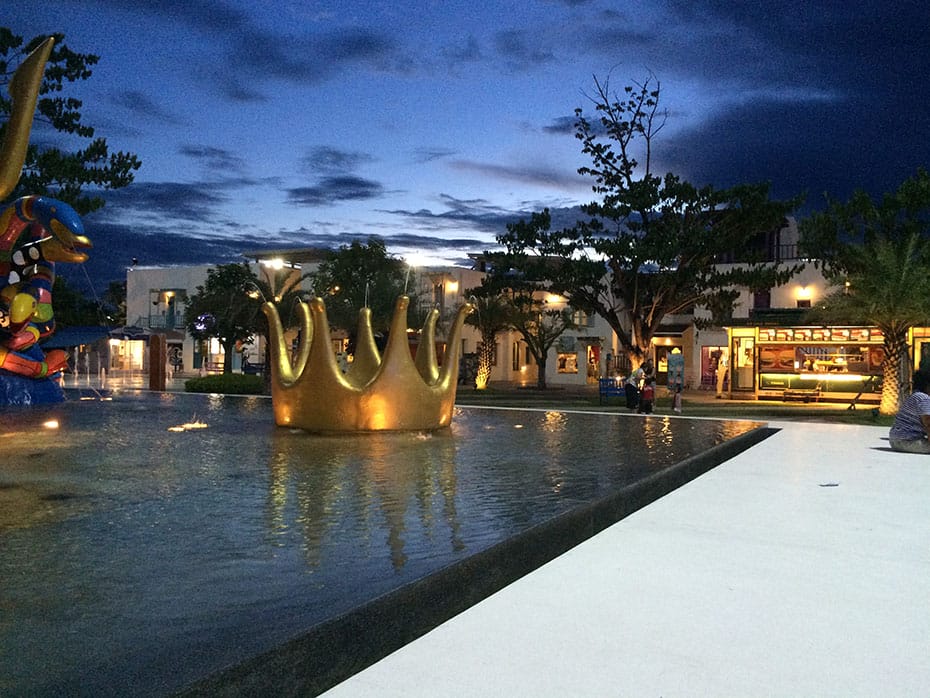
One of the most unexpected is Santorini Park Cha-am, a playful entertainment complex inspired by the Greek island of Santorini. Its bright blue-and-white architecture feels almost surreal against the Thai sky.
Yet even here, the crowds are mostly domestic travelers. International tourists remain rare.
Which is precisely what makes the region feel special.
Hua Hin – The Royal Escape
Just 30 minutes south of Cha-am, the coastline curves gently into Hua Hin.
Today Hua Hin is one of Thailand’s most beautiful seaside resorts, but its origin story is deeply royal.
In the 1920s, King Rama VII built the summer residence Klai Kangwon Palace.
The name translates poetically as “Far from Worries.”
That philosophy still defines Hua Hin.
Even now, the Thai royal family continues to visit regularly, and the town retains an understated elegance rarely found in Thailand’s busier beach destinations.
The beach itself begins near a small fishing harbor and curves southward for about three kilometers. Soft sand stretches toward Khao Takiab, where a massive Buddha statue sits quietly at the base of the mountain.
At sunrise, fishermen return with their catch.
By afternoon, horses trot slowly along the shoreline.
By evening, the sea breeze carries the scent of grilled seafood.
The atmosphere is calm rather than flashy.
And that calm seeps into everyday life.
Markets, Kitchens, and Moonlight
During my stay, I was invited to stay in a seaside home designed by a local fashion designer from the brand It's Happened To Be A Closet. The house overlooked the beach, every corner arranged with thoughtful detail.
It was the kind of place where leaving the room felt unnecessary.
Eventually curiosity won, and I took a tuk-tuk to the local market.
The difference from big Thai cities was immediate.
Here, conversations unfolded slowly. Vendors smiled easily. Transactions felt more like friendly exchanges than hurried sales.
Seafood glistened on ice—squid, shrimp, shellfish. Nearby stalls overflowed with tropical fruit and herbs.
I returned with bags full of ingredients.
That evening we grilled seafood beside the beach. The tide whispered against the sand. A full moon rose above the water, turning the ocean silver.
The only thing missing from the meal was wine.
Otherwise it was perfect.
The Butterfly Garden and a Gentle Reminder
The following morning I visited the Hua Hin Butterfly Garden, located opposite Klai Kangwon Palace. The garden, filled with herbs and tropical plants, hosts clouds of colorful butterflies drifting between flowers.
Walking there reminded me of another destination I had postponed for years: Cat Tien National Park back home in Vietnam.
Travel has a strange way of doing that.
A place thousands of kilometers away can suddenly remind you of landscapes you still need to explore in your own country.
Thailand’s Most Beautiful Railway Station
Before leaving Hua Hin, I visited one more landmark: Hua Hin Railway Station.
Built during the reign of King Rama VI, it is widely considered one of the most beautiful railway stations in Thailand.
Its design blends classic Thai architecture with royal elegance. The station complex includes a lavish Royal Waiting Room, originally moved here from Sanam Chan Palace in Nakhon Pathom.
Bright red and gold colors gleam against the tropical sky.
Unlike many historic stations around the world that have become little more than photo backdrops, trains still arrive and depart daily. The building remains alive with movement.
Watching passengers step on and off the platform, I was reminded that heritage survives best when it continues to serve everyday life.
A Place the World Has Not Yet Discovered
In many ways, the stretch of coastline between Phetchaburi and Hua Hin feels like Hoi An in the early 1990s—quiet, promising, and still slightly hidden from the global travel map.
There are night markets.
There are golf courses and balloon rides.
There are modern resorts and seaside cafés.
Yet the atmosphere remains gentle.
Perhaps international travelers are too busy chasing Thailand’s famous islands—Phuket, Koh Chang, Koh Tao, Koh Lipe—or the nonstop energy of Bangkok and Pattaya.
And so this royal coastline waits patiently.
With peaceful beaches.
Fresh seafood.
Soft ocean wind.
And a feeling that Thailand still holds secrets for those willing to wander just a little further.
Sometimes the most memorable journeys are not to the places everyone knows.
They are to the ones the world forgot.
And when you find them, you understand why some travelers never tell anyone.
The Royal Road South – A Hidden Thailand Journey From Cha-am to Hua Hin.
Phetchaburi Thailand travel, Hua Hin beach guide, Cha am Thailand coast, Thailand royal palaces, Phra Nakhon Khiri palace, Hua Hin railway station, Kaeng Krachan national park, Thailand hidden destinations, quiet Thailand beaches, Cha am seafood village, Hua Hin royal resort, Thailand slow travel, Santorini Park Cha am, Gulf of Thailand coast, Thailand cultural heritage
