
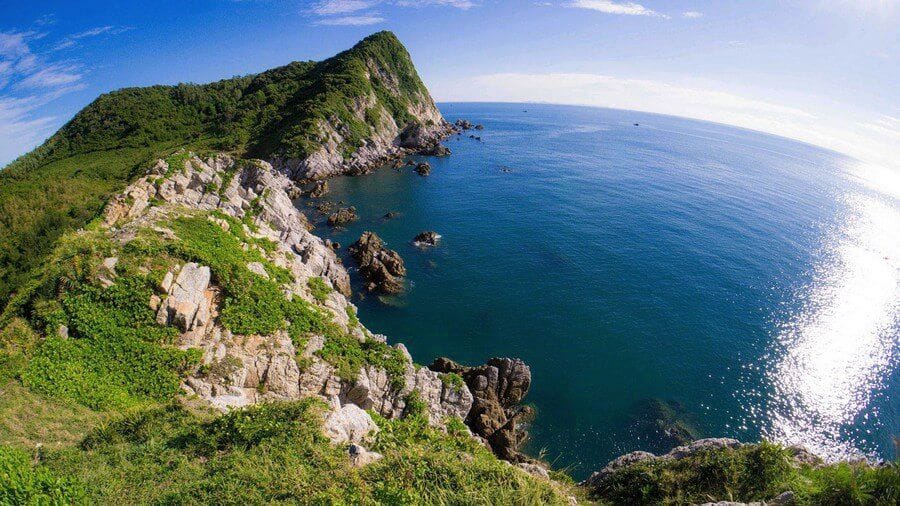
Seafood Beaches and Silence, A Slow Travel Journey to Quan Lan Island
There are places that shout for attention, and places that whisper. Quan Lan Island belongs to the second category. It does not sell itself loudly. It waits. Somewhere beyond the busyness of Ha Long Bay, past the choreographed cruises and predictable viewpoints, this island rests in Bai Tu Long Bay like a thought you almost forgot you had, then suddenly need to pursue.
Quan Lan Island covers barely eleven square kilometers, a modest scrap of land scattered with sand, forest, temples, and sea. Yet its smallness is deceptive. What it offers is not abundance in quantity, but intensity in feeling. The kind of destination that recalibrates your internal clock. The kind that persuades you, without argument, to slow down.
Reaching Quan Lan already feels like crossing a threshold. Boats pull away from the mainland, the water darkens, the skyline thins. The bay opens wide. Limestone silhouettes drift past like half remembered myths. When the island finally appears, it looks untroubled. No towers. No neon. Just a low green outline resting against a pale horizon.
Life on Quan Lan runs on human scale. Around five thousand residents live here, most of them bound to the rhythms of fishing, tides, and the seasonal pulse of visitors. Transportation is refreshingly unglamorous. Three wheeled electric carts and small vehicles shuttle travelers along sandy roads. Prices are fixed. There is no haggling theatre. You sit. You ride. You arrive.
Electricity, too, has its own rules. There is no national grid. Power comes from diesel generators, expensive and rationed. Air conditioning hums only at night, from early evening until morning. During the day, the island encourages a different relationship with heat. You open windows. You let the breeze in. You adapt. And strangely, you feel better for it.
Accommodation on Quan Lan reflects this same understated realism. There are a couple of three star hotels, comfortable and clean, but never intrusive. More common are family run guesthouses, simple rooms with tiled floors, fans, sea air, and hosts who know the island not as a product, but as home. Staying here feels less like checking in and more like being quietly accepted.
The real seduction, however, lies along the shore. Quan Lan Beach stretches long and pale, with sand so fine it squeaks faintly underfoot. Son Hao Beach is broader, moodier, edged by low dunes and whispering casuarina trees. Minh Chau Beach, perhaps the most luminous of all, glows at certain hours with water so clear it appears unreal, like glass poured over sand.
These beaches are not curated. There are no synchronized loungers. No relentless music. You walk. You stop. You swim. You sit. Often you find yourself alone, or nearly so, with nothing but wind, water, and the quiet awareness that places like this are becoming rare.
Quan Lan is not only a beach destination. It is layered with memory. The island holds one of the most distinctive historical complexes in northern Vietnam. Ancient communal houses, temples, shrines, and pagodas stand in dignified silence, shaded by old trees. The Quan Lan Communal House, built during the Later Le Dynasty, occupies a special place. It is the only communal house in Vietnam that worships King Ly Anh Tong, the ruler who established Van Don as a trading port in 1149, alongside General Tran Khanh Du, guardian of this maritime frontier.
Inside, time thickens. Eighteen royal decrees from the Nguyen Dynasty remain preserved, their calligraphy still declaring loyalty, gratitude, and continuity. You do not need to be a historian to feel the gravity. You just need to stand still long enough.
Not far away lies the site of the ancient Van Don Trading Port, once the first international seaport of Vietnam. Centuries ago, merchant ships from distant lands anchored here, trading ceramics, spices, silk, and stories. Today, there is little noise. Just land, water, and imagination filling the gaps. Travel, at its best, does this. It asks you to see what is no longer visible.
Quan Lan’s culinary life is unapologetically marine. Seafood arrives fresh, often still tasting of the tide. Sea cucumber stir fried with vegetables, steamed squid sweet and resilient, mantis shrimp grilled until fragrant, grouper prepared simply to respect its flesh. The island’s prized delicacy, sa sung, appears sautéed with betel leaves or dried for broth, its briny depth lingering long after the meal ends.
Dining here is not about menus thick with options. It is about availability. What was caught today. What the sea allowed. Meals unfold slowly, usually near the water, where conversation drifts and the horizon absorbs your attention.
What makes Quan Lan compelling is not comfort in the conventional sense. It is the feeling of stepping slightly out of alignment with modern expectations. You sleep earlier. You wake earlier. You notice the weather. You listen. The island does not perform. It simply exists, and invites you to do the same.
For travelers seeking polished luxury, Quan Lan may feel too quiet. For those craving an island that still belongs to itself, it feels essential. This is not a destination for ticking boxes. It is for travelers who want their journeys to leave a residue. A scent of salt. A memory of silence. A desire to return, even before leaving.
Quan Lan Island is not trying to be the next big thing. And that, precisely, is why you should go now.
Quan Lan Island travel, Bai Tu Long Bay island tour, Vietnam off grid island, Quan Lan beach vacation, Vietnam hidden island destination, Quan Lan seafood experience, Van Don ancient port, Quan Lan hotel guide, Vietnam slow travel island, untouched beaches Vietnam, Quan Lan cultural heritage, northern Vietnam island tour, eco travel Vietnam islands, Quan Lan travel guide, quiet beach destinations Vietnam
