
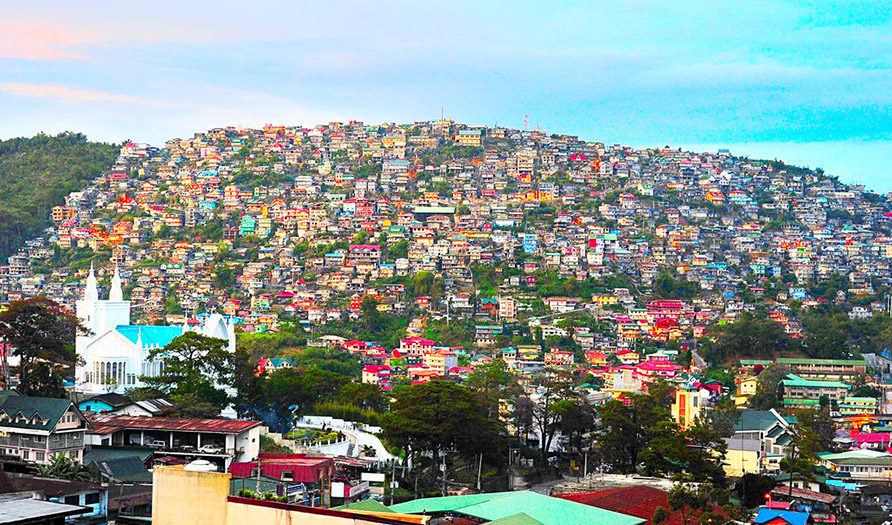
There is a persistent myth about the Philippines. It says the country is forever hot, endlessly humid, a place where the sun presses down like a hand that refuses to lift. It is a lazy idea, and like many lazy ideas, it dissolves the moment you climb. Go up. Go higher than the palms and the traffic and the sea air, and another Philippines reveals itself. One of pine needles, misted mornings, volcanic soil, cloud drenched afternoons, and evenings cool enough to make you reach for a jacket and smile.
These are not resorts invented by air conditioning. These are real towns and cities shaped by altitude, history, and stubborn human settlement in the mountains. They offer a different kind of tour product. Slower. Fresher. Surprisingly intimate. Once you taste this highland Philippines, the beaches can wait.
Baguio sits first, and proudly so, like an old colonial photograph that has somehow learned to breathe. Built at more than 1,400 meters above sea level, it was designed by Americans in the early twentieth century as a summer capital, a place to escape Manila’s heat. That intention still lingers in the wide roads, the stone cottages, the orderly chaos of a hill station that refuses to be entirely Asian or entirely Western. Walk through Burnham Park in the early morning and you will see joggers wrapped in fog, students clutching hot coffee, and vendors roasting chestnuts whose scent curls into the cold air. Mansion House, once the presidential summer residence, remains a symbol of retreat rather than power. Nearby strawberry fields offer fruit so fresh it feels like a rebellion against the tropics. Baguio is not polished. It is alive. And that is its luxury.
An hour south of Manila, Tagaytay rises abruptly, like a balcony overlooking one of the world’s most peculiar views. Here the land falls away to reveal Taal Volcano, a volcano within a lake within a volcano, a geological riddle that never quite sits still. Tagaytay’s elevation brings relief from the lowland heat, and its proximity makes it a favorite weekend escape. But linger longer and the place reveals more than cafés with views. Old estates, winding roads, and gardens that thrive in cooler air give Tagaytay a genteel unpredictability. At 766 meters above sea level stands the Sky Palace, once a guesthouse for world leaders, including Ronald and Nancy Reagan. From here, clouds drift across the crater like passing thoughts. This is not a destination you rush. This is a place where you sit, stare, and let the earth remind you that it is still at work.
Further north, the road narrows and the mountains grow more serious. Sagada waits at 1,766 meters, quiet, restrained, and almost monastic. Early agricultural planners once decided the climate here was suitable for citrus, a notion that now feels prophetic. Today, Sagada is often called the Shangri La of the Philippines, not because it is mythical, but because it feels slightly removed from ordinary time. Limestone cliffs guard hanging coffins. Echo Valley whispers back your voice with unsettling clarity. Sumaguing Cave opens into a cathedral of stone and shadow. Rise before dawn and climb Kiltepan Peak, where clouds gather below you in a rolling white sea. In Sagada, tourism is not loud. It is contemplative. You leave with less noise in your head than when you arrived.
Canlaon does not pretend to be gentle. It lives under the watchful presence of Mount Canlaon, the most active volcano in the Philippines, erupting more than twenty times in the past century. And yet, the town endures. At roughly 1,200 meters above sea level, Canlaon enjoys a mild microclimate shaped by geothermal forces. Hot springs bubble from the ground like secrets that cannot be contained. Waterfalls hide caves behind their curtains of water. When the volcano sleeps, hikers are allowed into Saddle in the Sky, one of its massive craters, a place that feels both peaceful and faintly forbidden. At night, ancient trees glow with fireflies, tiny constellations flickering close enough to touch. This is adventure tourism with a pulse.
On Mindanao, Davao stretches wide and confidently, a city that refuses to be summarized easily. Covering nearly 244,000 hectares, it is a tapestry of mountains, forests, and a coastline that gleams in shades of jade. While parts of the city sit at sea level, its heart leans toward Mount Apo, the highest peak in the Philippines. Trekking tours lead you upward through changing ecosystems, from farmland to mossy forest, where rare birds dart through filtered light. The air cools as you climb, and the noise of the city dissolves into wind and wings. Davao’s strength lies in its range. You can eat durian in the heat at noon and breathe alpine air by nightfall.
Not far away, Lantapan clings to the slopes of the Kitanglad Mountain Range at 1,333 meters above sea level. This is agricultural Philippines at its most photogenic and productive. Lantapan is the country’s vegetable basket, its fields improbably green and orderly in the cool climate. From here, serious hikers begin their ascent of Mount Dulang Dulang, the second highest peak in the nation. The town itself offers a quieter pleasure. Farm stays. Morning markets heavy with dew. Trails that wind through cloud forests where silence feels intentional. Lantapan does not sell spectacle. It offers authenticity, and that is increasingly rare.
Marawi, often misunderstood, rises at 1,300 meters and carries a cultural gravity unlike anywhere else in the country. As a predominantly Muslim city, its architecture is shaped by mosques, royal houses, and geometric elegance rather than colonial echoes. The cooler climate has long made it a summer refuge, but Marawi’s true value lies in its cultural depth. Travel here rewards curiosity and respect. The call to prayer drifts across Lake Lanao in the evening air, and the city feels momentarily suspended between tradition and resilience. This is not mass tourism. This is meaningful travel.
Finally, Banaue stands like a living monument to human patience. At elevations reaching 1,700 meters, the Ifugao rice terraces curve along the mountainsides, carved by hand more than 2,000 years ago. Recognized by UNESCO, they are not relics. They are working landscapes, still planted, still harvested, still sustaining communities. Mist rolls through the valleys at dawn, softening the lines of stone and earth. Walking here is humbling. Every step reminds you that travel is not about consumption, but about witnessing endurance.
These highland towns and cities form a different Philippines, one defined not by beaches but by breath. Cooler air. Sharper light. Slower conversations. They are ideal for curated tours focused on climate comfort, cultural immersion, hiking, agritourism, and reflective travel. Hotels here trade infinity pools for views that shift with the weather. Benefits are tangible. Better sleep. Deeper walks. Food that tastes more vivid in cool air. Experiences that linger.
If you think you know the Philippines, climb. The country changes as you rise. And once you have felt tropical air turn crisp against your skin, you will understand why leaving suddenly feels like the hardest part.
cool climate Philippines travel, Philippines highland tours, Baguio travel blog, Sagada mountain tours, Tagaytay volcano view travel, Banaue rice terraces tour, Philippines mountain destinations, cool weather Philippines vacation, Mindanao highland travel, Mount Apo trekking tours, cultural travel Philippines, Philippines eco tourism highlands, volcanic landscapes Philippines tour, unique Philippines travel blog, best mountain towns Philippines
