Nine days in Laos does not feel like a checklist. It feels like an apprenticeship in patience. The country stretches long and narrow beside Vietnam, more than two thousand kilometers of land border, yet culturally it feels wide open, almost unguarded. For travelers who prefer backpacks over itineraries and stories over souvenirs, Laos offers something increasingly rare in Southeast Asia: room to breathe. This is a journey designed and executed independently, from first bus ticket to last river sunset, moving slowly north, letting distance do its quiet work.
Preparation is less about gear than mindset. A valid passport is non negotiable, of course, but beyond that you need curiosity, tolerance for delays, and a willingness to improvise. A current Laos travel guidebook is worth its weight. In Ho Chi Minh City, they are easy to find around Pham Ngu Lao, and the latest edition matters. Laos changes gently, but it does change.
Money behaves differently here. The local currency is the Lao Kip, but US dollars circulate freely, especially for accommodation and transport. Exchange rates are friendliest at border crossings, where competition keeps numbers honest. Carry small bills. Laos is not fond of breaking large notes, and impatience is not part of the culture.
Movement inside Laos is an education in itself. In towns, tuk tuks rule short distances. They are communal, negotiable, and oddly social. Prices are per ride, not per person, so gather fellow travelers and share. Between provinces, buses and minibuses leave from stations, hotels, and travel offices. Buying one way tickets is wiser than committing early. Plans evolve here. Let them.
Mobile connectivity is reliable enough to be useful, unreliable enough to remind you where you are. Local SIM cards are cheap and effective, with Unitel being the most dependable network. International roaming works, but feels unnecessary in a country that encourages selective disappearance.
The route begins overland. From Ho Chi Minh City, buses head north toward Kon Tum, following Highway 14C through the Central Highlands. From Ngoc Hoi, near the Bo Y border gate, the journey crosses into Laos at Phou Keua. Timing matters. Border offices close early. Plan so you arrive during working hours, between morning and late afternoon.
The first night belongs to Attapeu, a modest provincial town that does not pretend to impress. After a long day on the road, it offers exactly what you need: food, rest, and darkness. Hotels are simple, clean, and inexpensive. Sleep comes easily.
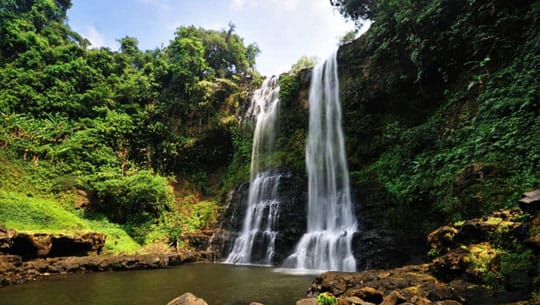
Day two moves north to Pakse, the gateway to southern Laos and the Champasak region. The road stretches for over two hundred kilometers, and arrival feels like reaching a crossroads. Pakse is practical rather than beautiful, but it unlocks some of the country’s most compelling landscapes. The Bolaven Plateau rises nearby, twelve hundred meters above sea level, where coffee plantations and waterfalls interrupt the heat. Tad Yuang Falls plunges with confidence, framed by dense greenery. Nearby, Wat Phou stands in composed silence, a pre Angkorian temple complex recognized by UNESCO, aligned perfectly with mountain and sky. Further south, Khone Phapheng Falls spreads wide and furious, the largest waterfall in Southeast Asia by volume, a reminder that the Mekong does not always drift politely.
Evenings in Pakse are easy. Local restaurants serve Lao, Thai, and Vietnamese dishes at prices that feel unreal. Meals are unhurried. Streets quiet early. The river waits.
The long haul north begins on day three. From Pakse to Vientiane is a full day on the bus, crossing Savannakhet, where Vietnamese run eateries along the main road. Grilled fish, sticky rice, fresh herbs. The bus pauses, life resumes briefly, then moves on.
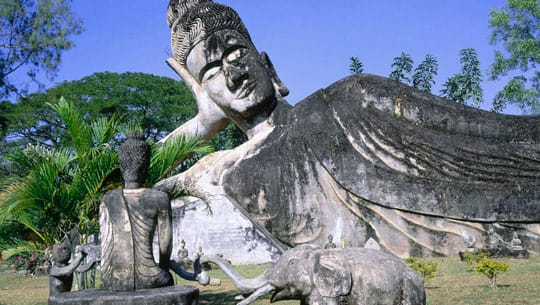
Vientiane arrives without drama. The capital is more town than city, stretched along the Mekong, understated to the point of humility. This is not a place that overwhelms. Patuxai stands in the center, a victory monument with Lao restraint. Wat Sisaket holds thousands of small Buddha images in quiet repetition. The Buddha Park, just outside the city, gathers surreal sculptures in a riverside field, part devotion, part dream. Entry is inexpensive. Time is generous.
Food here is best enjoyed near the river. Larb, a minced meat salad sharp with lime and herbs, is a signature. Lao hot pot simmers slowly, encouraging conversation. At night, the riverside market glows softly, selling textiles, handmade goods, and small indulgences. Bargain politely. Smiles matter.
Days six and seven take you to Luang Prabang, the spiritual heart of Laos. The bus ride is long but scenic, winding through mountains and villages that seem unchanged by decades. Arrival feels like stepping into a slower century. Luang Prabang rests at the confluence of the Mekong and Nam Khan rivers, a former royal capital wrapped in temples and frangipani.
Here, mornings begin early. Monks walk silently at dawn, receiving alms. Waterfalls tumble outside town. Kuang Si Falls cascades in turquoise tiers, irresistibly cool. Tham Ting Caves shelter hundreds of Buddha images left by pilgrims over generations. Wat Xieng Thong, the city’s most revered temple, glows with layered roofs and intricate mosaics, balanced, precise, eternal.
Accommodation in Luang Prabang ranges from riverside guesthouses to refined boutique hotels, many housed in colonial buildings. They offer more than beds. They offer atmosphere. Wooden shutters, shaded courtyards, breakfasts that stretch into midmorning. Staying central allows everything to unfold on foot.
The final days are open ended by design. You can retrace your steps south, stopping where curiosity demands, or continue along Route 13 through Vang Vieng, then back to Vientiane, exiting Laos toward Vietnam via the Cau Treo border in Ha Tinh. The country does not insist on one ending. It allows several.
Food accompanies you everywhere. Sticky rice is fundamental, eaten with hands, paired with dried beef, grilled fish, or simply salt and sesame. Meals are communal, casual, memorable. Beer Lao deserves its reputation. Cold, balanced, quietly excellent, it tastes best at sunset, somewhere near the Mekong.
This nine day journey through Laos is not about conquering distance. It is about yielding to it. About understanding that travel, at its best, rearranges your internal tempo. Laos does this effortlessly. You will leave lighter than you arrived, carrying fewer plans and more stories, already wondering when you can return.
Laos backpacking, Laos travel itinerary, Laos budget travel, Laos overland journey, Laos tour guide, Laos backpacker route, Luang Prabang travel, Vientiane travel guide, Pakse travel, Bolaven Plateau tour, Laos cultural travel, Laos border crossing, Laos food travel, Mekong River travel, Laos independent travel