
A Squatting Market in One of the World’s Richest Countries.
Kianggeh River Market. Floating Life in the Capital of Brunei
Brunei is often introduced with numbers. Fifth highest GDP per capita in the world. One of the highest in Asia. Oil wealth. Gleaming mosques. Wide boulevards.
And then, in the middle of Bandar Seri Begawan, the capital city whose name feels as grand as its skyline, you stumble upon a market that looks like it was borrowed from a small riverside town in Southeast Asia.
That contrast is what makes Tamu Kianggeh unforgettable.
I arrived in Brunei prepared for polish. Even a simple dinner at a regular local eatery cost around 10 Brunei dollars. Nothing shocking for a country known for prosperity, but enough to remind you that you are not in a budget backpacker haven.
So when I wandered through the city center and saw, beside modern buildings and shopping complexes, a slightly worn riverside market buzzing with chatter, plastic sheets, and baskets of produce, I stopped in my tracks. This was not the Brunei I had imagined. And that was exactly why I wanted to dive in.
Tamu Kianggeh and the Kianggeh River
Tamu Kianggeh sits along a small branch of the Kianggeh River, right in the heart of Bandar Seri Begawan. On ordinary days, it is a modest market with proper stalls and counters. Not glamorous. Not chaotic. Just practical.
But come Friday, the weekly market day, the scene transforms.
Vendors arrive early. Space fills quickly. And one corner of Tamu Kianggeh spills beyond its official boundaries, turning into what locals might casually call a squatting market. Plastic sheets and tarps are spread across the ground. Goods are laid out simply. Buyers weave between sellers.
The market creeps onto small bridges crossing the river. Below, boats move steadily along the Kianggeh. On the other side, cars line up in impressive numbers, polished and expensive, crowding the streets as traffic police guide them with patient gestures.
It is a fascinating image. Riverboats and luxury cars. Village-style stalls and modern high-rises. All within a few hundred meters.
If you have ever visited floating markets in the Mekong Delta of Vietnam, the rhythm will feel strangely familiar. “On the wharf and under the boats” is the phrase that comes to mind. Life flowing on water and land at the same time.
What You Find on the Ground
Look closely and the details become even more intriguing.
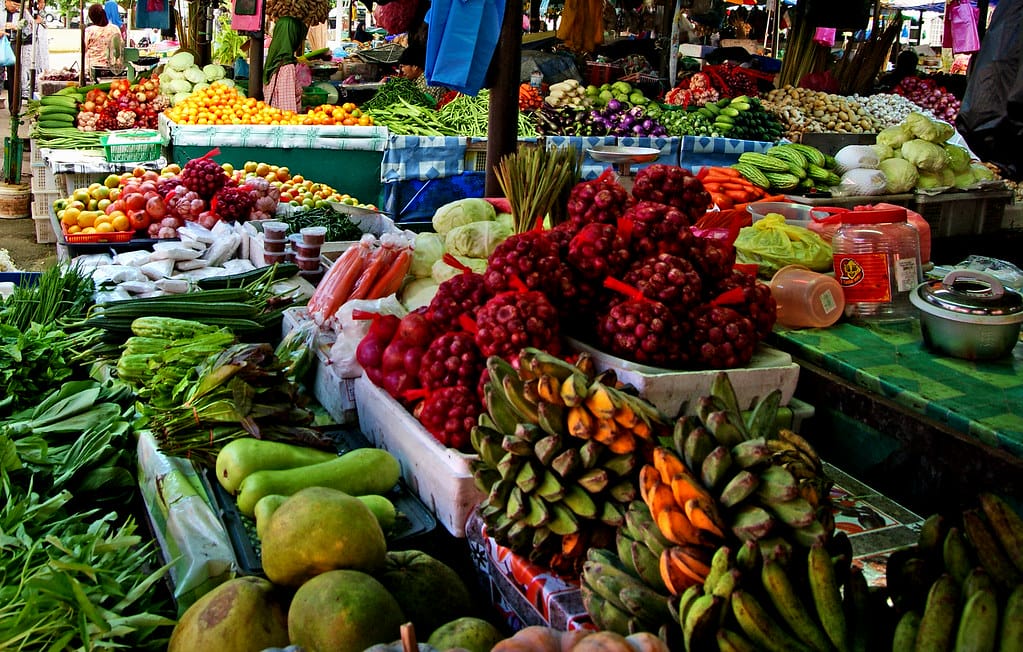
There are bundles of nipa palm fruit stacked by the river. Small bunches of leafy greens tied with string. Red chilies resting beside bright green mango shoots. Boys sitting cross-legged, scraping fresh coconut for customers who plan to cook rich curries at home.
There are also things distinctly Bruneian. A few unusual forest fruits you may not recognize. Stalls selling Islamic clothing, headscarves, and traditional caps. And across the river, rows of brand-new cars parked tightly together, their owners browsing the humble produce market just meters away.
The mix is almost poetic.
This is not a staged tourist attraction. It is a working market for local families. Yet travelers wander through as well. Western backpackers. Japanese solo explorers. Curious visitors who have heard that Brunei is more than oil and mosques.
Prices That Surprise You
Given Brunei’s wealth, you might expect everything here to be uniformly expensive. And in some cases, you would be right. Certain items cost noticeably more than what you would pay in neighboring countries.
But then you see something unexpected. A generous bundle of fresh greens priced at just 0.5 Brunei dollars. Two solid banana blossoms for 1 Brunei dollar. Simple, everyday ingredients sold at rates that feel almost modest, even by Southeast Asian standards.
The logic, as one young man explained to me later, is simple. If a crop grows well in a particular season, it becomes affordable. If it is scarce, the price climbs. In the supermarket, he said with a grin, everything is expensive in a steady, predictable way. Here at the market, nature still has the final say.
That explanation stayed with me. In a country defined by stable wealth, this market still dances to the rhythm of soil and harvest.
The Smiles That Define the Market
What truly defines Tamu Kianggeh is not the pricing or the produce. It is the atmosphere.
Prices are clearly marked on fish and vegetables, making it easy for visitors who do not speak Malay. There is no guessing game. No awkward bargaining.
Buy a bundle of greens and you might receive a few red chilies as a small gift. Show curiosity about an unfamiliar fruit and the vendor may slice it open so you can taste it on the spot. Even if you compliment the flavor and walk away without purchasing, you are met with a smile.
People laugh. They greet each other warmly. They chat. The market is not merely a place to shop. It is a place to reconnect.
Standing on one of the small bridges, I spoke with a young man named Niah who had driven his mother to the market in a gleaming car. I asked why she still came every week if she often bought only a few vegetables and some fish.
He laughed. Of course she comes, he said. She meets friends here. She talks. She asks about families. She spends half the morning socializing. When she returns home, she is happy. And when she is happy, we are happy.
In that moment, Tamu Kianggeh stopped being a curiosity and became something deeper. It was a community anchor in one of the wealthiest countries on Earth.
Lunch by the River
At one of the food stalls, I squeezed in beside a mix of foreign travelers and locals. I bought a box of rice generously topped with various dishes for 1 Brunei dollar. Simple. Filling. Perfect for a wandering afternoon.
I slipped the box into my backpack and continued exploring.
It struck me then that Brunei’s per capita GDP once stood around 48,714 US dollars, compared with roughly 1,300 US dollars in Vietnam around the same period. The gap is enormous. On paper, the two countries seem worlds apart.
Yet here I was, walking through a riverside market that could have been in Can Tho or a small Mekong town. The sounds, the laughter, the humble displays on tarps, the boats sliding along the river. It felt familiar. Comforting.
Prosperity had not erased tradition.
Practical Notes for Visiting
Getting to Brunei is straightforward from regional hubs like Kuala Lumpur or Bangkok, with low-cost flights available.
In Bandar Seri Begawan, several attractions around the capital can be reached by public bus. For more distant experiences such as exploring the Borneo rainforest or going diving, you will likely need to join organized tours. These tend to be more structured and significantly pricier than everyday city experiences.
But Tamu Kianggeh requires no tour. No ticket. No schedule beyond showing up, especially on Friday.
Come in the morning. Walk slowly. Cross the bridge. Watch the boats. Taste what you do not recognize. Smile back.
Why You Should Go
In a country known for its oil wealth and high living standards, Tamu Kianggeh reminds you that culture is not measured by income. It is measured by connection.
This market is not flashy. It does not try to impress. It simply exists, serving its people week after week. And in doing so, it offers travelers something rare: a glimpse of everyday life that feels genuine.
If you visit Brunei and only see its grand mosques and wide avenues, you will understand its wealth.
If you spend a Friday morning at Tamu Kianggeh, you will understand its heart.
And that is the reason to go.
A Day in Bandar Seri Begawan. Why Tamu Kianggeh Feels Like Southeast Asia’s Soul.
Tamu Kianggeh Market, Bandar Seri Begawan market, Brunei travel guide, Kianggeh River market, Brunei Friday market, Brunei GDP per capita, Southeast Asia markets, Brunei street food, squatting market Brunei, Brunei local life, Borneo travel experience, Bandar Seri Begawan travel, Brunei budget meal, Brunei cultural travel, Kianggeh River boats
