
There is something unsettling about a volcano even when it sleeps. It looks calm. It behaves politely. Yet it carries memory. Heat. Pressure. A past life of fire and violence now translated into meadows, lakes, coral reefs, villages, temples, and improbable beauty. Travelers are instinctively drawn to these places not in spite of their history, but because of it. A dormant volcano is a reminder that the Earth, like us, can learn to rest without forgetting who it once was.
Across continents and oceans, these sleeping giants have become destinations of pilgrimage for hikers, divers, photographers, scientists, and travelers who crave landscapes that feel earned rather than manufactured. You do not simply arrive at a dormant volcano. You enter a story written in magma and patience.
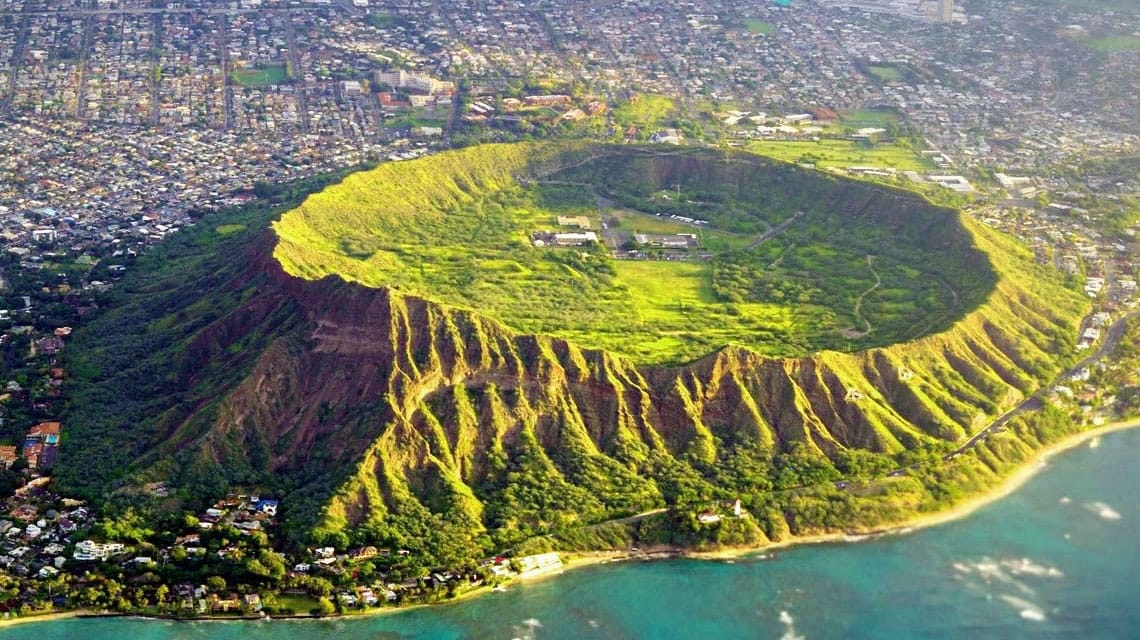
Diamond Head on Oahu is a perfect introduction. From a distance it looks almost polite, a symmetrical rise above Waikiki’s gentle sprawl. Up close, it reveals its origin as a volcanic crater formed more than 300,000 years ago. British sailors once mistook the calcite crystals embedded in its rock for diamonds, giving it a name that still glitters with misunderstanding. Today, the crater shelters hiking trails, panoramic viewpoints, and remnants of military tunnels quietly absorbed into the landscape. From the summit, the Pacific stretches endlessly while Honolulu hums below. Hotels across Oahu benefit from this proximity, offering travelers the rare luxury of pairing beach indulgence with geological drama before breakfast.
Kelimutu in Indonesia feels less like a mountain and more like a mood swing. Located near the small town of Moni on Flores Island, this dormant volcano holds three crater lakes that refuse consistency. One remains stubbornly blue. The other two shift colors without warning, turning from emerald to rust, from ink to ash. The changes are driven by volcanic gases still breathing beneath the surface, unseen yet influential. Locals attach spiritual significance to each lake, believing they house the souls of the dead, sorted by age and morality. Standing at the rim at sunrise, watching color seep slowly into water, you feel like a witness rather than a tourist. Lodges in the region are simple but intentional, designed to place silence and stars back into your nights.
Off the coast of Santiago Island in the Galapagos, Rocas Bainbridge presents a gentler afterlife of volcanic power. These cone shaped craters now hold shallow saltwater lagoons tinted turquoise, the color of diluted gemstones. Flamingos arrive seasonally, long legs tracing ripples through water that once boiled. This is nature’s most persuasive argument for patience. Galapagos cruises and eco lodges frame Rocas Bainbridge not as a spectacle but as a quiet lesson in resilience, where life repurposes destruction into sanctuary.
Xico in Mexico tells a different story, one shaped by human necessity. Located at the southern edge of Mexico City, this dormant volcano was once submerged beneath Lake Chalco. As waters receded, Aztec fishermen settled along the shores. Centuries later, the lake was drained completely, and fertile volcanic soil became farmland. When space grew scarce, residents climbed into the crater itself, cultivating crops on slopes shaped by ancient eruptions. Today, Xico is a densely populated town built inside a volcano. Hotels in Mexico City offer easy access to this unlikely landscape, where geology and urban survival intersect without ceremony.
Molokini near Maui feels almost mythical. A crescent shaped volcanic crater rising just above sea level, it forms a natural barrier against waves and currents. Inside, the water becomes cathedral clear. Coral thrives at shallow depths. Fish arrive in colors that seem invented rather than evolved. More than 250 species live here, many found nowhere else. Snorkeling Molokini is not an activity. It is immersion. Tour operators depart early to catch the calm, while resorts across Maui frame the experience as essential rather than optional. This is one of the few places where the inside of a volcano feels like an invitation.
On Jeju Island, Seongsan Ilchulbong rises from the sea like a crown. Formed by underwater eruptions roughly 4,000 years ago, this tuff cone volcano now stands 182 meters high, its bowl shaped crater opening toward the sky. At dawn, visitors climb its slopes to watch the sun emerge from the East China Sea, light spilling across grass covered ridges and stone. The crater hosts rare plant species and provides a living classroom for volcanic formation. Jeju’s hotels range from minimalist guesthouses to refined resorts, all aligned with the island’s rhythm of wind, stone, and sea.
Nabiyotum in Kenya rests quietly near Lake Turkana, the world’s largest alkaline lake. The crater rises starkly from an already alien landscape of desert and water, its symmetry amplified by emptiness. Few travelers reach it. Those who do speak of silence so complete it feels physical. Lodges near Turkana cater to explorers rather than crowds, offering access to one of Africa’s least altered volcanic landscapes.
Aogashima in Japan is a paradox. The island itself is a volcano, and inside it sits another volcano. A double caldera surrounded by sheer cliffs, accessible only by ferry or helicopter, it hosts a small village of roughly 200 residents governed by Tokyo yet living far from it in spirit. The last eruption in the nineteenth century was deadly, and memory remains sharp. Yet life persists. Steam vents warm the ground. Locals cook with geothermal heat. Travelers stay in modest inns, rewarded with night skies unmarred by light pollution and mornings shaped by mist.
Santa Margarida in Spain hides a Romanesque chapel inside its crater, a structure rebuilt after an earthquake and left to sit alone in a grassy bowl of volcanic soil. The surrounding Garrotxa Natural Park is lush, almost indulgent, while the crater floor remains flat and sparse. Walking here feels ceremonial, as if the land itself demands quieter footsteps. Rural hotels and farm stays enhance the sense of stepping away from urgency.
Koko Crater in Hawaii completes the circle. A vast cone overlooking Maunalua Bay, it now shelters horse stables and a cactus garden adapted perfectly to the crater’s dry heat. The climb to the rim is steep, uncompromising, and rewarded with views that recalibrate perspective. Waikiki feels distant. The ocean feels immense. The volcano feels present, even in rest.
Dormant volcanoes offer more than scenery. They offer narrative density. They remind us that beauty can be the long echo of violence, that calm landscapes often have the most dramatic pasts. Travel products built around these destinations succeed because they promise transformation rather than distraction. Hotels near dormant volcanoes do not merely provide beds. They provide proximity to awe.
Once you stand inside a crater turned meadow, swim in a volcano turned reef, or sleep near a mountain that remembers fire, ordinary destinations lose some of their appeal. These places do not shout. They wait. And when you arrive, they stay with you long after you leave.
dormant volcano travel, sleeping volcano destinations, volcano tourism guide, Diamond Head Oahu travel, Kelimutu crater lakes tour, Molokini snorkeling travel, Seongsan Ilchulbong Jeju travel, Aogashima volcano island tour, Santa Margarida volcano Spain, Koko Crater Hawaii hike, unique volcano landscapes, adventure travel volcanoes, nature travel destinations, geological tourism world, volcano travel blog
