
The Essential Laos Backpacking Route – Vientiane Vang Vieng Luang Prabang And Xieng Khouang
The Essential Laos Backpacking Route – Vientiane Vang Vieng Luang Prabang And Xieng Khouang
Travel in Southeast Asia often begins with the same comparisons.
Thailand is energetic and highly developed for tourism. Malaysia feels modern and efficient. Vietnam is intense and fast-moving.
Then there is Laos.
The country often called the Land of a Million Elephants moves at a noticeably slower pace. Cities are smaller. Roads pass through forests and limestone mountains. Monks collect alms quietly at dawn.
For travelers planning an independent journey, Laos rewards patience. It is a destination where travel feels less like a checklist and more like a gradual unfolding of landscapes and culture.
This guide focuses on a budget-friendly backpacking route across Laos, beginning from Vietnam and moving through four key destinations:
-
Vientiane
-
Vang Vieng
-
Luang Prabang
-
Xieng Khouang
Instead of simply listing attractions, this guide approaches Laos from a planner’s perspective—how to structure a route, what food to expect, and which cultural stops deserve time.
Quick Summary Table – Backpacking Route Across Laos
| Destination | Travel Character | Highlights |
|---|---|---|
| Vientiane | Cultural capital | Temples monuments markets |
| Vang Vieng | Landscape stop | Limestone mountains Nam Song river |
| Luang Prabang | Historic city | Temples Mekong peninsula |
| Xieng Khouang | Cultural heritage | Plain of Jars archaeological site |
Why Laos Works Well for Backpacking Travel
Laos is particularly suited to slow travel for several reasons:
-
Compact route connections between major cities
-
Strong cultural identity centered on Buddhism
-
Natural landscapes that remain relatively undeveloped
Travelers moving through Laos often follow a northbound route beginning at border crossings from Vietnam.
Compared with many destinations in Southeast Asia, Laos feels quieter. Cities are smaller. Streets are calmer. Temples remain central to everyday life.
For travelers seeking cultural immersion rather than constant nightlife, this shift can be refreshing.
Getting There – Entering Laos from Vietnam
The most economical way to reach Laos is by long-distance bus from Vietnam.
Travelers departing from Hanoi often take buses heading toward Vientiane, departing from 3A Nguyen Gia Thieu Street (So 3A Nguyen Gia Thieu).
The route usually crosses the border through Cau Treo Border Gate.
Another option is traveling from Vinh and continuing toward Xieng Khouang through Nam Can Border Gate.
Travelers departing from Ho Chi Minh City can enter Laos by land through border crossings in:
-
Kon Tum
-
Quang Tri
-
Hue
-
Quy Nhon
Among these routes, the Kon Tum crossing is often preferred due to easier road connections.
For travelers with their own vehicles, permits can be obtained through the Vietnamese Department of Transport to drive across the Vietnam–Laos border.
Flights are available through Vietnam Airlines, which operates direct routes to Vientiane.
However, independent travelers often prefer overland routes because they allow a gradual transition between landscapes.
Vientiane – Laos’ Quiet Capital
Unlike many Asian capitals, Vientiane feels relaxed and spacious.
Wide boulevards stretch between temples and colonial-era buildings.
Key sites include:
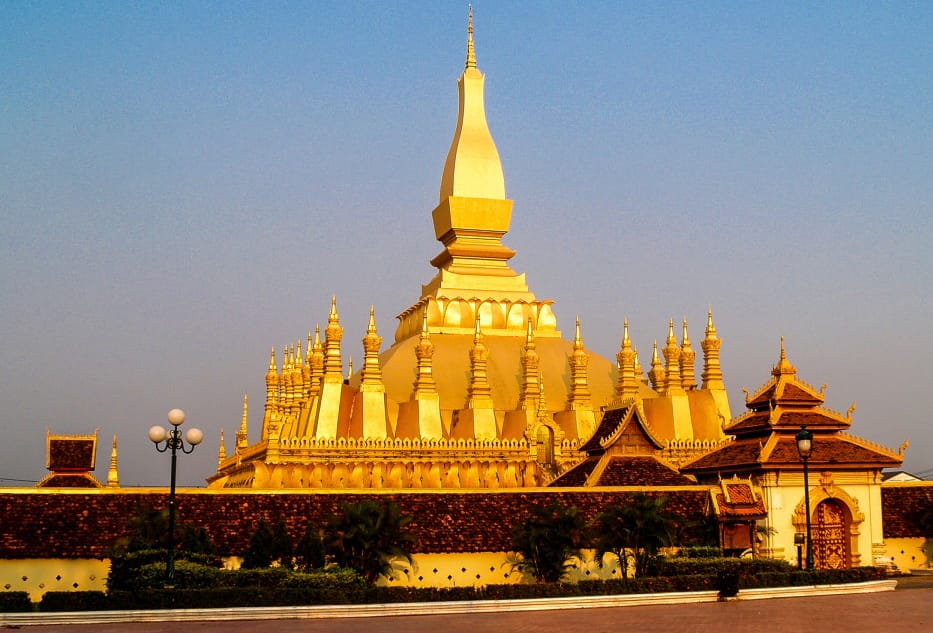
• Pha That Luang – the most important national monument
• Wat Si Muang – often called the Mother Temple where monks perform blessing ceremonies
• Wat Sisaket – home to thousands of Buddha statues
• Patuxai Monument – Laos’ answer to the Arc de Triomphe
• Black Stupa
For shopping, travelers typically explore Morning Market Vientiane, where clothing, handicrafts, and everyday goods fill several floors.
Vientiane works best as a starting point rather than a long stay destination. Most travelers spend a day or two before heading north.
Vang Vieng – Limestone Landscapes and River Travel
About four hours north of Vientiane, the small town of Vang Vieng sits between limestone mountains.
The scenery is dramatic.
Cliffs rise abruptly from rice fields, and the Nam Song River winds through the valley.
Travelers stop here to relax between long journeys.
Popular activities include:
-
floating down the Nam Song River on inflatable tubes
-
exploring caves in the surrounding mountains
-
cycling through rural villages
While Vang Vieng once had a reputation for party tourism, the town has gradually shifted toward nature-focused travel.
The real attraction is the landscape.
Luang Prabang – The Cultural Heart of Laos
The former royal capital Luang Prabang is widely considered one of Southeast Asia’s most atmospheric towns.
The city sits on a peninsula formed by the Mekong River and the Nam Khan River.
Its streets contain a mix of colonial architecture and traditional Lao temples.
Notable temples include:
-
Wat Xieng Thong
-
Wat Visounarath
-
Wat Mai
-
Wat Aham
-
Wat Sene
Each morning, lines of monks walk silently through the streets collecting alms.
At sunset, many travelers climb Mount Phousi for panoramic views of the Mekong.
Nearby destinations include:
-
Kuang Si Waterfalls
-
Pak Ou Caves
-
Ban Phanom
The Luang Prabang Night Market opens from 17:00 to 22:00, offering handicrafts and street food.
Xieng Khouang – The Plain of Jars
The province of Xieng Khouang attracts travelers interested in archaeology.
Its most famous site is the Plain of Jars, where hundreds of large stone jars sit scattered across fields.
These mysterious containers date back roughly 2,000 years, though their original purpose remains debated.
Daily buses connect Xieng Khouang with Luang Prabang, typically departing in the morning.
Food You Should Try in Laos
Laotian cuisine is surprisingly approachable for Vietnamese travelers because several dishes share familiar ingredients.
Must-try dishes include:
Sticky Rice (Khao Niao)
The staple food of Laos, often eaten with grilled chicken and dipping sauces.
Laap
A minced meat salad with lime juice, chili, herbs, and roasted rice powder.
Savannakhet Grilled Chicken
Free-range chicken grilled over charcoal for a smoky flavor.
Khao Soy Luang Prabang
A noodle dish resembling pho but made with minced pork, tomatoes, and garlic.
Tam Maak Hung
Papaya salad similar to Thai som tam.
Lao Pho
A noodle soup where diners season the broth themselves.
And of course, travelers often end meals with Beerlao, widely regarded as one of Southeast Asia’s most recognizable beers.
Things the Media Doesn’t Tell You
Travel blogs often describe Laos as peaceful and untouched. That image is partly true—but incomplete.
Here are several realities travelers notice quickly:
Transportation takes time.
Roads wind through mountains, so distances that appear short on maps can require long bus rides.
Cities close early.
Nightlife exists but is far quieter than in neighboring countries.
Infrastructure is improving but uneven.
Internet and transportation services vary between cities and rural areas.
Cultural etiquette matters.
Temples and religious traditions remain central to daily life, and respectful behavior is expected.
Understanding these factors helps travelers plan better—and enjoy Laos more deeply.
Voices from the Travel Community
Comments from travelers often capture the experience well:
“Luang Prabang feels like a city designed for walking and reflection.”
“Vang Vieng surprised me – the mountains are the real attraction.”
“Laos isn’t about rushing through places. It’s about slowing down.”
These perspectives highlight something guidebooks sometimes overlook: Laos rewards travelers who move slowly.
Final Thoughts – Planning a Laos Backpacking Journey
A journey through Laos rarely follows a rigid itinerary.
Instead, travelers move gradually northward—from the calm capital of Vientiane to the limestone valleys of Vang Vieng, then onward to the historic streets of Luang Prabang.
Along the way, meals revolve around sticky rice and herbs. Rivers shape the landscapes. Temples mark the rhythm of daily life.
For travelers willing to travel patiently, Laos offers something increasingly rare in global tourism:
a destination where the journey itself becomes the main experience.
Backpacking Laos Step By Step – Border Crossings Street Food And Cultural Cities.
laos backpacking guide, budget travel laos, vientiane travel guide, vang vieng travel, luang prabang temples, plain of jars laos, laos street food, backpacking southeast asia, vietnam laos border travel, laos travel itinerary, mekong river travel, luang prabang night market, laos temple guide, vang vieng river tubing, laos overland travel
