
Silk, Clay and Legends, The Ultimate Hanoi Travel Blog for Curious Wanderers
There are days in Hanoi when the air feels heavy with horns, deadlines, and the faint taste of dust. On such mornings, the city seems to whisper an invitation: leave. Not far. Not long. Just enough to remember that Vietnam is not only a capital of traffic and ambition, but a country of villages where time behaves differently. Within an easy radius of Hanoi lie places that do not shout for attention. They wait. And once found, they stay with you like a half remembered dream.
This is not travel for ticking boxes. This is travel for texture. Silk beneath your fingers. Clay dust on your shoes. The hush of ancient walls holding secrets older than the nation itself. These journeys are close enough to feel spontaneous, yet rich enough to feel like a small escape from the modern world.
Van Phuc Silk Village, Where Softness Has a History
Just ten kilometers from central Hanoi, Van Phuc Silk Village unfolds quietly, without ceremony. You arrive expecting shops. What you find instead is a living craft, still breathing after more than a thousand years. This is not a museum village. This is a working place, where looms hum like patient insects and silk slides through fingers with an almost indecent smoothness.
Van Phuc silk does not scream with color. It murmurs. Subtle patterns, restrained tones, elegance without vanity. It is silk for people who understand that luxury does not need to announce itself. Walk beyond the main street and the souvenir stalls thin out. In the narrower lanes, families still weave as their ancestors did, thread by thread, mistake by mistake, perfection earned slowly.
For travelers, Van Phuc offers more than shopping. It offers context. You see how tradition survives by adapting, not by freezing itself in nostalgia. Buying silk here feels less like consumption and more like participation in a long, delicate story.
Getting here is easy, almost suspiciously so. A short ride along Le Van Luong Extended Road and suddenly Hanoi feels far away. The village is compact, walkable, and welcoming. Prices vary, bargaining is expected, and discernment is rewarded. Simpler designs tend to be more authentic. Trust your hands. Real silk announces itself the moment you touch it.
Co Loa Ancient Citadel, A Capital Lost to Time
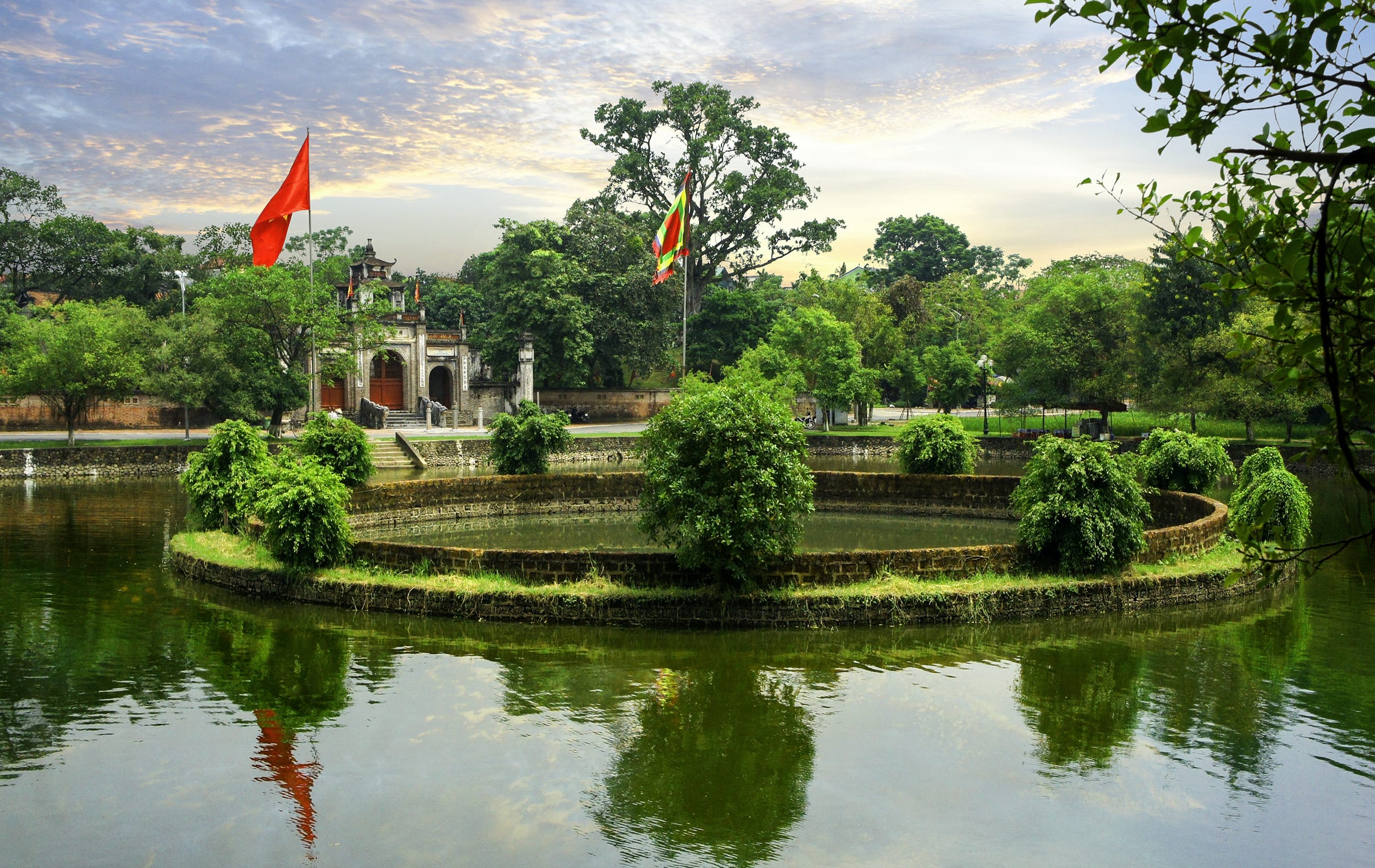
Eighteen kilometers north of Hanoi, the land flattens and the road grows quieter. Fields stretch wide, interrupted by waterways and the occasional buffalo. Then, almost without warning, you arrive at Co Loa Ancient Citadel. There are no dramatic gates. No grand reveal. Just earth walls, rising gently, looping across the landscape like the memory of something once immense.
This was once the capital of Au Lac, ruled by King An Duong Vuong more than two thousand years ago. The citadel’s triple ring of earthen ramparts still traces the ambition of an ancient state. Archaeologists uncovered thousands of bronze arrowheads here, silent evidence of power, defense, and eventual betrayal.
Walking Co Loa is a meditative act. The grass moves in the wind. Children ride bicycles along the embankments. History is not fenced off. It lives alongside daily life. The Temple of An Duong Vuong stands quietly, dignified without ostentation. Nearby, the Shrine of Princess My Chau feels almost painfully intimate. Her tragic story of love and misplaced trust hangs in the air, especially in the early morning, when mist lingers and the crowds are absent.
For travelers seeking depth rather than spectacle, Co Loa offers something rare: the chance to feel history rather than simply observe it. Festivals in early spring add another layer, with rituals and processions that connect the present village to its ancient past.
Bat Trang Pottery Village, Clay, Fire, and Curiosity
Follow the Red River downstream for about ten kilometers and you reach Bat Trang Pottery Village, a place where earth becomes art and utility at the same time. For over five centuries, Bat Trang has shaped clay into bowls, jars, vases, and objects that quietly populate Vietnamese homes and temples.
The first impression is abundance. Pottery everywhere. Stacked, displayed, drying in the sun. Yet the deeper pleasure lies in watching the process. Many workshops welcome visitors not as customers but as witnesses. You see hands centering clay on spinning wheels. You learn how glazes are mixed, how colors change in the kiln, how unpredictability is accepted as part of the craft.
Bat Trang’s pottery market is refreshingly unhurried. Browsing is encouraged. Questions are answered with pride rather than impatience. For travelers, this openness transforms shopping into education. You begin to see the difference between mass production and individual care.
The village is easily reached by road or even by boat along the Red River, which adds a pleasing sense of arrival. For those traveling with children or simply with curiosity intact, hands on pottery workshops offer the rare joy of making something imperfect and taking it home.
Duong Lam Ancient Village, A Living Archive of Vietnamese Life
If you are willing to go a little farther, about fifty kilometers west of Hanoi, Duong Lam Ancient Village rewards the effort generously. This is not a reconstructed heritage site. This is a real village that has resisted the erasure of modern uniformity.
Laterite stone houses line narrow lanes. Gates creak. Courtyards hide old wells and fruit trees. Duong Lam is over three hundred years old, yet it feels unselfconscious about its age. Life goes on. Chickens wander. Elders sit in doorways, watching the world with practiced calm.
Historically, Duong Lam is extraordinary. It is the birthplace of two Vietnamese kings, Phung Hung and Ngo Quyen, both commemorated by temples and monuments that remain deeply woven into local life. The Mia Pagoda nearby is a treasure of Vietnamese Buddhist sculpture, dense with statues and quiet devotion.
For travelers, Duong Lam offers intimacy. Some ancient houses serve traditional meals, allowing you to taste rural cuisine as it was meant to be eaten. Simple dishes, bold flavors, fermented sauces that linger in memory. This is slow travel in its purest form.
Transportation is straightforward, whether by motorbike, car, or public bus combined with a short taxi ride. The reward is a day spent in a Vietnam that feels increasingly rare.
Why These Journeys Matter
What unites Van Phuc, Co Loa, Bat Trang, and Duong Lam is not proximity to Hanoi, though that helps. It is their refusal to become theatrical. These places do not perform for tourists. They exist. And by visiting respectfully, you become part of that existence, however briefly.
For travelers staying in Hanoi hotels, these destinations pair beautifully with the capital’s urban energy. They offer contrast. Balance. A deeper understanding of where Vietnam has been and how it continues to shape itself.
These are ideal tours for curious travelers, cultural explorers, photographers, and anyone who believes that the best travel moments often happen close to home, just beyond the noise.
Once you go, the city feels different when you return. Quieter, somehow. Or perhaps that quiet has followed you back.
Hanoi day tours, travel near Hanoi, cultural villages Hanoi, Bat Trang pottery village tour, Van Phuc silk village travel, Co Loa ancient citadel tour, Duong Lam ancient village, Hanoi weekend trips, Vietnam cultural travel, traditional craft villages Vietnam, Hanoi countryside tours, heritage travel Vietnam, authentic Vietnam experiences, Hanoi travel blog, Vietnam village tours
