
Vietnam road trip blog, where danger beauty and freedom collide
There are roads that carry you somewhere, and roads that change you. In Vietnam, the latter twist through mountains so steep they seem to argue with gravity itself. These are not polite highways designed for efficiency. They are elemental corridors of stone, wind, and nerve, carved into cliffs by human persistence and stubborn belief. Among Vietnamese adventure travelers, four mountain passes rise above all others, spoken of with a mix of reverence and appetite. They are known collectively as the Four Great Mountain Passes of Vietnam, and riding them is not simply travel. It is initiation.
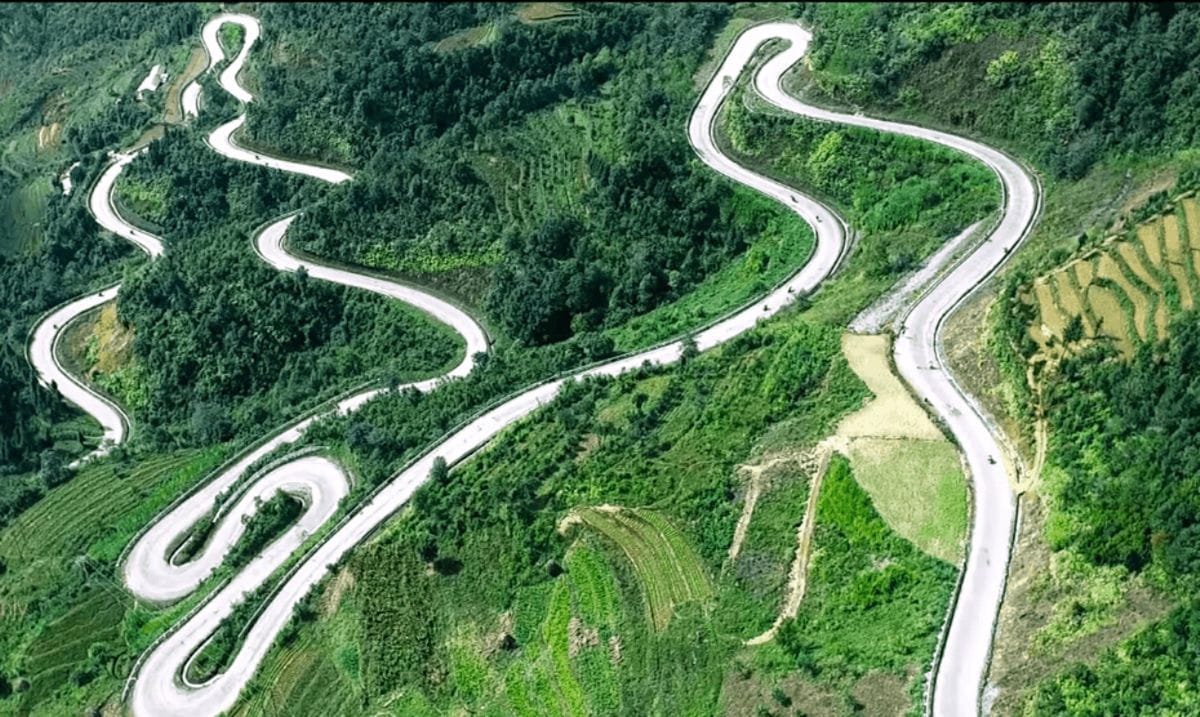
Ma Pi Leng Pass in Ha Giang begins like a dare. The road coils for roughly twenty kilometers at nearly two thousand meters above sea level, stitching together Meo Vac and Dong Van across a landscape that feels unfinished, raw, and astonishingly alive. From above, the asphalt resembles a dark ribbon flung carelessly across limestone giants. From the saddle of a motorbike, it feels intimate and unforgiving. One wrong calculation and the mountain reminds you who is in charge.
The name Ma Pi Leng translates roughly to the horse’s nose bridge, an image that makes sense when you see the pass rising narrow and sharp against the sky. Local lore speaks of slopes so steep that horses once collapsed from exhaustion trying to cross. Yet humans prevailed. The Happiness Road, which threads through Ma Pi Leng, was built between 1959 and 1965 by tens of thousands of young volunteers from multiple ethnic groups. They worked suspended by ropes against vertical cliffs for months at a time. Riding this pass today is to glide across their defiance.
From the highest viewpoint, the Nho Que River cuts a jade slash through the canyon far below. Silence presses in. Even seasoned travelers pause here, helmets off, words inadequate. Nearby lodges and boutique guesthouses in Dong Van and Meo Vac offer simple comforts, panoramic balconies, and early breakfasts tailored for riders who want the road before the crowds. This is not luxury in the conventional sense. It is luxury measured in altitude, space, and silence.
If Ma Pi Leng feels like a blade, O Quy Ho Pass feels like a long argument with the sky. Stretching nearly fifty kilometers along National Road 4D, it crosses the Hoang Lien Son range and links Lao Cai with Lai Chau. This is Vietnam’s longest mountain pass, and length matters. Weather shifts without warning. Sun yields to fog. Fog thickens into cloud. At its summit, nearly two thousand meters high, riders often find themselves riding through whiteness, guided more by instinct than sight.
The name O Quy Ho comes from the cry of a mountain bird, woven into a tragic love legend. Locals also call it Hoang Lien Pass, or simply the Cloud Pass, an entirely practical name given how often the road dissolves into mist. In winter, ice can form. On rare mornings, snow dusts the edges, transforming the pass into something almost alpine. At Heaven’s Gate, the unofficial crest, the world seems paused mid breath.
Modern improvements have made the road safer, but the scale remains humbling. Once feared for stories of tigers stalking travelers, O Quy Ho now attracts photographers, motorbike tour groups, and solitary riders chasing light. Accommodation near Sapa and Tam Duong caters well to adventure tourists, offering heated rooms, gear storage, hearty mountain meals, and guides who understand that timing is everything on this road.
Pha Din Pass offers a different gravity. Located on National Road 6 between Son La and Dien Bien, it climbs to sixteen hundred forty eight meters and stretches for thirty two kilometers. Its name, derived from the Thai language, means the meeting place of Heaven and Earth. That sounds poetic until you ride it. Then it feels precise. Halfway up, villages scatter below like afterthoughts. Higher still, habitation vanishes. Only sky and mountain remain, merging without ceremony.
Clouds cling stubbornly to the mid slopes, then suddenly break. The view opens. The air sharpens. Pha Din is visually generous but historically heavy. During the First Indochina War, this pass was a vital supply route for the Dien Bien Phu campaign. It endured relentless bombing. Thousands of young volunteers carried food and ammunition through fire and stone. Riding here is to traverse both beauty and memory.
A newer bypass has diverted most commercial traffic, leaving the original pass quieter, better suited to travelers seeking challenge rather than speed. Small hotels and homestays along the Son La and Tuan Giao approach emphasize rest and reflection, offering regional cuisine, warm fires in colder months, and local stories that give the road context beyond its curves.
Khau Pha Pass in Yen Bai closes the circle with a sense of grace that feels almost unfair. More than thirty kilometers long, it rises between one thousand two hundred and one thousand five hundred meters, skirting Mu Cang Chai and touching places whose names alone suggest poetry. La Pan Tan. Tu Le. Che Cu Nha. Nam Co. The pass crosses Khau Pha Mountain, whose name means Horn of Heaven, a fitting image when peaks puncture the cloud sea like ancient instruments sounding a silent note.
Khau Pha is at its most seductive during the rice harvest season, usually September and October. Terraced fields ripple gold along the slopes, following contours older than any road. Paragliders launch from high points, floating above geometry shaped by generations of hands. Riders slow instinctively here, not from fear but from awe.
Forests along the pass remain deeply intact, sheltering rare flora and fauna. The air smells different. Earthier. Lodges and eco homestays in Tu Le and Mu Cang Chai have adapted to adventure travel without erasing local character. Natural hot springs, wooden architecture, seasonal food, and unobstructed views reward those who linger.
Together, these four mountain passes form more than a route. They form a philosophy of travel rooted in effort, awareness, and respect. Tour operators specializing in Vietnam motorbike travel often build multi day itineraries linking these passes, providing experienced guides, mechanical support, safety briefings, and accommodations chosen for location rather than excess. The benefit is not just convenience. It is coherence. Each road prepares you for the next.
You do not ride these passes to arrive somewhere quickly. You ride them to feel the scale of Vietnam, the stubborn elegance of its landscapes, and the quiet heroism embedded in its roads. When the engine cools and the helmet comes off, you understand something difficult to explain and impossible to forget.
Vietnam mountain passes, Ma Pi Leng Pass travel, O Quy Ho Pass motorbike, Pha Din Pass adventure, Khau Pha Pass road trip, Vietnam motorbike tour, adventure travel Vietnam, Vietnam road trip blog, best mountain roads Vietnam, Ha Giang motorbike route, Northwest Vietnam travel, scenic drives Vietnam, Vietnam adventure tourism, legendary roads Vietnam, motorbike travel Asia
