
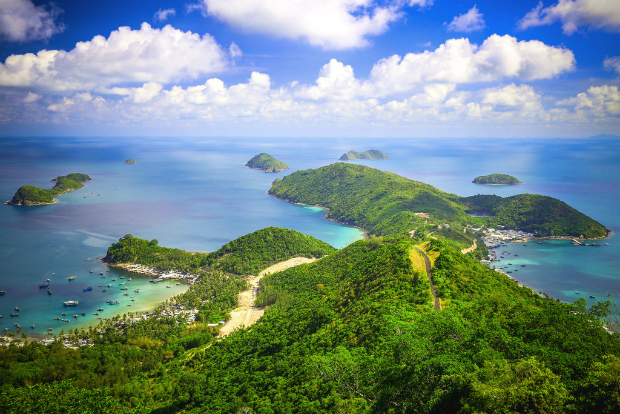
Vietnam beach tour, four islands still ruled by wind and water
There is a particular kind of longing that arrives every summer. It is not for crowds or cocktails or carefully staged sunsets. It is for places where the map thins out, where the sea decides the schedule, where the land still looks faintly surprised to see you. Vietnam, for all its accelerating momentum, still shelters islands that resist taming. They are not polished. They are not rehearsed. They are persuasive in a quieter, more dangerous way. You go, and you do not quite come back the same.
Nam Du sits far enough from the mainland to discourage casual visitors, and that distance is its greatest asset. This archipelago of roughly twenty one islands floats sixty kilometers off the coast of Kien Giang, exposed to weather, rumor, and salt. Hon Lon, also known as Cu Tron Island, is the anchor, fourteen square kilometers of ridges and coves crowned by a lighthouse that watches the sea with institutional patience.
Reaching Nam Du requires commitment. The fastest route is a high speed boat from Rach Gia, a three hour crossing that runs once daily when the sea allows. Morning departures head out. Afternoon returns trace the same blue corridor back. That simplicity shapes the rhythm of the island. You arrive with intention.
Life on Nam Du is unvarnished. A short climb to the lighthouse delivers a view that rearranges priorities. Dawn spills across the archipelago, revealing a scatter of green islands stitched together by water so clear it feels almost fictional. Days unravel slowly. Beaches appear without warning. Fishing boats drift. Coral reefs hover just beneath the surface, unadvertised. There is no organized snorkeling industry here. Bring your own mask. Hire a local boat. Trust the informal economy of island hospitality.
The essential experience is island hopping. Hon Hang, Hon Moc, Hon Tre, Hon Dam, Hon Ong, Hon Dau, Hon Ngang. Each island introduces a variation on solitude. Rockier here. Softer sand there. Wind behaves differently around every curve. Nam Du does not overwhelm with spectacle. It accumulates intimacy.
There is one formality to respect. Upon arrival, visitors must register with the border police before exploring freely. Accommodation remains minimal. On Hon Lon, a single guesthouse operates. Many travelers choose instead to camp, string hammocks between trees, sleep where the breeze makes sense. Nam Du encourages this kind of freedom. It rewards self reliance.
Cua Lao Cham offers a different persuasion. Located off the coast of Hoi An, roughly twenty kilometers from shore, this island cluster balances accessibility with restraint. Despite its proximity to Da Nang, the journey requires intention. Bus, taxi, boat. Or, more efficiently, a day tour arranged locally. That slight inconvenience protects the island’s character.
Cua Lao Cham greets visitors with softness. White sand curves gently into water that holds color like glass. Waves arrive politely. Seafood arrives fresh, uncomplicated, honest. Rock crab, peculiar and prized, becomes a conversation starter at the table. Beneath the surface, coral gardens spread in quiet abundance. Snorkeling here is not theatrical. It is immersive. Fish appear in improbable colors, moving with the assurance of residents unconcerned by guests.
Beyond the beaches, spiritual landmarks anchor the island’s memory. Hai Tang Pagoda, Ong Mausoleum, Ba Shrine. These are not tourist props. They are lived spaces, woven into daily belief. Walking between them reveals how the island sustains both livelihood and reverence. Cua Lao Cham feels balanced, neither isolated nor diluted, a rare equilibrium in coastal travel.
Con Dao stands apart. Geography, history, atmosphere. This archipelago, administered as part of Ba Ria Vung Tau Province, carries weight that cannot be ignored. Known historically as Poulo Condor, Con Dao once symbolized imprisonment and suffering. That past has not been erased. It has been contextualized.
Reaching Con Dao takes time or altitude. Boats depart from Vung Tau, journeys stretching close to twelve hours depending on conditions. Flights connect directly from Ho Chi Minh City, Can Tho, and Hanoi, compressing distance but not meaning. Arrival feels ceremonial either way.
What surprises most visitors is the beauty. Steep cliffs drop into water the color of jade. Forests press close to the coast. Beaches remain astonishingly empty. White sand arcs between headlands without interruption. Marine life thrives. Dugongs, dolphins, sea turtles, coral systems. Con Dao is ecologically assertive, protected by remoteness and regulation.
Once dismissed as a place of exile, Con Dao now registers among the world’s most mysterious island destinations. Luxury resorts coexist with memorials. Reflection coexists with indulgence. You can dive in the morning and walk through history in the afternoon. The island insists on complexity. It is not an escape. It is an encounter.
Ly Son, also known as Cu Lao Re, rises from the sea with geological confidence. This island district of Quang Ngai Province measures just under ten square kilometers, yet it holds disproportionate significance. Formed from volcanic activity twenty five to thirty million years ago, Ly Son retains the physical memory of fire. Five extinct craters shape its contours. Lava cliffs frame fields. The land feels forged rather than settled.
Ly Son consists of three islands. Ly Son Island itself, often called the Big Island. An Binh Island, the Small Island, quieter and even more elemental. Mu Cu Islet, a rocky punctuation point to the east. Together, they form a landscape that feels stark and lyrical in equal measure.
Cultural depth runs deep here. National heritage sites include An Hai Communal House, Am Linh Pagoda, and Hang Pagoda, a temple carved directly into rock. Archaeological traces of Sa Huynh and Champa cultures surface throughout the island, quietly asserting continuity. Ly Son is not only scenic. It is historical.
Reaching the island involves a high speed boat from Sa Ky Port, accessed via National Route 24B from Quang Ngai City. Once ashore, motorcycles become the preferred mode of exploration. Roads circle volcanic cliffs. Garlic fields stretch in improbable geometry, their white soil contrasting sharply with black rock. Ly Son garlic, pungent and celebrated, anchors local cuisine alongside anchovy salad, garlic salad, and don dot, dishes that taste inseparable from place.
The visual palette of Ly Son is relentless. Deep blue sky. Palm fronds cutting sharp silhouettes. Garlic fields reflecting lava cliffs. Coral beaches breaking into fragments of stone. It is not gentle beauty. It is declarative.
These four islands share a refusal. They refuse excess. They refuse haste. They refuse to become replicas of one another. Each requires effort, patience, respect. In return, they offer something increasingly scarce. A sense of first arrival. A reason to leave now.
Vietnam island travel, hidden islands Vietnam, Vietnam summer island tour, Nam Du island travel, Cua Lao Cham tour, Con Dao island experience, Ly Son island travel, Vietnam beach destinations, off the beaten path Vietnam, Vietnam island hopping, untouched beaches Vietnam, eco travel Vietnam islands, Vietnam coastal travel guide, best islands in Vietnam, Vietnam nature escape
