
There are travelers who chase miles, and there are travelers who chase moments. The latter understand a secret that only reveals itself once you stop moving: sometimes the greatest journey happens when you stand at a window, glass cool against your fingertips, and the world opens itself to you without effort. Asia, vast and theatrically beautiful, excels at this kind of revelation. Across its cities, bays, rivers, and high plateaus, a select group of hotels has mastered the art of framing the world.
This is not about a room with a view as a marketing phrase. This is about altitude, angle, light, and silence. It is about the way a harbor glimmers at dawn, or how a river bends lazily past a colonial façade, or how mountains loom like ancient witnesses beyond your balcony. These hotels are not simply places to sleep. They are vantage points. They turn geography into theater.
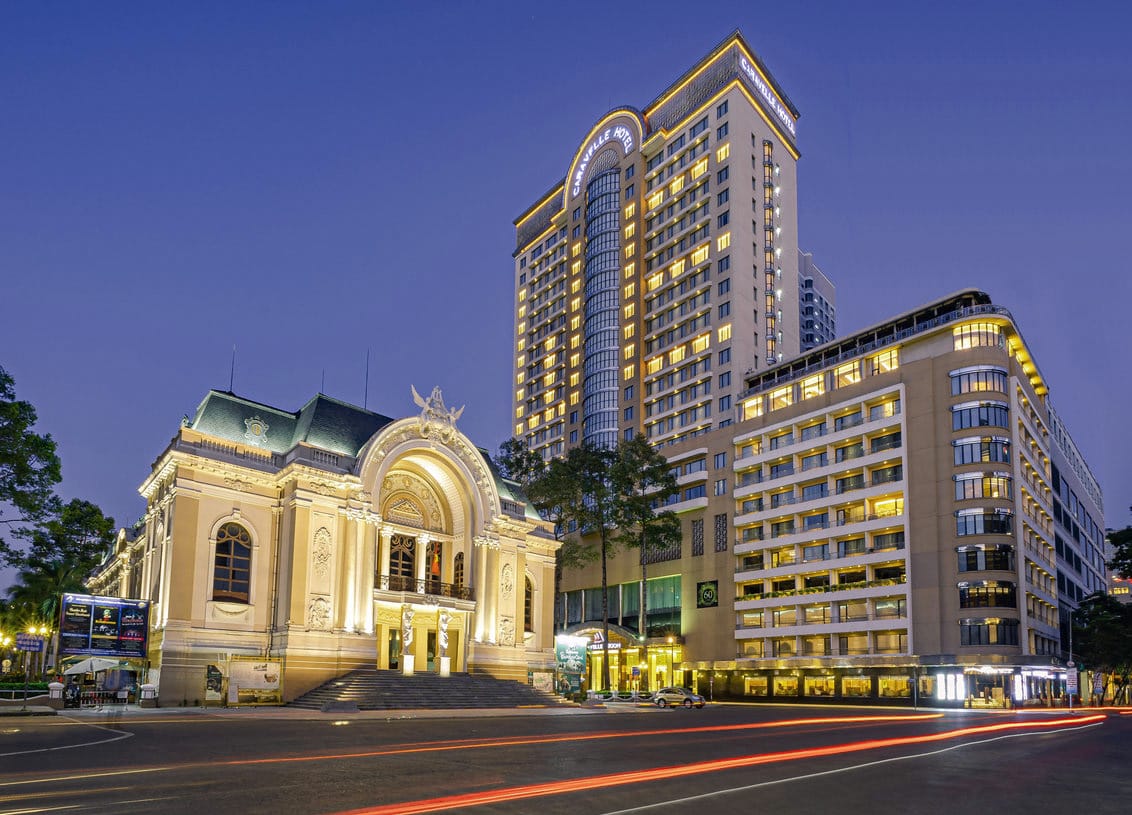
Caravelle Hotel, Ho Chi Minh City, Vietnam
Ho Chi Minh City is restless, kinetic, unapologetically alive. The Caravelle Hotel sits at its very heart, a poised observer amid the swirl. From the moment you step inside, history makes itself known quietly. Opened in 1959, the hotel has watched decades pass from its windows, revolutions of fashion, politics, and pace unfolding below.
The true seduction, however, waits upstairs. Saigon Saigon Rooftop Bar is less a bar than a balcony onto the city’s collective memory. As dusk settles, the skyline glows, traffic hums like a living organism, and the colonial opera house stands luminous and defiant. Pool Bar, tucked beside the swimming pool, offers a gentler pleasure: cool water, chilled drinks, and the feeling of floating above the city without leaving it. Caravelle’s strength lies in contrast. Outside, chaos. Inside, composure.
Palace Hotel Tokyo, Japan
Tokyo can overwhelm even the seasoned traveler, but Palace Hotel Tokyo offers a deliberate counterpoint. Here, the city exhales. The hotel overlooks the Imperial Palace gardens, a vast green sanctuary at the city’s core, with the modern spine of government buildings rising respectfully beyond.
From the indoor pool and spa, the view becomes meditative. Water meets water. Garden meets skyline. It is a rare alignment, one that encourages stillness rather than spectacle. Rooms are designed to frame the outdoors rather than distract from it. Morning light filters through curtains with ceremonial restraint. Staying here feels like being granted a private audience with Tokyo’s quieter self.
Ritz Carlton Hong Kong, Hong Kong
Height changes perception. At the Ritz Carlton Hong Kong, perched between floors 102 and 118, the city rearranges itself beneath you. Victoria Harbour curves like a polished instrument. Ferries trace deliberate lines across the water. The island and the mainland face each other in a perpetual conversation of light and shadow.
Silence is the most surprising luxury here. Despite the city’s reputation, the altitude absorbs the noise. The rooftop pool feels suspended between sky and sea, an improbable calm hovering above one of Asia’s most intense urban environments. From this height, Hong Kong looks less frantic, more elegant, almost contemplative.
Emeraude Cruise, Ha Long Bay, Vietnam
Not all views require windows. Some unfold as movement itself. Ha Long Bay is not a place you look at once. It is a place you drift through. Aboard the Emeraude Cruise, the bay reveals itself slowly, deliberately, island by island.
Modeled after a French steamship of the early twentieth century, the Emeraude blends nostalgia with modern comfort. From the deck, limestone karsts rise abruptly from jade colored water, each formation distinct, sculptural, impossibly old. Mist curls around their bases in the early morning. At night, the bay becomes ink dark, pierced by starlight.
Cabins are designed to keep your attention outward. Meals linger. Time stretches. The view is not framed by architecture but by patience.
La Residence Hotel and Spa, Hue, Vietnam
Set along the Perfume River, La Residence Hotel and Spa is less a hotel than a conversation with the past. Once the residence of a French governor in the 1920s, the building retains its art deco elegance, softened by tropical gardens and river light.
From the river facing rooms, Hue unfolds in layers. The old citadel sits across the water, dignified and weathered. Beyond it lie the royal tombs of the Nguyen dynasty, hidden among trees and hills. The river itself moves with ceremonial slowness, carrying boats, reflections, and history.
The hotel encourages engagement rather than enclosure. Guests cycle through the city, swim beneath open skies, play tennis as the sun lowers itself behind ancient walls. The view is not static. It invites participation.
The Chedi Chiang Mai, Thailand
Northern Thailand has a different rhythm, slower, earthier. The Chedi Chiang Mai embraces this cadence. Positioned along the Ping River, the hotel looks toward distant mountains, temple spires, and the languid flow of water that has shaped the city for centuries.
Rooms are minimalist, allowing the view to dominate. At sunrise, monks pass silently along the riverbanks. At sunset, the sky turns the color of bruised fruit. The Chedi does not overwhelm with decoration. It trusts the land to do the work.
The Chedi Club Tanah Gajah, Bali, Indonesia
In Bali, beauty is not rare. What is rare is privacy. The Chedi Club Tanah Gajah, set amid rice paddies near Ubud, offers an intimacy that feels increasingly precious. Villas open onto fields where farmers move with deliberate grace, their routines unchanged by the presence of luxury.
Views here are horizontal, not vertical. Green stretches outward in all directions, punctuated by palm trees and distant temples. At night, frogs sing. The sky feels close. This is a place where the view encourages grounding rather than elevation.
Grand Hotel Beijing, China
Beijing’s grandeur is formal, architectural, ceremonial. The Grand Hotel reflects this sensibility. Overlooking Tiananmen Square and the Forbidden City, the hotel places guests at the crossroads of power and history.
From higher floors, the city appears ordered, monumental. Rooflines align. Courtyards reveal themselves like hidden chapters. This is not a romantic view in the tropical sense. It is compelling in its authority, its scale, its reminder that cities, like empires, leave long shadows.
Hyatt on the Bund, Shanghai, China
Shanghai is a city obsessed with surfaces, and Hyatt on the Bund understands the assignment. Facing the Huangpu River, the hotel captures the full theatricality of the skyline. On one side, the colonial facades of the Bund. On the other, Pudong’s futuristic spires.
At night, the city performs. Lights ripple across glass and water. Boats slide past like illuminated punctuation marks. Rooms are designed to face the river, making the view the primary entertainment.
St. Regis Lhasa Resort, Tibet, China
Altitude alters everything. In Lhasa, the air thins, colors sharpen, and the land asserts itself. St. Regis Lhasa Resort offers views of the Potala Palace, its white and red walls rising against a vast sky.
This is not a view that dazzles in the conventional sense. It humbles. The plateau stretches endlessly. The palace glows at dawn and dusk, anchoring the city spiritually and visually. Staying here feels like standing at the edge of something vast, ancient, and quietly powerful.
Why these views matter
These hotels understand that travel is not always about movement. Sometimes it is about perspective. A well chosen window can teach you as much as a museum. A balcony can tell you stories a guidebook never will.
They offer more than comfort. They offer context. They help you see a place before you step into it, and understand it a little better when you leave.
Asia luxury hotels, hotels with best views Asia, luxury travel Asia, rooftop hotels Asia, river view hotels Asia, Ha Long Bay cruise luxury, Ho Chi Minh City luxury hotel, Tokyo palace view hotel, Hong Kong skyline hotel, Hue riverside hotel, Chiang Mai luxury resort, Bali rice field villa, Shanghai Bund hotel, Beijing luxury hotel view, Lhasa luxury resort
