
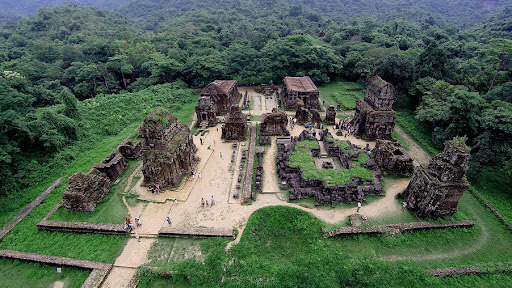
There are places where time does not behave. It slows, thickens, and lingers in the air like incense. Southeast Asia is full of such places, but only a few temple complexes possess the gravity to silence even the most restless traveler. Among them stands My Son Sanctuary in Vietnam, ranked among the ten most beautiful and significant temple complexes in Southeast Asia. It does not shout its importance. It murmurs it, stone by stone.
My Son Sanctuary, Vietnam
Hidden within a forested valley in Quang Nam Province, My Son Sanctuary rests about an hour from both Da Nang and Hoi An, close enough for convenience yet distant enough to feel removed from modern life. The valley spans roughly two kilometers, encircled by low mountains that seem to cradle the ruins protectively. This was once the spiritual heart of the Champa Kingdom, a place of royal rituals, sacred burials, and devotion to Hindu deities, particularly Shiva.
Walking through My Son is an act of quiet discovery. Brick towers rise unexpectedly from greenery, some worn smooth by centuries of rain, others still bearing intricate carvings that defy time. The craftsmanship feels intimate. These were not monuments built for spectacle but for communion. Morning light filters through mist, turning ruins into silhouettes, and for a moment, the modern world dissolves.
Travelers typically base themselves in Da Nang or Hoi An, both offering a wide range of hotels from boutique heritage stays to polished beachfront resorts. The benefit is obvious. You return from the sanctuary to comfort, refined dining, and the soft hum of coastal evenings, carrying with you the residue of something ancient.
Bagan, Myanmar
Bagan stretches across the plains of central Myanmar like a mirage made solid. Once the capital of the Pagan Kingdom between the ninth and thirteenth centuries, this vast archaeological zone covers nearly seventy square kilometers and contains thousands of temples, stupas, and monasteries. The sheer scale is disorienting at first.
At sunrise, hot air balloons drift above the plain, revealing a landscape punctured by spires and domes. Some temples remain active places of worship, others are hollowed relics open to sky and birdsong. Bagan is not about visiting one site but surrendering to many. Hotels here range from elegant riverside lodges to quiet boutique properties that emphasize stillness and space, offering terraces where the sunset feels like a private performance.
Angkor, Cambodia
Angkor does not require introduction, yet it constantly demands reconsideration. Between the ninth and fifteenth centuries, it served as the capital of the Khmer Empire, growing into one of the most sophisticated urban centers of its time. Angkor Wat and Angkor Thom dominate the imagination, but the wider complex contains hundreds of temples, each with its own geometry and mood.
Siem Reap provides an excellent base, with hotels that balance accessibility and retreat. Colonial inspired resorts, contemporary design hotels, and intimate garden villas allow travelers to recover between temple explorations. Angkor is best approached slowly. Dawn at Angkor Wat. Midday shade beneath carved galleries. Dusk at a lesser known ruin where roots reclaim stone.
Ayutthaya Historical Park, Thailand
North of Bangkok lies Ayutthaya, once the proud capital of Siam until its destruction in 1767. Today, its historical park spreads across more than two thousand square kilometers, a mosaic of temples, palaces, and museums. The ruins are striking in their restraint. Brick prangs stand roofless against the sky, Buddha statues sit headless yet serene.
Ayutthaya feels reflective rather than triumphant. Its proximity to Bangkok makes it an easy journey, yet it retains a provincial calm. Hotels here often favor riverside settings, allowing guests to watch boats drift past ancient walls. The benefit is balance. History without exhaustion.
Yogyakarta, Indonesia
On the island of Java, Yogyakarta occupies a singular position as the cultural soul of Indonesia. It is a place where tradition is practiced, not preserved. The city is most famous for Borobudur, the massive Buddhist monument recognized as a World Heritage Site, its terraces ascending like a stone mandala.
Sunrise at Borobudur is an exercise in reverence. Mist coils around stupas. The countryside awakens gradually. Yogyakarta itself offers palaces, batik workshops, and a thriving arts scene. Hotels range from heritage properties to contemporary resorts, many emphasizing wellness and cultural immersion.
Shwedagon Pagoda, Yangon, Myanmar
Shwedagon Pagoda rises above Yangon from Singuttara Hill, visible from almost anywhere in the city. Gilded and luminous, it is Myanmar’s most sacred site. The pagoda complex glows from dawn until nightfall, its gold leaf surface catching light in ways that feel almost unreal.
Visitors circle barefoot along marble walkways, passing shrines, bells, and prayer corners. From the hilltop, the city stretches outward, a reminder that devotion here exists within daily life. Yangon’s hotels include historic colonial buildings and modern high rises, offering views that frame the pagoda as both landmark and lodestar.
Luang Prabang, Laos
Luang Prabang is gentler than most capitals of faith. Founded in the eighth century and recognized as a World Heritage Site, the city sits at the confluence of the Mekong and Nam Khan rivers. Its temples feel intimate rather than imposing.
Wat Xieng Thong, with its sweeping roofs, and Wat Mai, with its gilded reliefs, are among the most beautiful. Alms giving at dawn turns streets into rivers of saffron robes. Hotels here emphasize tranquility, often converted from traditional houses or colonial villas, with gardens that invite reflection.
Chiang Mai, Thailand
Encircled by mountains, Chiang Mai holds more than three hundred temples. It is a city where spirituality coexists comfortably with cafés and night markets. Wat Phra Singh, Wat Suan Dok, and Wat Chang Lom each reveal different layers of Lanna architecture.
Above the city, Doi Suthep Temple crowns the mountain. The climb, twelve kilometers of winding road, ends in sweeping views and a sanctuary many Thais consider deeply sacred. Chiang Mai’s hotels are diverse, from boutique guesthouses in the old city to luxury retreats tucked into forested hills.
Ubud, Indonesia
Ubud is less a town than a state of mind. Located in Bali’s interior, it is surrounded by rice terraces and ravines that breathe green. Temples appear everywhere. The Ubud Palace anchors the center, while Pura Desa Ubud and Pura Taman Saraswati showcase Hindu rituals in daily motion.
Hotels in Ubud often blur boundaries between architecture and landscape. Infinity pools overlook jungle. Yoga pavilions open to birdsong. Staying here is not just accommodation but participation in a slower rhythm.
Kek Lok Si Temple, Penang, Malaysia
In Air Itam, Penang, Kek Lok Si Temple unfolds across hillsides in layers of prayer halls, pagodas, and courtyards. It is the largest Buddhist temple complex in Southeast Asia, blending Chinese, Thai, and Burmese influences.
The Pagoda of Ten Thousand Buddhas rises at its heart, while the statue of the Goddess of Mercy watches over the island. Penang’s hotels range from heritage mansions in George Town to modern seaside resorts, allowing travelers to combine temple visits with culinary exploration.
These sacred sites are not checklist destinations. They are experiences that seep under the skin. They invite stillness, curiosity, and the rare pleasure of feeling small in the presence of something enduring.
My Son Sanctuary travel, Southeast Asia temple tour, Vietnam heritage travel, ancient temple complexes Asia, cultural travel Southeast Asia, Angkor temple travel guide, Bagan temple journey, Ayutthaya historical park tour, Borobudur travel experience, Shwedagon Pagoda visit, Luang Prabang temple travel, Chiang Mai temple tour, Ubud spiritual travel, Kek Lok Si Temple Penang, Southeast Asia cultural destinations
