
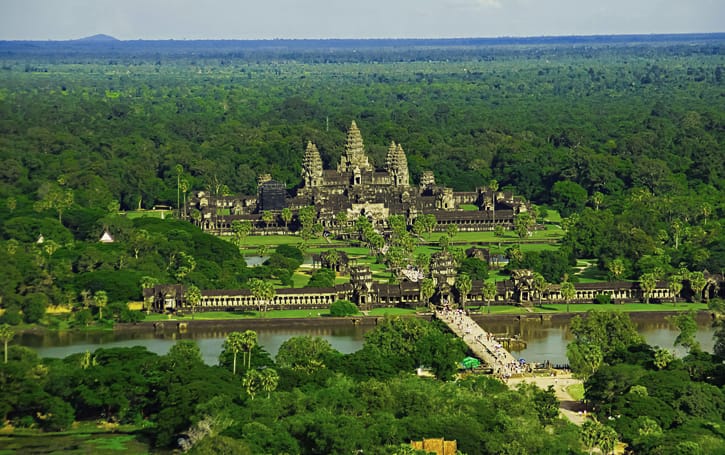
Cambodia does not reveal itself politely. It arrives all at once, thick with incense, dust, laughter, and the low hum of history that refuses to stay buried. This is a country where the past does not sit behind glass. It leans against you in market stalls, glides past on rivers, and rises suddenly from jungle and plain in stone that has outlived empires. To travel Cambodia is not to tick off landmarks. It is to be quietly unsettled, then completely won over.
Siem Reap
Siem Reap is not merely a gateway. It is a mood. Once a sleepy provincial town, it now hums with a confident rhythm that balances ancient reverence and modern appetite. Mornings begin with monks padding barefoot along streets washed clean by night rain. Evenings belong to lantern lit markets, cafés perfumed with lemongrass, and conversations that stretch longer than planned.
Hotels here are part of the experience, not an afterthought. From boutique hideaways shaded by frangipani trees to five star resorts echoing Khmer architecture, accommodation in Siem Reap is designed to slow you down. Courtyards, pools, quiet breakfasts. All before you step out toward temples older than imagination. Stay here and Angkor becomes not a checklist, but a companion.
Preah Vihear
Preah Vihear demands effort. It sits high on the Dangrek Mountains, clinging to a cliff 525 meters above the plains, and the road to reach it feels like a slow ascent into another era. The reward is silence, scale, and a view that stretches far beyond borders.
Built between the eleventh and twelfth centuries, this Khmer temple complex unfolds along a sacred axis, stairway after stairway leading upward, as if faith itself were a climb. Standing here, wind tugging at your shirt, the world feels suddenly vast and irrelevant. Few places remind you so clearly that belief once shaped geography.
Sihanoukville
Sihanoukville is Cambodia exhaling. This coastal city, also known as Kampong Som, rests along the Gulf of Thailand and offers a different persuasion entirely. Sun bleached beaches, islands floating offshore like invitations, afternoons that dissolve into swims and seafood.
Resorts here range from simple beachfront lodges to refined escapes with infinity pools staring straight at the horizon. It is the kind of place where time slips, willingly. Travelers come for short breaks and stay longer than intended, seduced by salt air and the gentle indifference of the sea.
Tonle Sap
Tonle Sap is not static. It breathes. As Southeast Asia’s largest freshwater lake, it expands and contracts with the seasons in a rhythm that governs life itself. In the dry months, the lake retreats, revealing fertile land. When the rains arrive, it swells dramatically, swallowing forests and lifting entire villages onto water.
Floating communities live here, houses perched on stilts or rafts, children rowing themselves to school. Visiting Tonle Sap is not spectacle. It is insight. Boat tours reveal how deeply Cambodians adapt rather than conquer their environment. Nearby lodges offer quiet nights where water laps gently beneath wooden floors, and the stars seem closer for it.
The Silver Pagoda
Within the Royal Palace complex in Phnom Penh lies a place of hushed astonishment. The Silver Pagoda earns its name from its floor, laid with thousands of solid silver tiles that catch the light softly rather than loudly. This is not a shrine that dazzles aggressively. It whispers wealth and devotion.
Inside rest national treasures: a Buddha carved from emerald green crystal, a golden Maitreya encrusted with nearly ten thousand diamonds. The setting invites contemplation rather than haste. Hotels in Phnom Penh nearby blend colonial elegance with contemporary comfort, making it easy to explore the capital’s layered identity by day and retreat in calm by night.
Bokor Hill Station
Above the southern town of Kampot, Bokor Hill Station waits in mist and memory. Built by the French in the 1920s, abandoned, reclaimed by cloud and moss, then partially revived, it is a place that resists simple categorization. The old railway station and abandoned buildings feel like a film set paused mid scene.
Travelers hike here not for comfort but for atmosphere. Fog rolls suddenly. Silence settles heavily. The views, when they appear, spill across coastline and forest. Nearby accommodations in Kampot offer relaxed riverfront stays, ideal for decompressing after the eerie grandeur of Bokor’s heights.
Kratie
Kratie sits gently along the Mekong River, a town that refuses to hurry. Once a bustling trading post, it now charms with faded French colonial houses and a pace that feels deliberately human. The main attraction here is not architecture, but movement.
Just offshore, Irrawaddy dolphins surface quietly, their presence a reminder that rarity still exists. Boat trips are unflashy, respectful, deeply memorable. Guesthouses and small hotels emphasize simplicity and warmth, perfect for travelers who value mornings over schedules.
Koh Ker
Deep in northern Cambodia lies Koh Ker, a former Khmer capital that ruled briefly but built ambitiously. The jungle has reclaimed much of it, which only adds to the drama. Prasat Thom rises in stepped tiers, a pyramid temple thirty meters high, startling in its geometry.
Garuda figures carved into stone watch from shadows. There are fewer visitors here, fewer explanations. Exploration feels personal. Staying in nearby towns is modest, but the experience is rich. Koh Ker rewards curiosity rather than convenience.
Banteay Srei
Often called the jewel of Khmer art, Banteay Srei sits northeast of Angkor, small in scale but monumental in detail. Built in the tenth century from red sandstone, its carvings are astonishingly precise, floral motifs and mythological scenes etched as if by hand yesterday.
The temple glows in late afternoon light. Visits here feel intimate. Many travelers base themselves in Siem Reap, returning in the evening with a renewed appreciation for craftsmanship and patience, qualities Cambodia offers generously.
Angkor
Angkor is not one temple. It is a civilization in stone. Spanning centuries and kilometers, this vast complex is Cambodia’s heart and its calling card. Angkor Wat stands serenely iconic, reflected in lotus ponds at dawn. Bayon stares back with its enigmatic faces. Ta Prohm lets nature reclaim architecture, roots and walls locked in silent struggle.
Exploring Angkor demands time and humility. Nearby hotels range from discreet luxury to characterful heritage stays, allowing travelers to tailor their immersion. Angkor does not end when you leave its gates. It follows you, reshaping your sense of scale and endurance.
Cambodia is not polished. It is textured. It asks for attention, rewards patience, and lingers long after departure. This is travel that leaves a mark. The kind that makes you glance at maps late at night and wonder how soon you can return.
Cambodia travel guide, top Cambodia attractions, famous places in Cambodia, Cambodia tour destinations, best places to visit Cambodia, Cambodia cultural travel, Cambodia heritage sites, Cambodia temple tours, Cambodia travel blog, luxury hotels Cambodia, Cambodia sightseeing guide, Angkor tour experience, Cambodia river travel, Cambodia island resorts, Cambodia historical landmarks
