
The world has always been steered, quietly but insistently, by love. Empires rose for it, wars paused because of it, poems survived centuries on its behalf. And long after the lovers themselves have vanished into legend, the places where they met, waited, whispered, and lost one another remain. They stand patiently, sunlit or moon washed, inviting travelers to step into stories that refuse to fade.
This journey is not a checklist tour. It is a pilgrimage. A wandering through cities and landscapes where romance became myth, and myth hardened into stone, marble, sea air, and memory. You do not simply visit these destinations. You inhabit them.
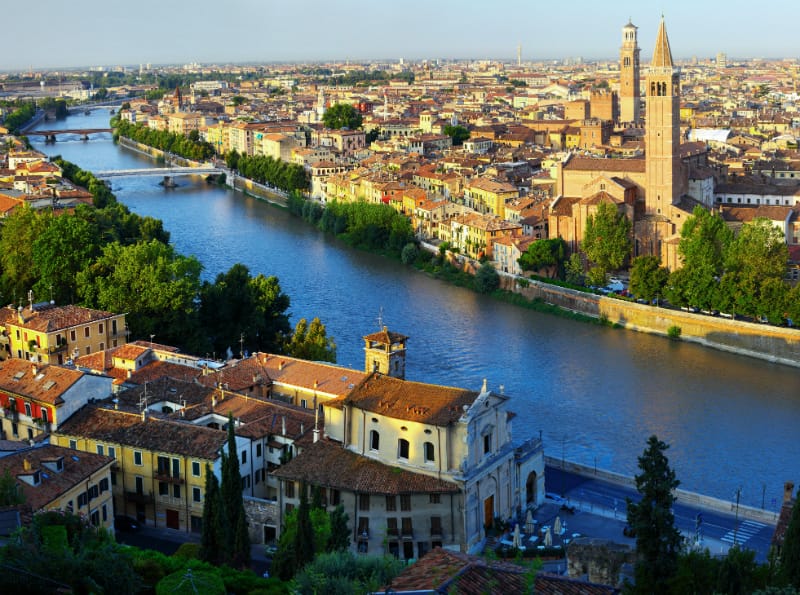
Verona, Italy begins quietly, almost modestly, then tightens its grip. The city is compact, medieval, ochre toned, stitched together by narrow streets that seem designed for secrecy. This is where Romeo and Juliet unfolded, not as fiction alone, but as an emotional geography. Walk here long enough and the story starts to feel plausible, even inevitable.
Visitors drift toward Juliet’s House, but the real Verona reveals itself elsewhere. Climb the Lamberti Tower and the city spreads below you like a palimpsest of centuries. Terracotta rooftops. Church domes. The Adige River looping lazily, indifferent to human tragedy. From this height, the feud that destroyed two young lives seems absurd, and heartbreakingly familiar.
As dusk arrives, the mood shifts. Couples stroll across Ponte Pietra, the ancient stone bridge arching gracefully over the river. Nearby restaurants glow with candlelight. Dinner here is not rushed. Pasta arrives slowly. Wine lingers. The city insists that love, however doomed, deserves to be savored. Verona does not sell romance aggressively. It lets you discover it, step by step, as if it were your own.
From Italy, the journey stretches east to Agra, India, where love announces itself on a monumental scale. The Taj Mahal does not need introduction, yet no description truly prepares you for the moment it appears. White marble rising from symmetry so precise it feels otherworldly. A structure born from grief, devotion, and imperial power.
Emperor Shah Jahan built the Taj Mahal for his beloved wife Mumtaz Mahal, and in doing so created the most enduring love letter in stone. The mausoleum changes personality throughout the day. At dawn it blushes faintly. At noon it gleams with authority. At night, under a full moon, it becomes something else entirely. Soft. Intimate. Almost vulnerable.
Travelers who stay in hotels facing the monument experience a rare privilege. From a private balcony or garden terrace, the Taj floats beyond the Yamuna River, luminous and impossibly calm. There is no need to speak. Silence does the work. In this stillness, the idea of eternal love no longer feels naive. It feels plausible.
India surrounds this perfection with life in full volume. Rickshaws weave through traffic. Markets spill color and noise. Yet within the Taj complex, time slows. Couples walk hand in hand along the reflecting pools, mirroring one another, as if aware that love, like architecture, requires balance to endure.
Far south, beyond continents and expectations, lies Mauritius, an island that understands romance as atmosphere rather than monument. This is the setting of Paul and Virginia, the tragic novel that drenched generations of readers in longing. The island itself seems written by a romantic. Volcanic mountains soften into green slopes. Beaches curve gently, never aggressively. The Indian Ocean glimmers with an almost deliberate calm.
Mauritius is now synonymous with honeymoon travel, and with reason. Resorts here are designed not to impress but to soothe. Villas open toward the sea. Breakfast arrives with the sound of waves. Days dissolve into swimming, walking, talking, and not talking. The island does not push narratives. It lets couples write their own.
Yet beneath the ease lies melancholy. The story of Paul and Virginia haunts the coastline, a reminder that love can be fragile even in paradise. This tension gives Mauritius depth. It is not merely beautiful. It is emotionally resonant. Travelers leave with sand in their bags and a strange tenderness they cannot quite explain.
North again, and back through time, Egypt waits. The Giza Plateau rises abruptly from the desert, severe and uncompromising. The pyramids dominate, but it is the Great Sphinx that holds the gaze. Half lion, half human, eroded yet defiant, it watches silently over one of history’s most famous romances.
Cleopatra and Mark Antony’s story is told with relish by local guides, each embellishment delivered as if it were personal gossip. Cleopatra, the last ruler of the Ptolemaic dynasty, was not merely beautiful. She was shrewd, multilingual, politically lethal. Antony, Roman general and reluctant romantic, followed her into legend and ruin.
Standing before the Sphinx, the love story feels heavy with consequence. This was not youthful infatuation. This was love entangled with power, ambition, and destiny. Travelers often arrive expecting spectacle and leave with reflection. The desert has that effect. It strips distractions away. What remains is scale, silence, and the unsettling realization that love can alter the course of empires.
Modern Cairo hums nearby, chaotic and alive, but at Giza the past dominates. Camels shuffle. Wind sculpts sand endlessly. The story lingers long after you leave, whispering that passion has always carried a price.
Taken together, these destinations form a different kind of tour. Not one of beaches alone, or landmarks ticked off a list, but of emotional inheritance. Each place offers more than scenery. They offer resonance. They invite travelers to feel something larger than themselves.
Hotels along this route understand their role. In Verona, boutique accommodations hide behind ancient facades, offering quiet courtyards and intimate dining rooms. In Agra, properties frame the Taj Mahal deliberately, turning windows into altars. In Mauritius, luxury is measured in space and privacy, not opulence. In Egypt, riverside hotels on the Nile provide a contemplative counterpoint to the desert’s severity.
The benefit of traveling this way is subtle but lasting. You return changed, not because you saw beautiful things, but because you felt them. These journeys slow you down. They encourage conversation. They remind you that travel, at its best, is not escape but engagement.
This is a tour for readers who linger over sentences, for travelers who believe places remember us as much as we remember them. The world is full of love stories. Some are carved in marble. Some dissolve into sea foam. Some stare back at you through stone eyes in the desert.
All of them are waiting.
romantic travel destinations, famous love stories travel, couples tour itinerary, luxury honeymoon destinations, Verona Romeo Juliet tour, Taj Mahal romantic travel, Mauritius honeymoon island, Egypt Cleopatra Antony tour, iconic romance travel guide, cultural love story journeys, luxury romantic hotels, world romance travel blog, historic love destinations, legendary lovers travel route, experiential romantic tourism
