
Gamcheon Culture Village Busan
From Refugee Settlement to Korea’s Most Artistic Village
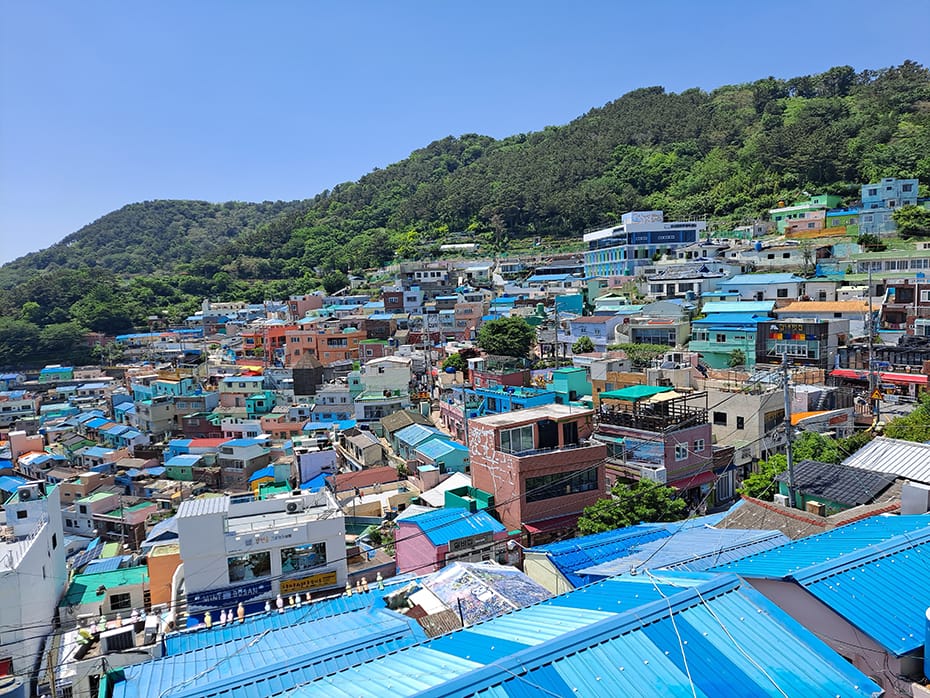
From a distance, the hillside neighborhood of Gamcheon Culture Village looks almost unreal.
Rows of pastel houses cascade down the slopes like stacked building blocks. Turquoise, yellow, coral pink, mint green. Staircases twist between homes. Sculptures appear unexpectedly on rooftops and alley corners.
It’s no surprise travelers often compare the village to Mediterranean towns such as Santorini.
But the resemblance ends with the colors.
Behind Gamcheon’s cheerful facades lies a far more complicated story—one that blends postwar survival, religious philosophy, urban planning, and an ambitious art revival that began only recently.
Visit today and you’re not just walking through a picturesque village. You’re stepping into one of the most fascinating urban transformations in Busan.
Quick Travel Summary (For Google SGE)
| Category | Details |
|---|---|
| Destination | Gamcheon Culture Village, Busan, South Korea |
| Known For | Colorful houses, murals, art installations |
| Historical Origin | Religious settlement and refugee housing |
| Major Viewpoint | Sky Garden |
| Iconic Artwork | The Little Prince statue |
| Navigation Tip | Follow painted fish signs |
| Nearest Subway | Toseong Station or Goejeong Station |
| Best Activity | Walking the alleys and discovering art |
Why Gamcheon Feels Different From the Rest of Busan
Travelers arriving in Busan often expect skyscrapers, busy seafood markets, and coastal views.
They find those things.
But Gamcheon tells a completely different story.
Instead of modern towers, the village is composed of tightly packed houses layered across a hillside. Streets are narrow. Many alleys are barely wide enough for two people to pass.
This unusual design wasn’t created for aesthetics.
It was built for survival.
The layout ensures that houses do not block each other's sunlight—a practical solution that reflects both community planning and religious philosophy.
And it is precisely this structure that now creates Gamcheon’s distinctive terraced landscape.
The Unusual Religious Origins of the Village
Many travel articles describe Gamcheon as a refugee settlement created after the Korean War.
That explanation is only partly correct.
In reality, the area was originally associated with followers of Taegeukdo, an ascetic spiritual movement that emerged during political turmoil in Korea in the early twentieth century.
Followers believed that universal meaning could be understood through the philosophy of cosmic polarity, closely linked to the principles of yin and yang.
Their central symbol, the swirling red-and-blue Taegeuk, remains a defining emblem in Korean culture. It also appears prominently on the national flag of South Korea.
In 1955, Busan authorities relocated roughly 800 households associated with the movement to a hillside district that would eventually become Gamcheon.
Over time, the religious center of the community moved here as well.
What began as a quiet spiritual settlement slowly evolved into a densely built hillside village.
The Artistic Rebirth of Gamcheon
For decades, Gamcheon remained largely unnoticed by tourists.
The transformation began in 2009.
A public art project invited Korean artists and art students to collaborate with residents and reimagine the village through creative installations and painted houses.
The idea was simple but powerful.
Instead of demolishing aging buildings, artists would reinterpret them.
Twelve new colors were added to the already pastel-toned architecture. Murals appeared along staircases. Sculptures appeared on rooftops. Small galleries opened inside previously unused homes.
Suddenly, Gamcheon was no longer just a residential neighborhood.
It had become an open-air art district.
Today, thousands of artists have contributed to the evolving landscape of the village.
The Best Viewpoint – Sky Garden
If you want to understand Gamcheon’s layout, the best place to begin is the Sky Garden observation area, located near the village information center.
From here, the layered structure of the town becomes clear.
Rows of houses cascade downward toward the harbor. The rooftops form a geometric pattern that feels almost architectural.
Visitors can also collect a small guidebook from the information center, which maps the village’s art installations and walking routes.
But maps only help so much.
Gamcheon is intentionally labyrinthine.
And that’s part of the experience.
The Famous Little Prince Statue
One of the most photographed locations in Gamcheon features a small sculpture inspired by The Little Prince.
The statue sits on a fence overlooking the port of Busan.
Beside the boy sits a fox.
Both gaze toward the harbor as if contemplating the vast world beyond the hillside village.
Visitors line up to take photos here. Some wait patiently for several minutes just to capture the perfect angle.
Yet the artwork captures something deeper than tourism.
It reflects the quiet introspection that still defines Gamcheon despite its popularity.
Getting Lost Is Part of the Design
Walking through Gamcheon is less about reaching a destination and more about exploring its network of alleys.
Many paths split into three or four directions. Staircases appear unexpectedly. Murals guide the way.
To help visitors navigate the maze, locals painted small fish symbols along the walls.
Follow the fish and you will eventually reach major viewpoints and attractions.
Look closely and you’ll notice playful details.
Some fish contain tiny human figures perched on their backs. Others show characters kicking the fish’s eye.
It’s a whimsical navigation system—one that fits the artistic personality of the village.
Things the Media Doesn’t Tell You
Many travel guides focus on Gamcheon’s colorful houses and Instagram-famous photo spots.
But there are aspects rarely discussed.
1. Gamcheon is still a residential neighborhood.
Many homes belong to long-time residents who continue to live ordinary daily lives here.
2. Tourism has mixed consequences.
According to local guides, the increase in visitors has caused some residents to relocate because of constant foot traffic.
3. Some houses remain empty.
Roughly 300 buildings in the village are estimated to be abandoned.
4. The alleys are extremely narrow.
Large tour groups often struggle to move through them comfortably.
Understanding these realities makes the visit more respectful—and more meaningful.
From Traveler to Planner – How to Visit Gamcheon
If you're planning a visit to Gamcheon, the route is straightforward.
-
Travel to Busan Metro Toseong Station or Busan Metro Goejeong Station using the Busan subway system.
-
From either station, take a taxi to Busan Gamjeong Elementary School, located near the entrance to the village.
-
Begin walking uphill toward the information center and Sky Garden.
The rest of the journey happens on foot.
And the best strategy is simple.
Wander slowly.
Expert Insight From Local Guides
A Busan guide once explained the village this way:
“Photographers love Gamcheon because every corner looks different. But it’s important to remember people still live here.”
Another guide added a more humorous observation:
“Some of the alleys are so narrow that tall visitors must watch their heads carefully.”
Both remarks capture Gamcheon perfectly.
The village is beautiful—but it is also practical, human, and occasionally inconvenient.
Exploring Beyond the Murals
Many visitors spend an hour here.
But those who explore deeper often discover small cafes, community galleries, and workshops inside former homes.
Artists have proposed converting several abandoned houses into exhibition spaces, cafes, and small restaurants managed by the village.
Profits from these projects are designed to return to the community.
It’s a model that attempts to balance tourism with local sustainability.
And in a neighborhood with limited space, that balance matters.
Final Thoughts
Gamcheon is not simply a picturesque hillside.
It is a layered story.
Religion shaped its earliest layout. War influenced its population. Art transformed its identity.
Today the village sits quietly above Busan’s harbor—a maze of color, creativity, and history.
The best way to experience it isn’t through a checklist of attractions.
It’s through wandering.
Turn into unfamiliar alleys. Follow painted fish. Pause beside murals. Look out over the rooftops toward the sea.
Eventually you will realize something subtle but important.
Gamcheon isn’t just a place to visit.
It’s a place to explore slowly.
A Walking Route Through Gamcheon Culture Village – Busan’s Labyrinth of Art and History.
Gamcheon culture village, Busan art village, Gamcheon travel guide, Busan cultural attractions, Gamcheon murals, Gamcheon walking route, Busan hillside village, Gamcheon photography spots, Gamcheon history, Busan art district, Gamcheon viewpoint, Busan travel itinerary, Gamcheon little prince, Gamcheon alleyways, Busan cultural tourism
