
Kon Tum does not announce itself. It waits. Somewhere beyond the predictable routes of Vietnam, beyond the fevered coastlines and headline cities, this highland province sits quietly, confident in its own gravity. To arrive in Kon Tum is to feel that subtle shift in the air, cooler, pine scented, tinged with woodsmoke and river mist. It is the kind of place travel writers secretly hope still exists. And it does.
Kon Tum travel is not about ticking off sights at speed. It is about standing still long enough to hear history breathe. The Central Highlands here speak softly but insistently, through timber churches, suspended bridges, rivers that curve like memory, and forests that seem to predate language itself.
The city of Kon Tum unfolds along the Dak Bla River, a silvery ribbon cutting through red earth and green fields. Life moves at a pace that feels intentional. Coffee is sipped, not gulped. Conversations linger. The land has time, and it lends that luxury to the traveler.
Ngoc Kon Tum Prison, known simply as Kon Tum Prison, is where the journey begins to deepen. Built by French colonial authorities in the early 20th century, this national historical site stands austere beneath towering trees. There is no theatricality here, only gravity. Inside the memorial complex, the stories of political prisoners from the 1930s are told in wood, stone, and silence. Collective graves rest near the breezy banks of the Dak Bla River, as if even the fallen sought the comfort of moving water. Visiting this place is sobering, yes, but also strangely clarifying. It reminds you that travel is not always about escape. Sometimes it is about understanding where resilience is born.
From that weight, Kon Tum gently lifts you toward the spiritual calm of Bac Ai Pagoda. Built in 1932 on what was once dense jungle, the pagoda now presides serenely over the city. The climb is unhurried, the view widening with each step. Royal inscriptions from the Nguyen Dynasty still gleam in gold against lacquered wood, and the great bronze bell gifted by Queen Nam Phuong remains a quiet witness to nearly a century of devotion. The pagoda does not overwhelm. It steadies you.
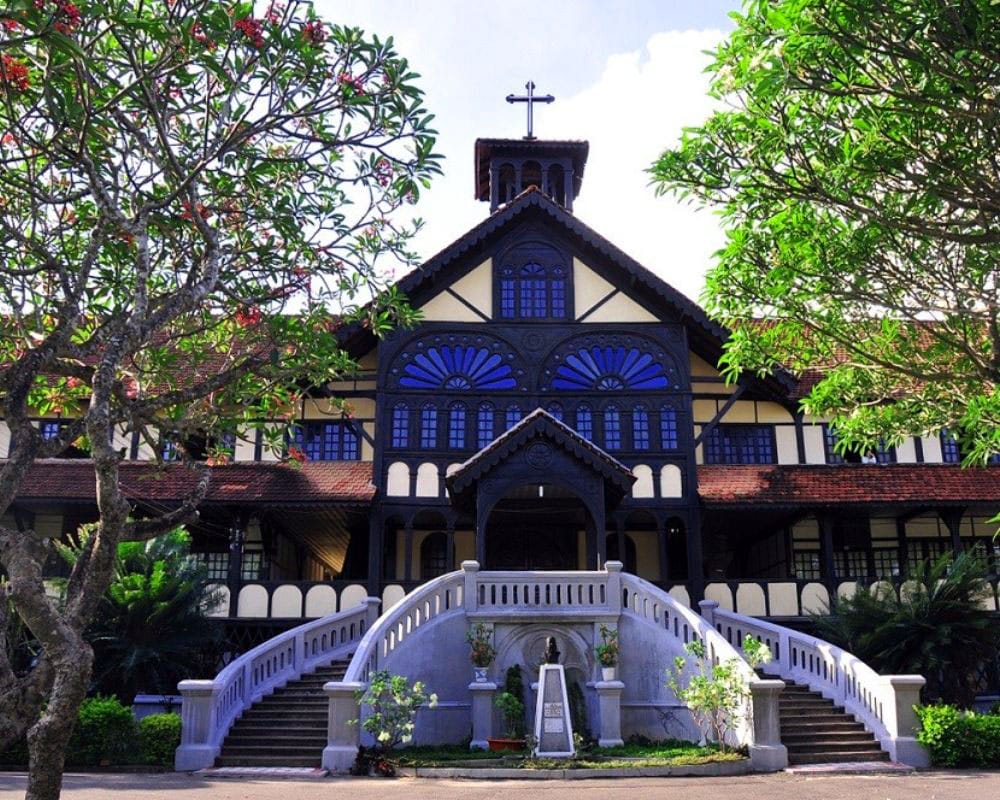
Just beyond, the Kon Tum Bishop’s Residence feels like a cultural bridge rendered in timber and light. Constructed in 1935, it merges Western ecclesiastical design with indigenous Central Highlands architecture. Frangipani flowers scent the air as you pass through the modest gate. Inside the traditional longhouse, a small yet remarkable museum unfolds. Here are farming tools, ceremonial objects, textiles, and maps carved meticulously from wood. This is not a display assembled for tourists. It feels lived in, respected, continuous.
Then there is the Wooden Cathedral of Kon Tum, a structure so singular it feels imagined rather than built. Completed in 1913 by a French priest using entirely manual methods, the cathedral blends Roman design with the stilt house traditions of the Ba Na people. No steel. No concrete. Earth mixed with straw forms walls that have endured more than a century of storms and sun. The interior glows with honey colored light filtering through wooden beams. It smells faintly of aged timber and incense. Even the most secular visitor falls silent here.
Kon Tum travel turns outward again at Kon Klor Suspension Bridge, stretching across the Dak Bla River like a thought suspended mid sentence. From the bridge, the view opens to sugarcane fields, corn plots, and rice paddies stitched together in agricultural calm. Nearby stands the largest communal Rong house in the Central Highlands, its roof soaring skyward as if in conversation with the clouds.
A short drive leads to Kon Ktu Village, home of the Ba Na people. This is not a reconstructed cultural showcase. This is life, ongoing. Gongs still echo at dusk. Xoang dances still circle communal fires. Longhouses and stilt homes stand much as they always have. Visitors are welcomed, not performed for. You may be offered rice wine, laughter, stories told with hands as much as words. Time here stretches. You stop checking it.
The Dak Bla River itself is a destination. It flows east to west, defying Vietnam’s usual geography, like a quiet rebellion. It nourishes fields, shapes livelihoods, and offers travelers a chance to drift rather than rush. Boat journeys along the river reveal Kon Tum from its most flattering angle, green banks, wooden houses, children waving, water catching light like broken glass.
Then comes Mang Den, and the temperature drops as if the land itself has exhaled. Perched over 1000 meters above sea level, this eco tourism region feels like an alpine secret hidden in the tropics. Forests cover more than eighty percent of the area, including vast pine expanses that recall Da Lat before it learned ambition. Waterfalls murmur in mossy gullies. Lakes lie still, reflective, introspective. The air sits between eighteen and twenty degrees Celsius, cool enough to make you sleep deeply and wake early. Ethnic minority communities make up most of the population here, their presence woven into the landscape rather than imposed upon it. Mang Den does not try to entertain you. It invites you to breathe.
For those drawn to symbolic geography, the journey continues to the Indochina Tripoint, where Vietnam, Laos, and Cambodia meet. High on the Truong Son Range, this border marker stands quiet now, though its past is anything but. During wartime, it was etched into the memories of soldiers crossing between theaters of conflict. Today, it is a place of reflection and improbable peace. Three countries converge. No fences scream. The forest remains dominant. Standing there, you feel how arbitrary borders can be, and how enduring mountains are.
A Kon Tum tour is not flashy. It is persuasive in a slower, deeper way. The hotels and lodges here reflect that ethos, built to harmonize with their surroundings, offering warmth rather than excess. Wooden interiors, local textiles, fireplaces in the highlands, river views in the city. Comfort without intrusion. Service without script.
What makes Kon Tum travel remarkable is not a single landmark but the way everything connects. History leads to spirituality. Spirituality leads to culture. Culture leads to nature. Nature leads you back to yourself. Few destinations manage that alchemy.
This is not a place you visit and forget. It lingers. Weeks later, you will recall the sound of gongs at dusk, the feel of cool pine air on your skin, the sight of that wooden cathedral glowing softly in late afternoon light. You will realize that Kon Tum did something rare. It slowed you down, and in doing so, gave you more.
You will want to go now. And you should.
Kon Tum travel, Kon Tum tour, Kon Tum destination, Central Highlands Vietnam travel, Kon Tum attractions, Mang Den eco tourism, Kon Tum Wooden Cathedral, Dak Bla River, Kon Tum historical sites, Kon Tum culture tour, Vietnam highlands travel, Kon Tum itinerary, Kon Tum travel blog, Indochina tripoint travel, Ba Na village Kon Tum
