
Discover Nam Du Islands – Vietnam’s Quiet Alternative to Phu Quoc
Discover Nam Du Islands – Vietnam’s Quiet Alternative to Phu Quoc
In southern Vietnam, where the waters of the Gulf of Thailand shimmer beneath endless tropical skies, lies an archipelago that still feels almost secret.
While travelers flock to the famous beaches of Phu Quoc, another group of islands quietly waits nearby—less developed, less crowded, and far more mysterious.
This is Nam Du Archipelago.
Floating roughly 100 kilometers from the coastal city of Rach Gia, the Nam Du islands form a constellation of 21 small and large islands, scattered across turquoise waters in the district of Kien Hai District.
Some islands hold fishing villages alive with daily maritime life.
Others remain untouched, wild, and astonishingly quiet.
For travelers seeking a Vietnam that still feels undiscovered, Nam Du may be one of the most captivating destinations in the country.
The Geography of a Hidden Archipelago
The Nam Du Archipelago spreads across approximately 1,054 hectares, divided administratively between two island communes: An Son Commune and Nam Du Commune.
Among the 21 islands, 11 are inhabited, forming small maritime communities whose lives revolve around fishing and aquaculture.
Each island possesses its own identity.
Some are lively, filled with fishing boats and floating fish farms.
Others contain only a handful of homes and quiet coconut groves.
A few remain almost entirely untouched.
The most populated islands include:
-
Hon Cu Tron (also known as Hon Lon)
-
Hon Ngang
-
Hon Mau
Meanwhile smaller islands such as Hon Nom, Hon Dau, and Hon Dung remain quiet and sparsely populated.
Together, they create a maritime landscape that feels both intimate and vast.
Hon Lon – The Largest Island
The largest island in the archipelago is Hon Lon, located in An Son Commune. Locals also call it Hon Cu Tron.
Covering about 771 hectares and home to nearly 5,000 residents, it serves as the main hub of life in Nam Du.
Here the landscape reveals the classic beauty of Vietnam’s southwestern seas: forested hills descending toward white beaches, fishing boats rocking gently in small bays, and narrow coastal roads weaving between coconut trees.
Several beaches on Hon Lon are particularly admired by visitors:
-
Bai Chet
-
Bai Co
-
Bai Ngu
-
Bai Gieng
Each beach offers a slightly different mood.
Some are lively with fishing activity. Others remain tranquil enough that the only sound you hear is the wind moving through palm leaves.
Standing on the shoreline here, it becomes clear why Nam Du has begun attracting the attention of adventurous travelers.
A Two-Hour Journey Across the Sea
Reaching the islands is surprisingly simple.
From Rach Gia, high-speed passenger boats cross the sea to An Son Island in just over two hours.
As the mainland fades into the distance, the water deepens into shades of sapphire and jade. Soon the first islands appear on the horizon—green hills rising suddenly from the sea.
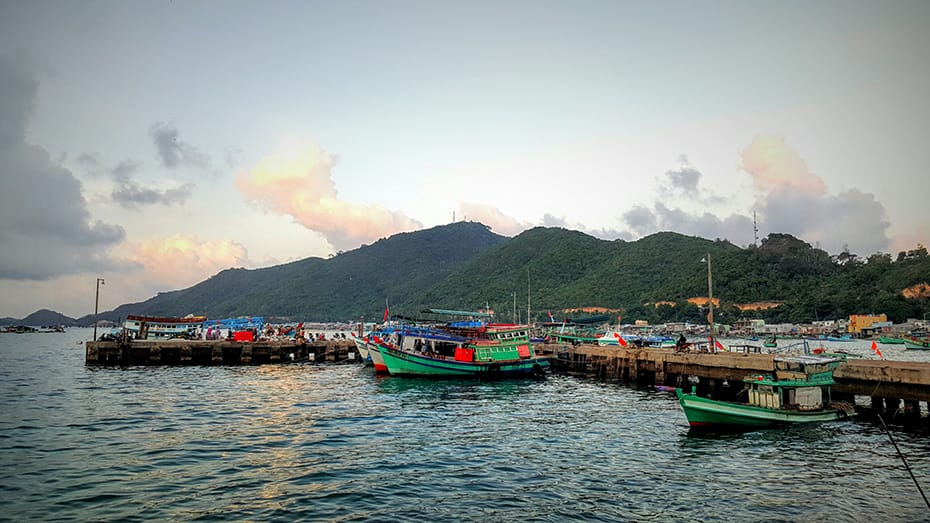
Unlike many crowded island destinations, Nam Du retains an atmosphere of calm. Boats approach slowly, and the harbor activity revolves mostly around fishing vessels rather than tourism.
It feels less like arriving at a resort island.
It feels like discovering a living maritime community.
A Sea of Islands and Local Legends
The people of Nam Du often describe their archipelago through a traditional folk rhyme, listing the islands in a playful rhythm passed down through generations.
It begins with Hon Mau, moves through Hon Ngang, Hon Dung, Hon Dau, and many others—each name representing a piece of the maritime puzzle that forms Nam Du.
This oral tradition reflects the deep connection between the local communities and the surrounding sea.
For fishermen here, each island serves as both landmark and companion, guiding them through waters they know intimately.
Life on the Water
Daily life across the Nam Du islands revolves around the ocean.
Fishing fleets depart before sunrise. Nets are hauled in throughout the day. Floating fish farms sway gently in sheltered bays.
Statistics from local communities illustrate just how central the sea remains to their lives.
The archipelago operates over 1,700 fishing vessels, generating tens of thousands of tons of seafood annually. Aquaculture is equally important, with hundreds of floating cages raising species such as:
-
Cobias (Ca Bop)
-
Groupers (Ca Mu)
-
Various reef fish
Seafood harvested from these waters is famously fresh.
Among the most popular local delicacies are:
-
Fresh squid
-
Blue swimming crab
-
Sea snails including oc nhay, oc ngoc, and oc buou bien
In Nam Du, seafood rarely travels far from ocean to plate.
Often the distance is measured in minutes.
Hon Mau – The Jewel of Nam Du
Among all islands in the archipelago, Hon Mau stands out as one of the most promising for tourism.
Located about two kilometers southeast of Hon Ngang, this island covers roughly 58.6 hectares and is home to around 130 households.
Despite its small population, Hon Mau possesses some of the most beautiful beaches in the region.
The island features five distinct beaches, each offering a different landscape:
Bai Chuong
Perhaps the most famous beach on Hon Mau, Bai Chuong boasts a long stretch of white sand framed by coconut palms.
The water here glows with remarkable clarity, shifting between emerald and turquoise depending on the light.
It is the kind of beach that appears in travel magazines—yet remains largely undiscovered.
Bai Nom
Gentle waves roll toward the shore here, making Bai Nom a peaceful location for swimming or simply sitting by the water with nothing to do except watch the horizon.
Bai Da Den and Bai Da Trang
These two beaches are especially fascinating because of their stone formations.
Smooth rocks of various shapes and colors scatter across the shoreline, creating natural sculptures carved slowly by centuries of tides.
Among them, Bai Da Den is often considered the most visually striking.
Each stone seems unique—some patterned, some polished smooth by the sea.
Bai Nam – The Island’s Harbor
Facing the main maritime route, Bai Nam serves as the island’s front entrance.
Here fishing boats anchor, trade occurs, and daily life unfolds. Because the bay is sheltered from strong winds, the waters remain calm for much of the year.
A Place Still Waiting to Be Discovered
Compared with major island destinations, tourism in Nam Du remains at an early stage.
The government of Kien Giang Province has recognized the region’s potential and approved plans to develop sustainable tourism across several islands, particularly Hon Mau.
Several investors have already begun exploring eco-resort projects designed to protect the archipelago’s fragile environment while introducing visitors to its beauty.
Yet for now, Nam Du remains largely authentic.
Fishermen repair their nets beside wooden houses. Children play along quiet beaches. Coconut trees sway above empty stretches of sand.
It feels, in many ways, like stepping back to a time before mass tourism reshaped tropical islands around the world.
Sunset Over the Nam Du Sea
As evening approaches, the sky above the archipelago transforms.
Clouds turn amber and violet. Fishing boats return slowly toward shore. The water reflects the fading sunlight like polished glass.
From the hills of Hon Cu Tron, the view stretches across dozens of islands scattered through the sea.
It is a scene that feels impossibly wide, almost cinematic.
And in that moment, it becomes clear why many travelers describe Nam Du as another Phu Quoc—only quieter, wilder, and more mysterious.
For those willing to journey a little farther from the familiar tourist routes, these islands offer something rare.
Not just beautiful beaches.
But discovery itself.
Hon Mau Beach – The Most Beautiful Secret in the Nam Du Archipelago.
Nam Du archipelago travel, Nam Du islands Vietnam, Hon Mau beach, Hon Lon island, Kien Giang islands, Rach Gia ferry Nam Du, Vietnam hidden islands, Nam Du snorkeling spots, Hon Ngang fishing village, Nam Du island beaches, southwest Vietnam islands, Nam Du seafood culture, Gulf of Thailand islands, Vietnam island getaway, Nam Du travel guide
