
Riding O Quy Ho Pass and Falling for Sapa at First Sight
Sapa is no longer a secret. The name appears in guidebooks, on Instagram feeds, and in conversations among travelers who crave mountains instead of beaches. Yet nothing prepares you for the first breath of cold air at 1,600 meters above sea level, when the mist parts just enough to reveal a town tucked into the mountains like a well-kept story.
We arrived early on a summer morning. The streets were still half asleep. Fog rolled slowly over rooftops. The air carried that cool, almost European sharpness that surprises anyone who thinks Vietnam is only tropical heat. At an average elevation between 1,500 and 1,800 meters, Sapa enjoys a temperate climate year round. Even in summer, you may find yourself reaching for a light jacket.
This is the highland heart of northwest Vietnam. Rugged. Beautiful. Unapologetically dramatic.
And for first-time backpackers like us, it felt like stepping into a different country entirely.
The Road to O Quy Ho Pass. Vietnam’s Legendary Mountain Challenge
We rented motorbikes in the center of town and headed toward Lai Chau. Within minutes, the scenery shifted from sleepy streets to sweeping mountain curves. Our destination was O Quy Ho Pass, one of the longest and most formidable mountain passes in Vietnam.
Stretching over 40 kilometers and rising above 2,000 meters, O Quy Ho is not a casual drive. It is a commitment. Sharp bends cut into cliffs. Long downhill sections demand focus. One moment of distraction, and the abyss below reminds you who is truly in charge.
The pass drapes itself across the legendary Hoang Lien Son Range like a ribbon of asphalt. On clear days, you can glimpse the famous cluster of seven peaks known locally as “That Chi Son,” and if the weather is kind, the unmistakable summit of Fansipan rises at 3,143 meters, proudly called the Roof of Indochina.
There are four great mountain passes in Vietnam’s northwest. O Quy Ho stands among them, alongside Ma Pi Leng in Ha Giang, Khau Pha in Yen Bai, and Pha Din in Dien Bien. But here, on this stretch of road, statistics feel secondary. What matters is the wind against your face and the sensation of riding above the clouds.
Halfway up, we passed Silver Waterfall, a well-known cascade near Sapa. We did not stop. The road was calling.
Instead, we continued toward Heaven Gate.
Heaven Gate. Where the Mountains Swallow You Whole
Perched at the highest section of O Quy Ho, Heaven Gate offers one of the most expansive views in northern Vietnam. Standing there, you see it all. Endless mountain ridges. Serpentine roads. Valleys fading into layers of blue and grey.
The scale is humbling.
The cliffs drop sharply below. Peaks stab into the sky. You feel small. Not metaphorically small. Physically small.
A few Hmong women had set up simple stalls selling colorful brocade handicrafts. Nearby, a young Giay girl tended a charcoal grill, turning skewers of meat in the cold mountain air. The smell was irresistible.
We stopped. We ate grilled pork and sticky rice cooked in bamboo tubes, known as com lam. Steam rose from the rice as we split it open. The combination of smoky flavor and crisp mountain wind made everything taste sharper, better, more memorable.
Travel is not only about landscapes. It is about conversations. Sharing a few words with local vendors, learning about daily life in a place that remains cold for much of the year, gives you a different kind of understanding.
Sapa is not just a postcard. It is home to Hmong, Tay, Red Dao, and Giay communities whose cultures shape the region’s identity. Their textiles, languages, and farming traditions add color to the already vivid terrain.
Love Waterfall. A Forest Walk Worth Every Step
Leaving Heaven Gate, we descended and made our way to Love Waterfall, a striking cascade hidden deep within the forest.
Reaching it requires effort. A winding red dirt path stretches nearly two kilometers through thick vegetation. The walk is quiet except for birds and distant water.
Then suddenly, the trees part.
The waterfall drops nearly 100 meters along the Golden Stream, which begins high on Fansipan. Water crashes into the pool below, sending cool mist into the air. Surrounded by dense greenery and the scent of damp earth, the place feels untouched.
There are no loud crowds here. No urban noise. Just forest and falling water.
It is becoming one of Sapa’s most appealing newer attractions, and deservedly so. The hike in makes the reward sweeter.
The Ride to Muong Hum. Thirty Kilometers of Pure Highland Poetry
Back in Sapa town, we decided not to stop exploring. Instead, we rode over another pass toward Muong Hum, a small highland town located more than 30 kilometers away.
Muong Hum itself is simple. Quiet. Almost understated. It is a small settlement where Kinh people and ethnic minorities live side by side in peaceful coexistence. You will not find flashy attractions or curated experiences.
But the road there is unforgettable.
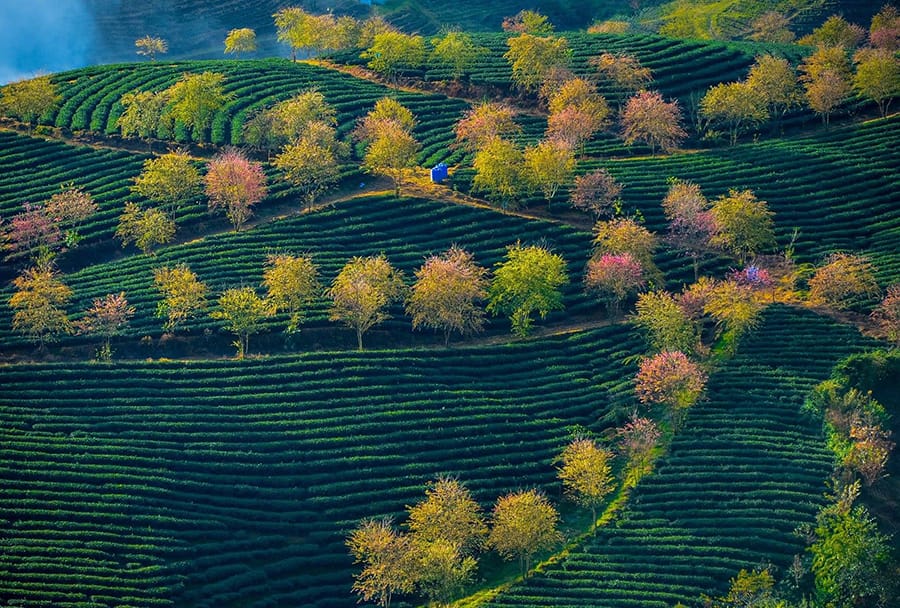
More than 30 kilometers of mountain curves reveal terraced hillsides layered in shifting shades of green and gold. Villages appear briefly behind ridgelines before vanishing into clouds. Herds of horses graze on high slopes. Dry rice fields prepare for harvest season.
At times, we passed village elders carrying medicinal leaves collected from hours of walking in the forest. Children, barely tall enough to see over a buffalo’s back, guided livestock along dusty paths.
Their eyes were curious. Gentle. Sometimes shy.
In these remote areas, tourism has not yet reshaped daily life. Poverty remains visible. Yet so does dignity. The people we met were sincere and welcoming, despite limited resources.
Moments like these stay with you long after the engine cools.
Returning to Sapa. Between Hope and Reflection
We rode back to Sapa carrying mixed emotions. Awe at the landscapes. Gratitude for the hospitality. And quiet reflection about the realities of highland life.
With continued investment and responsible tourism development in Lao Cai province, there is hope that economic growth will reach deeper into these mountain communities. Perhaps one day, children will spend more time in classrooms than in fields.
Travel, when done thoughtfully, can contribute to that change.
Beyond the Adventure Routes
Of course, Sapa offers more than mountain passes and waterfalls. Visitors can explore Ham Rong Mountain for panoramic views of town, visit the historic Sapa Stone Church, wander through Sapa Market, or discover ancient rock carvings in the Muong Hoa Valley.
Villages such as Cat Cat and Ta Phin reveal more about traditional highland architecture and craftsmanship. Bamboo bridges cross quiet streams. Terraced fields curve around hills like living sculptures.
But for us, the essence of Sapa was found on the road. In the cold wind of O Quy Ho. In the stillness of Love Waterfall. In the long ride to Muong Hum.
Why Sapa Demands to Be Experienced Now
Yes, Sapa is well known. Yes, it appears in every Vietnam itinerary.
But fame does not dilute its power.
Standing above 2,000 meters with clouds drifting below you, tasting grilled meat in icy air, hearing only wind and water, you realize something simple.
Places like this do not lose their magic because they are popular. They lose their magic only when you do not go.
Sapa remains wild at its edges. Cultural at its core. Challenging on its roads. Gentle in its human encounters.
And if you wake early enough, when the town still sleeps under mist, you might feel as though you have discovered it for the very first time.
Sapa travel guide, O Quy Ho Pass, Fansipan mountain Vietnam, Love Waterfall Sapa, Heaven Gate Sapa, Hoang Lien Son Range, Muong Hum Lao Cai, Sapa motorbike route, northwest Vietnam mountains, Sapa ethnic villages, Silver Waterfall Sapa, Sapa summer weather, Sapa trekking experience, Sapa cultural travel, Lao Cai tourism
