
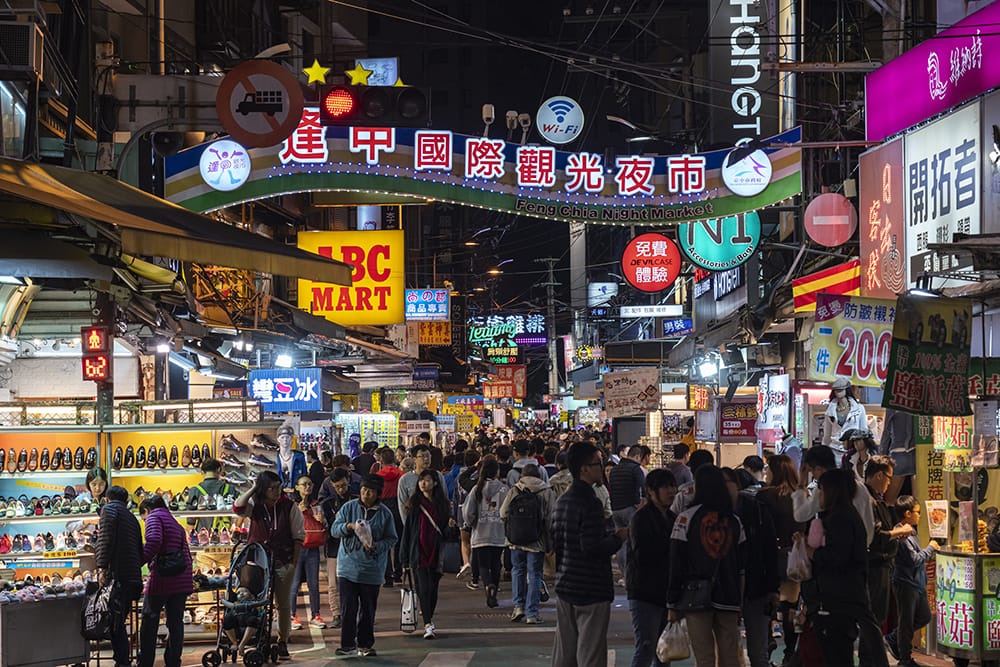
The Giants of the Night: Where to Begin
Taiwan has dozens of night markets, but four dominate the conversation:
-
Shilin Night Market – the largest and most iconic
-
Ximen Night Market – youthful and fashion-forward
-
Fengjia Night Market – a street food labyrinth
-
Liuhe Night Market – southern energy, seafood spirit
Each has its personality. Each pulls people out of their apartments and into the streets like clockwork.
By 5 PM, shutters roll up. Oil begins to heat. Neon flickers to life. By 7 PM, the crowd thickens until movement becomes a gentle negotiation of elbows and shopping bags. By 9 PM, it feels like a festival in full swing.
And nobody seems to be in a hurry to leave.
The Food: A Symphony of Frying Oil and Chili Sauce
The first thing that hits you is the aroma.
Frying oil. Sweet soy glaze. Char. Chili. Garlic. Steam rising from noodles. It hangs in the air like edible perfume.
Taiwanese night markets adore fried food. You see it everywhere:
-
Fried fish balls
-
Fried tofu
-
Fried chicken wings
-
Stir-fried noodles
-
Wonton noodles in generous bowls
Skewers dominate the landscape. Customers clutch freshly grilled sticks lacquered in vivid red chili sauce, still sizzling, oil barely finished dripping from the meat fibers. They blow on them impatiently, take a bite too soon, wince at the heat, then smile at the spice.
The lines can be astonishing. Two or three snaking queues weaving around each other like impatient serpents. Waiting ten, fifteen, even twenty minutes—for a handful of skewers.
And no one complains.
That patience is part of the experience. Anticipation is an ingredient.
Shilin: The Colossus of Taipei
If you only visit one, go to Shilin Night Market.
It is the largest in Taiwan and easily one of the most kinetic. The scale alone is impressive. Stalls stretch in every direction. Food bleeds into fashion, which bleeds into fruit vendors, which bleed into game booths.
You can spend hours here without realizing it.
Beyond the food, Shilin is a retail organism. Clothing stalls range from budget basics to mid-range and higher-end pieces. Prices vary accordingly. What stands out is the color palette—reds and yellows dominate, reflecting local aesthetic preferences. It’s bold. Festive. Unapologetic.
And then there are the shoes.
Taiwanese footwear is known for fashionable design and durability. Displays are meticulous. Sleek heels, playful flats, contemporary sneakers. Female travelers, especially, find it hard to resist the variety. Prices are slightly higher than in Vietnam, which can dampen enthusiasm—but the craftsmanship justifies a second look.
The Fruit That Surprised Me
I expected street food to be good. I did not expect fruit to steal the show.
Taiwanese fruit stalls are visually arresting. Massive starfruit. Plums the size of small apples. Everything seems oversized, fragrant, impossibly polished.
But the real revelation is custard apple.
Taiwan’s custard apple is extraordinary. The fruit is large—shaped somewhat like soursop but with a skin closer to the Vietnamese variety. Inside: snow-white flesh, intensely aromatic, sweet yet balanced, never cloying.
The texture is lush, almost creamy. The flavor lingers.
Other fruits—starfruit, plums—are surprisingly sweet as well, with barely a trace of the acidity you might expect.
The caveat? Price.
Expect roughly 80,000 to 150,000 VND per catty (three catties equal one kilogram). Not cheap. But the quality is undeniable.
Sometimes indulgence is justified.
Games, Noise, and Gentle Competition
Night markets are not just about consumption. They are playgrounds.
Game stalls are perpetually crowded:
-
Claw machines
-
Balloon shooting with air rifles
-
Ring toss
-
Fishing for shrimp in small square tanks
-
Mahjong-style games
The shrimp fishing booths are mesmerizing.
Middle-aged men—serious, patient—hold tiny rods over compact tanks, waiting for a bite. Around them, teenagers cheer or groan dramatically. It’s oddly dignified. Focused. Competitive without hostility.
The line to participate can be long. On several occasions, I wanted to try but simply couldn’t wedge myself into the crowd.
That’s the charm. You’re not watching a staged performance. You’re watching real leisure unfold.
Ximen and the Urban Pulse
If Shilin is grand, Ximen Night Market feels younger, more fashion-forward.
The clothing stalls here lean trendy. Accessories—rings, necklaces, earrings, phone cases—are everywhere. The atmosphere is slightly more curated, slightly more stylized.
And if you time it right, you may stumble into the coveted “golden hour.”
The Golden Hour Deals: 10, 20, 30 TWD
This is where strategy pays off.
Certain shops announce promotional “special golden hours.” During these windows, everything in the store sells at a single price—10, 20, or 30 New Taiwan Dollars.
With 1 TWD roughly equivalent to 700 VND, these deals feel almost mischievous in their generosity.
Suddenly you’re scooping up:
-
Rings
-
Keychains
-
Earrings
-
Necklaces
-
Vibrant phone cases
It’s lighthearted. Fast. Slightly chaotic. And deeply satisfying.
You feel like you’ve won something—even if it’s just a colorful souvenir.
Fengjia and Liuhe: Beyond Taipei
Travel south and the energy shifts.
Fengjia Night Market in Taichung feels expansive and food-driven, a labyrinthine sprawl of snack innovation.
Further down, Liuhe Night Market brings southern warmth and seafood sensibility into the mix. The atmosphere is still festive, but perhaps a touch more relaxed than Taipei’s intensity.
Yet the core remains unchanged: crowds, aroma, color, laughter.
Why Taiwan’s Night Markets Matter
You could argue they are simply commercial zones.
You would be wrong.
Taiwan’s night markets function as communal living rooms. They are where families stroll, couples date, friends gather, and solitary wanderers find belonging. They are democratic spaces—teenagers and middle-aged men compete in the same games, office workers and tourists stand in the same food lines.
In a modern, efficient city, this nightly ritual feels grounding.
It is structured chaos. Controlled exuberance.
And it happens every single night.
Go Hungry, Stay Late
No description fully captures the density of sensation.
The press of bodies on narrow lanes.
The hiss of oil.
The flash of neon on red and gold fabrics.
The sweetness of custard apple lingering on your tongue.
The stubborn focus of a man waiting for shrimp to bite.
You could analyze it. You could compare it. You could attempt to intellectualize it.
Or you could simply go.
Arrive at 5 PM. Stay until midnight. Eat too much. Buy something unnecessary. Try a game you don’t understand. Wait in a line longer than seems reasonable.
Then walk back to your hotel slightly dazed, slightly scented with fried oil, and completely certain of one thing:
Taiwan’s night markets are not optional.
They are essential.
Taiwan night market, Shilin Night Market, Ximen Night Market, Fengjia Night Market, Liuhe Night Market, Taipei street food, Taiwan street food, Taiwan custard apple, Taiwan fruit prices, Taiwan night market shopping, Taiwan golden hour deals, Taipei night market guide, Taiwan fried skewers, Taiwan souvenir shopping, Taiwan night market games
