
Hue has always known how to wait. For centuries, the former imperial capital stood composed, dignified, almost aloof, its citadels and pagodas resting quietly along the Perfume River while the world hurried elsewhere. Yet Hue has never been static. It has simply been patient. In recent years, the city has begun to reveal a fresher temperament, one that respects its past while gently opening doors to the present. The result is a destination that feels newly alive without sacrificing its soul.
Travelers who return to Hue after a long absence often experience a small shock. The familiar landmarks remain, yes, but woven between them are experiences that feel intimate, curated, and unexpectedly contemporary. Festivals, spiritual retreats, cultural spaces, night streets, and experiential tourism have reshaped Hue into a place where heritage is not preserved behind glass but lived daily. This is not reinvention. It is renewal.
A professional Hue tour today offers more than palace gates and royal tombs. It invites visitors to move slowly through landscapes of thought, belief, cuisine, music, and memory. And it does so with a confidence that makes you want to stay longer than planned.
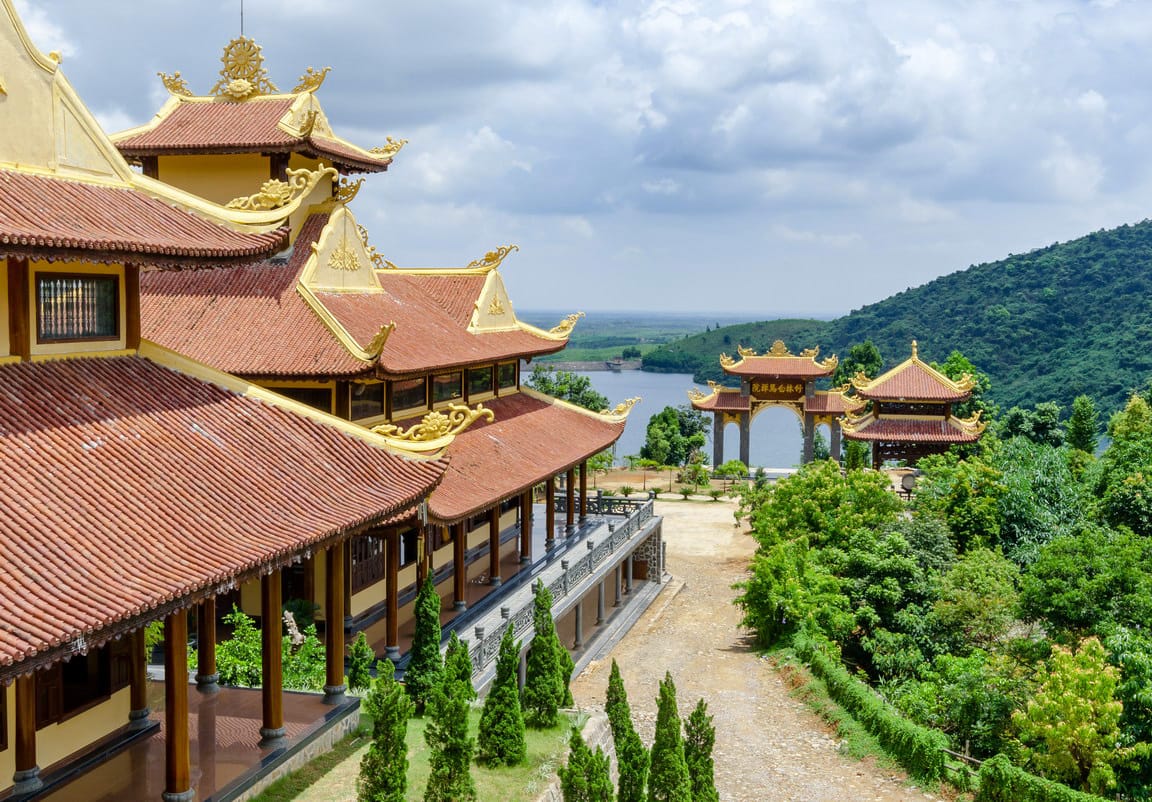
Truc Lam Bach Ma Zen Monastery sits quietly within the Bach Ma landscape, reached not by haste but by water. Built in 2006, it occupies a peninsula embraced by Truoi Lake, its reflection broken only by drifting clouds and the occasional oar stroke. From Hue City, the journey south unfolds gently along National Highway One, then narrows into a rural road before surrendering to a short boat crossing. The arrival feels ceremonial.
This was the first Truc Lam Zen monastery in Central Vietnam, founded by Zen Master Thich Thanh Tu. The complex unfolds in measured stages, outer grounds giving way to monastic quarters and nun residences. Stone steps lead the eye upward. Bells wait patiently. A monumental stone statue of Shakyamuni Buddha rises 24 meters high, weighing 1500 tons, serene and immovable, yet somehow light in spirit. Visitors speak softly here, not because they are told to, but because the place asks it of them. The benefit of visiting Truc Lam Bach Ma is not sightseeing. It is stillness, a luxury rarer than gold.
Ten kilometers from the city center, the Huyen Tran Cultural Center occupies the slopes of Ngu Phong Mountain, surrounded by pine forests and layered hills. Inaugurated in 2007 to commemorate 700 years of Thuan Hoa Phu Xuan, the complex feels both commemorative and contemplative. It honors Princess Huyen Tran, whose political marriage helped expand the nation southward, and Doan Nhu Hai, a statesman whose diplomacy shaped early Vietnamese administration.
Beyond that lies the temple dedicated to King Tran Nhan Tong, hero of resistance against Mongol invasion and founder of the Truc Lam Zen sect. Twin dragons stretch before the temple in a record setting display, symbols of vigilance and harmony. Higher still, the Peace Bell Tower crowns the mountain, housing a 1.6 ton bronze bell whose resonance carries across valleys. Along the path stands a colossal laughing Maitreya Buddha, smiling as if amused by history’s endless cycles. Travelers leave with a sense of perspective, the feeling that personal concerns have briefly shrunk to manageable size.
On Mount Ban, the Quang Trung Monument rises with unapologetic authority. Inaugurated in 2010 to mark the 221st anniversary of Nguyen Hue’s coronation, the statue stands 2.1 meters tall, assembled from eight massive Thanh Hoa stone blocks. Behind it stretches a nearly 60 meter bas relief depicting the Tay Son uprising, from its humble beginnings to the thunderous northern campaign that shattered Qing forces.
The site includes ceremonial grounds, temples honoring Emperor Quang Trung and Empress Le Ngoc Han, exhibition halls, and landscaped green spaces. It is a place of narrative, where history is told not in dates but in momentum. For travelers interested in Vietnam’s martial and political legacy, this monument offers clarity and scale. The benefit lies in context. Hue is not only poetic. It has been fierce.
As evening settles, the Perfume River takes on a different character. Since 2012, the Huong River Floating Restaurant has drifted quietly beneath Truong Tien Bridge, the city’s most lyrical span. It is the only floating restaurant in Hue, engineered with modern structural integrity capable of supporting 774 tons and hosting over 350 guests.
Dining here is an experience of rhythm. Water laps softly. Lights shimmer. Menus range from European and Asian selections to deeply traditional Hue cuisine, refined but unpretentious. Royal dishes echo the city’s past, while contemporary presentations signal confidence. The benefit is atmosphere. You are not simply eating near the river. You are dining with it.
Also inaugurated in 2012, the Hue Past Hue Present Experiential Tourism Center occupies a natural alluvial islet near Con Hen. Shaped like a giant poetic conical hat, it functions as a living museum rather than a static exhibit. Visitors enter a recreated village environment where traditional crafts, martial arts of the Nguyen court, and classical Hue singing unfold not as performances but as invitations.
Guests can learn to cook local dishes, understand their symbolic balance, and taste with intention. Programs extend beyond observation into participation. One day living in a Hue garden house. One day in a temple. One day as a Thua Thien farmer. One day navigating lagoon life. The benefit is immersion. Hue stops being a destination and becomes a temporary home.
Nightfall no longer signals retreat in Hue. The city that once slept early now stretches into the evening with confidence. Nguyen Dinh Chieu Night Street draws thousands nightly, alive with conversation and curiosity. Han Thuyen and Mai Thuc Loan Streets offer food culture that ranges from refined to exuberant. Lanterns glow. Music drifts. The atmosphere remains gentle, never frantic, preserving Hue’s temperament even as it embraces vitality.
Looking ahead, Hue continues to expand its cultural vocabulary. A ten hectare site at Bau Ho Hill is slated to become the Trinh Cong Son Cultural Space, honoring the city’s most beloved composer. Even now, Trinh Cong Son Street winds gracefully along the Perfume River, its curves shaded by trees and framed by old houses. Nearby, a memorial park nears completion, promising a gathering place for those drawn to music, poetry, and quiet reflection.
Hue today is not louder. It is richer. It offers travelers layered experiences that unfold slowly, rewarding patience and curiosity. Hotels range from heritage boutique properties to riverside resorts, offering spa treatments rooted in traditional medicine, garden views, attentive service, and strategic proximity to key sites. The benefits are tangible. Comfort. Access. Atmosphere. But the true reward is intangible.
Hue has learned to smile again. And it is inviting you to see it.
Hue travel blog, Hue cultural travel, Hue tour experience, Central Vietnam travel, Hue heritage tour, Hue sightseeing guide, luxury Hue tour, Hue spiritual travel, Hue night life travel, Hue Perfume River experience, Hue historical attractions, Hue experiential tourism, Hue festival travel, best places to visit Hue, Hue hotel and resort guide
