
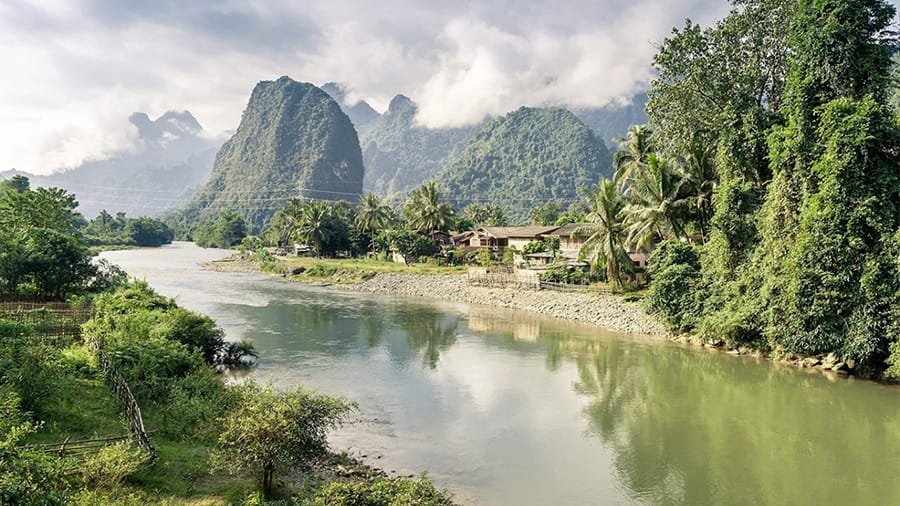
Laos does not rush to impress you. It does not glitter. It does not shout. It waits. And that patience, once you arrive, becomes contagious. This landlocked country in the heart of Southeast Asia reveals itself slowly, like a story told by someone who knows it will be remembered. The landscapes are generous. The people unhurried. Travel here feels less like consumption and more like participation.
These ten places form a journey rather than a list. They connect through river currents, mountain paths, and an unbroken sense of calm that modern travelers often forget they are missing. Together, they outline a Laos travel route designed for curiosity, reflection, and the deep satisfaction of being somewhere that has not been over explained.
Vang Vieng greets you with limestone cliffs that rise abruptly from flat farmland, as if the earth itself had decided to stretch. Once known solely for excess, the town has matured into something far more interesting. The Nam Song River curves lazily through the valley, reflecting cliffs, clouds, and the occasional hot air balloon drifting like a thought not yet finished.
Adventure here is immediate. Kayaking through gentle rapids. Caving through ancient chambers hidden behind unassuming entrances. Cycling along dirt roads that pass rice fields and villages where children wave without expectation. Hotels in Vang Vieng now emphasize balance. Riverside resorts offer quiet rooms, open air terraces, and guides who understand the terrain intimately. The benefit is flexibility. You can push your limits in the morning and retreat into silence by evening.
Muang Ngoi Neua requires intention. Reaching it involves following the Nam Ou River north of Luang Prabang, where the road dissolves and the journey takes over. The village sits between river and mountain, unguarded, unadorned, and remarkably complete.
Walking trails radiate outward, climbing into hills where viewpoints reward effort with expansive silence. The accommodation here is simple but thoughtful. Guesthouses prioritize airflow, views, and human warmth over decoration. Meals are local, unpretentious, deeply satisfying. The benefit lies in disconnection. Muang Ngoi Neua offers something increasingly rare. A place where nothing is urgent.
Pha That Luang dominates the skyline of Vientiane with quiet authority. Gold plated, symmetrical, and deeply symbolic, it stands not as spectacle but as anchor. Built atop older Khmer foundations, it absorbs centuries without strain.
Visiting Pha That Luang is less about photography than orientation. The surrounding grounds invite slow walking. Nearby hotels and boutique stays cater to travelers seeking proximity rather than extravagance. Rooms are designed for rest after city wandering, with thoughtful service and easy access to temples and cafes. The benefit is context. Staying nearby allows the monument to become part of your daily rhythm rather than a brief stop.
Si Phan Don, the Four Thousand Islands, is where the Mekong forgets to hurry. At the southern tip of Laos, the river spreads wide, fracturing into countless channels around islands that feel suspended between water and sky.
Here, travel is horizontal. Bicycles replace cars. Hammocks replace schedules. Boat trips drift past water buffalo and fishermen, and occasionally, if fortune allows, the rare Irrawaddy dolphin surfaces briefly before retreating into myth again. Island lodges emphasize openness. Wooden bungalows, river facing verandas, staff who greet you by name after the first hour. The benefit is release. Time becomes elastic.
Luang Prabang does not need advocacy. It needs time. The former royal capital remains one of Asia’s most intact historic cities, a place where French colonial lines soften into Buddhist curves, and monks move through dawn streets collecting alms with meditative precision.
Hotels here range from restored heritage houses to refined riverfront resorts. The best ones understand restraint. Linen instead of marble. Courtyards instead of lobbies. Service that anticipates without interrupting. The benefit is continuity. Staying in Luang Prabang feels like living inside a preserved moment, one that still breathes.
Bokeo Nature Reserve feels like a deliberate departure from everything above. Dense rainforest, steep valleys, and an ecosystem still intact enough to demand humility. The Gibbon Experience is not merely an attraction. It is a re education.
You zipline across forest canopy, sleep in tree houses, and wake to sounds that feel prehistoric. Accommodation here is minimal by design, sturdy platforms, mosquito nets, careful meals. Comfort exists, but only to support awareness. The benefit is awe. Bokeo recalibrates scale.
Tham Kong Lo Cave challenges assumptions about space and darkness. Seven kilometers of underground river carve through limestone, creating a cathedral that swallows light. You enter by boat, guided by headlamp and instinct.
The experience is visceral. The ceiling vanishes upward. Water echoes. The boat engine feels suddenly small. Nearby guesthouses cater specifically to cave travelers, offering early breakfasts, local guides, and practical rooms designed for rest after adrenaline. The benefit is memory. Tham Kong Lo imprints itself permanently.
Kuang Si Waterfall unfolds like a painting in motion. Cascading turquoise pools step down through forest, each level inviting, each sound softer than the last. It is popular, but deservedly so.
Arriving early or late transforms the experience. Nearby eco lodges and boutique hotels provide transport, timing advice, and spaces designed to extend the calm. The benefit is sensory pleasure. Kuang Si reminds you that beauty can still be uncomplicated.
The Mekong River is not a destination. It is a companion. Flowing from China through Laos and onward, it shapes life, travel, and memory. Boat journeys between Huay Xai and Luang Prabang stretch over days, not hours.
River lodges and cruise boats emphasize observation. Wide decks. Simple cabins. Meals timed to scenery rather than clocks. The benefit is narrative. The river stitches Laos together in a way roads never could.
Vieng Xai, in Houaphanh Province, offers the most unexpected chapter. A network of caves once housed tens of thousands during wartime, complete with hospitals, theaters, and command centers carved into stone.
Today, guided visits reveal resilience rather than spectacle. Nearby hotels are modest, practical, focused on access and understanding. The benefit is perspective. Vieng Xai reframes history as lived experience.
Traveling Laos is not about highlights. It is about alignment. Landscape, accommodation, and movement conspire to slow you down until you notice what was always there.
Laos travel destinations, best places to visit in Laos, Laos scenic tour, Luang Prabang travel guide, Vang Vieng adventure travel, Mekong River cruise Laos, Kuang Si waterfall tour, Si Phan Don islands, Laos nature travel, Bokeo Nature Reserve experience, Tham Kong Lo cave tour, Laos cultural travel, Southeast Asia hidden destinations, Laos eco tourism, Laos travel itinerary
