
There are places that announce themselves loudly, demanding attention with neon signs and overpromises. Dong Nai does the opposite. It waits. Just beyond the restless pulse of Ho Chi Minh City, this province unfolds quietly, a landscape of rivers, forests, waterfalls, and stone formations that feel unpolished in the best possible way. Dong Nai is not designed for mass tourism. It is designed for breathing again.
The appeal begins with proximity. Within a few hours of the city, the air changes character. It cools, it softens, it carries the scent of water and soil. Weekend travelers arrive expecting a picnic and leave with something rarer, a sense of having brushed against a more elemental Vietnam.
The Dong Nai River is the province’s spine, a 586 kilometer artery that has shaped life here for centuries. This is the longest river entirely within Vietnam, and it moves with an unhurried authority. Along its banks, villages sit low and honest, houses shaded by fruit trees, daily life unfolding without performance. The river curves gracefully around Tan Uyen Islet and Pho Islet, enclosing them like a protective arm. From the water, the scene feels untouched, almost pastoral, a Southern Vietnam that resists modern haste.
River tours glide along these stretches, offering a perspective unavailable from the road. The engine hums softly. The surface reflects wide skies. Fishermen tend nets with practiced calm. Stops along the way introduce visitors to traditional craft villages where hands still remember old rhythms. Tan Van pottery carries earth and fire in its glaze. Xuan Tam woodcraft reveals patience in every carved line. Tan Trieu pomelo orchards offer fruit heavy with fragrance and history. This is tourism that feels conversational rather than consumptive.
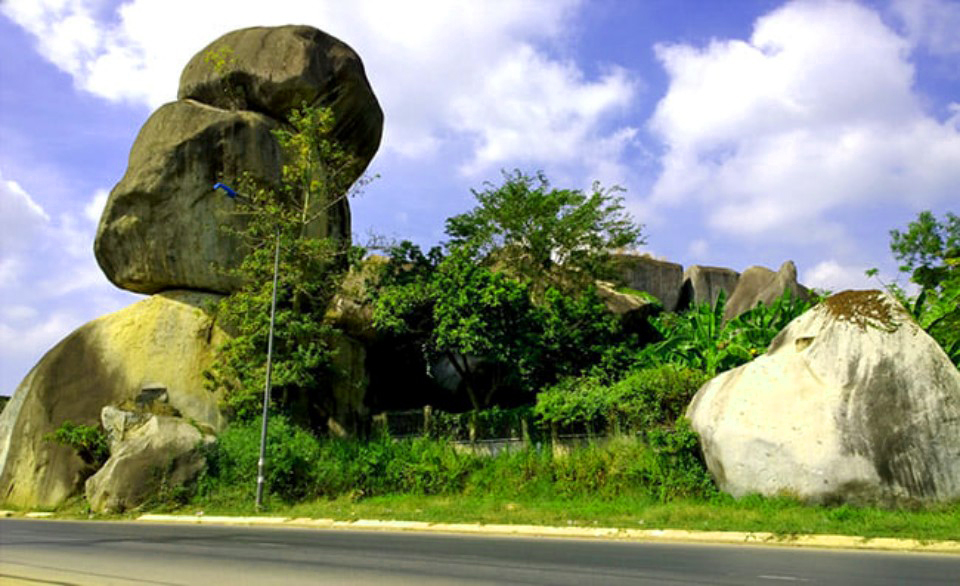
From water to stone, Dong Nai’s landscapes shift abruptly. Da Ba Chong, or the Three Stacked Rocks, rises unexpectedly amid the bustle of Dinh Quan on the road toward Da Lat. Three enormous boulders balance in improbable formation, reaching thirty six meters into the air. The bottom rock dwarfs the two above it. The top stone leans outward, defiant, as if daring gravity to intervene. It is unsettling. It is mesmerizing. Travelers slow instinctively, pulled by the quiet tension of natural architecture that feels deliberately dramatic.
Nearby, Bach Tuong Mountain, also known as Elephant Mountain, adds another layer to the experience. Its silhouette resembles two elephants kneeling in solemn attention. At its summit stands a statue of the Buddha, surveying the landscape with composed indifference. Below, Bach Ho Cave opens into darkness marked by mystery. Together, the rocks and caves form a compact complex that invites wandering, speculation, and silence.
Closer to Bien Hoa City, Buu Long Tourist Area offers a gentler interpretation of grandeur. Built around the expansive Long An Lake, this landscape feels like a miniature echo of Ha Long Bay. Jagged limestone formations rise from calm green water, their reflections blurring reality and illusion. Mountains and lake coexist in balanced proportion, softened by religious architecture that hints at multiple eras and beliefs.
Long An Lake becomes the emotional center of Buu Long. Walking its edges calms the nervous system. Small boats drift. Stone paths lead to unexpected viewpoints. Nearby, Buu Long Mountain shelters Buu Phong Pagoda, an ancient temple partially hidden behind a venerable bodhi tree. Visiting after an afternoon of exploration feels natural. You step inside not seeking answers, only equilibrium. Buu Long works because it allows leisure without emptiness, beauty without noise.
If water is the recurring theme in Dong Nai, Giang Dien Waterfall is its most expressive statement. Located just twenty kilometers from Ho Chi Minh City, this ecological tourism area feels improbably lush given its accessibility. Vegetation thickens as you approach. The sound arrives before the sight, a low, persistent rush. White water spills over rock shelves, breaking into spray that cools the air and mood alike.
Giang Dien is designed for day escapes that do not feel abbreviated. Picnic grounds open onto riverside lawns. Trails wander through dense greenery. Deeper inside lies Ky Cuc Farm, an imaginative garden shaped to resemble untamed wilderness. Hidden within this unexpected setting stands a Roman inspired palace, surreal and strangely fitting. It is the kind of detail that lingers in memory, proof that Dong Nai allows eccentricity to coexist with nature.
For travelers craving immersion rather than respite, Cat Tien National Park delivers scale and significance. Spanning more than 74300 hectares, Cat Tien is a UNESCO recognized biosphere reserve and one of Vietnam’s most important ecological sanctuaries. Forest here is not ornamental. It is dominant. Trails pass through towering trees and thick undergrowth where sound behaves differently, muffled, reverent.
Tour routes vary in intensity and intent. Some follow Ben Cu Rapids. Others lead to Mo Vet Waterfall or the dramatic Heaven and Dung Waterfalls. Cultural sites reveal traces of ancient civilizations. Botanical gardens catalog biodiversity with scientific care. Night wildlife tours introduce glowing eyes and cautious movements, reminding visitors that humans are guests here.
Transportation within the park becomes part of the experience. Walking invites intimacy. Cycling encourages rhythm. Vehicles offer reach. River cruises add poetry. The forest responds differently to each. Bird calls shift. Light filters unevenly. Time stretches. Cat Tien does not entertain. It absorbs.
Further north, deeper into Dong Nai’s wilder reaches, Mai Waterfall waits patiently. Nearly two kilometers wide, formed by countless streams and rivulets, Mai Waterfall feels less like a single cascade and more like a dispersed conversation between water and rock. Located far from urban influence, it remains refreshingly unaltered. No artificial platforms. No excessive signage. Just water moving freely through forest terrain.
Seasonal changes transform Mai Waterfall dramatically. When flowers bloom, wild orchids, yellow apricot blossoms, and narcissus line the streams, splashing color against stone and water. The scene feels almost excessive in its generosity, as if nature briefly overindulges. Travelers who make the journey during this period often struggle to describe it afterward. Words fall short.
Dong Nai does not sell fantasy. It offers reality, textured and varied. Rivers that remember villages. Rocks that defy balance. Lakes that mirror quiet thought. Forests that insist on respect. Waterfalls that speak in long sentences. For travelers weary of curated perfection, Dong Nai feels like permission. Permission to go now. To leave the city behind. To rediscover how travel is supposed to feel.
Dong Nai travel guide, Dong Nai eco tourism, Dong Nai weekend trip, Dong Nai nature attractions, Dong Nai river tour, Dong Nai waterfalls, Giang Dien Waterfall tour, Cat Tien National Park travel, Buu Long tourist area, Dong Nai adventure travel, Southern Vietnam nature tour, Dong Nai picnic destinations, Dong Nai forest trekking, Dong Nai hidden gems, Vietnam off the beaten path
