
Planning a Trip to Fenghuang Ancient Town – Bridges, Stilt Houses, and the Tuojiang River
Quick Summary – Fenghuang Ancient Town Travel Guide
| Category | Information |
|---|---|
| Destination | Fenghuang Ancient Town |
| Location | Fenghuang County, Hunan Province, China |
| Built | 686 (Tang Dynasty) |
| Key River | Tuojiang River |
| Cultural Groups | Han, Miao, Tujia |
| Famous Landmark | Hongqiao Bridge |
| Architectural Style | Qing dynasty wooden houses on stilts |
| Length of Riverside Area | About 5 km |
| Historical Role | Military and administrative center during Ming–Qing |
| Atmosphere | Historic town with active daily local life |
Introduction – A Riverside Town That Refuses to Hurry
In a province that has modernized rapidly, Fenghuang Ancient Town moves to a slower rhythm.
Founded in 686 during the Tang Dynasty, the town sits quietly along the Tuojiang River, its wooden houses leaning slightly toward the water as if listening to the current. While cities across Hunan Province expand with glass towers and highways, Fenghuang preserves something older: a layered historical landscape shaped by architecture, geography, and everyday human routines.
From a travel planning perspective, Fenghuang is not simply a “scenic town.” It is a place where military history, ethnic culture, and vernacular architecture intersect.
Visitors arrive expecting a picturesque Chinese old town. What they often find instead is a living community that still treats the river as part of daily life.
A Town Built With Strategic Vision
When Fenghuang was first established in the Tang Dynasty, it functioned as more than a settlement. The location was chosen with deliberate foresight.
The town sits at a natural defensive position along the river valley, surrounded by mountains. That geography helped it grow into a political and military center during the Ming and Qing dynasties (1368–1911).
At the time, the imperial government stationed soldiers here to control uprisings from surrounding ethnic groups, particularly the Miao people.
Evidence of this period still survives today.
The southern city wall, built during the Ming Dynasty between 1573 and 1620, remains as a physical reminder of Fenghuang’s strategic past.
For travel planners, this matters. It explains why Fenghuang’s streets feel different from purely commercialized historic towns. The layout follows the logic of defense, trade routes, and river access, not tourism design.
Architecture – Where Qing Dynasty Craftsmanship Still Defines the Skyline
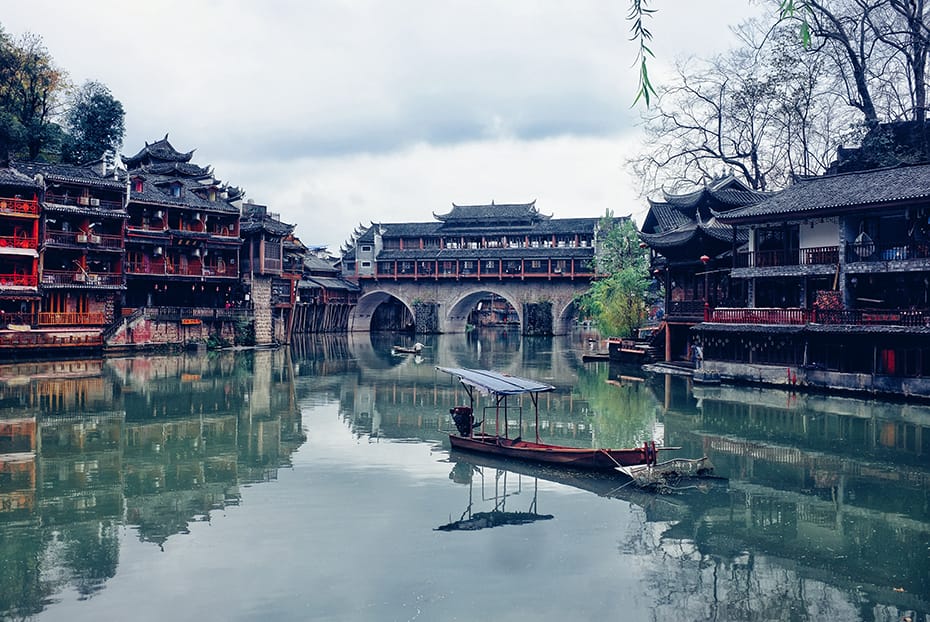
Fenghuang’s most recognizable feature is its line of wooden houses built on tall stilts along the riverbank.
These structures, often raised 5 to 7 meters above the water, are known locally as diaojiaolou stilt houses.
They were largely developed during the Qing Dynasty (1644–1911) by the Han and Miao communities living in the area.
Their design is both practical and aesthetic:
-
Elevated wooden foundations protect homes from flooding
-
Narrow balconies overlook the river
-
Grey “yin-yang” tiled roofs create rhythmic lines across the skyline
Seen from a distance, the rooftops form an almost endless pattern of curved tiles layered like scales.
Many travelers compare the view to a traditional Chinese ink painting. Yet the buildings are not staged scenery. Families still live inside them.
From a planning perspective, this architectural continuity is what makes Fenghuang unusual. The town is not simply preserved—it remains inhabited.
Hongqiao Bridge – The Architectural Centerpiece
Among the many bridges crossing the Tuojiang River, the most iconic is Hongqiao Bridge.
Unlike ordinary stone bridges, Hongqiao features a covered corridor structure, with traditional wooden roofing that protects pedestrians from rain and sun.
Its design reflects the regional architectural style sometimes described as the “Phoenix style”, which emphasizes symmetry, layered roofs, and decorative carvings.
Standing on one side of Hongqiao and looking across the river, visitors see the classic Fenghuang panorama:
-
Rows of stilt houses
-
Deep, narrow alleys
-
Grey rooftops with decorative relief sculptures
The view feels less like a tourist attraction and more like stepping into a centuries-old landscape.
The River That Shapes Daily Life
The Tuojiang River is shallow and clear enough that its bottom vegetation—algae and moss—gives the water a soft green tone.
From above, the river appears like a ribbon weaving through the town.
But the river is not just scenery.
It remains an integral part of daily routines.
Despite modern conveniences such as washing machines and bathrooms inside their homes, many residents still maintain older habits:
-
washing vegetables by the river
-
rinsing clothes in the water
-
bathing in the river during early mornings or late afternoons
This combination of modern life and traditional habits creates an atmosphere that feels authentic rather than staged.
For planners, it also means visitors should approach the town with cultural awareness. What may look like a picturesque scene is actually part of someone’s everyday life.
Walking the Stone Streets – Markets and Craft Traditions
Running parallel to the river are narrow streets paved with green stone.
These streets host small shops selling traditional products tied to local ethnic cultures.
Common items include:
-
rice wine jars associated with Han traditions
-
silver jewelry made by Miao artisans
-
decorative lanterns produced by Tujia people craftsmen
The markets are lively throughout the day, but they retain a distinctly local character.
Unlike large commercial tourist markets, many shopkeepers are residents whose families have lived in Fenghuang for generations.
For visitors interested in cultural craft traditions, these streets offer a compact introduction to the region’s ethnic diversity.
Fenghuang After Dark – When the River Turns to Light
If the town feels calm during the day, night brings a transformation.
Lanterns illuminate the riverside buildings. Their reflections ripple across the surface of the Tuojiang River.
The result is an almost theatrical atmosphere.
Hongqiao Bridge becomes particularly striking at night, when its roofline glows against the dark sky.
Along the riverbanks, vendors sell floating candle lanterns—small lights placed on the water that drift slowly downstream.
Seen from above, the scene resembles a stream of moving stars.
This nightly ritual has become one of Fenghuang’s most photographed moments.
Things the Media Doesn’t Tell You
Many travel videos present Fenghuang as a quiet fairy-tale town.
Reality is more nuanced.
1. The town is active, not frozen in time
Fenghuang is a functioning community. Residents commute, work, cook, and wash along the river.
Expect everyday noise and movement.
2. Tourism has grown rapidly
While the architecture remains historic, visitor numbers have increased significantly in recent years.
Peak seasons can feel crowded, particularly near the bridges.
3. The town’s beauty depends on perspective
Photos often focus on the riverside stilt houses. Walk a few streets inland and you’ll encounter more ordinary residential neighborhoods.
For planners, this contrast is part of Fenghuang’s charm. It reminds visitors that the town is not a museum.
Community Insight
Travel discussions on Chinese travel forums often highlight the same observation.
“The best moment in Fenghuang is early morning, before the tour groups arrive. The river is quiet and the stilt houses feel almost timeless.”
This comment appears repeatedly across travel communities and vlog reviews.
The takeaway is simple: timing shapes the experience.
Planner’s Recommendations
Instead of rushing through Fenghuang in a single afternoon, a thoughtful itinerary might include:
Morning walk along the river before shops open
Midday exploration of the historic bridges and stone streets
Late afternoon observation of daily life along the water
Evening return to the riverbanks when lanterns illuminate the town
This approach reveals the full rhythm of the town, rather than only its most photographed angles.
Final Perspective
Fenghuang Ancient Town is often marketed as a picturesque destination.
Yet its deeper appeal lies in the intersection of history, architecture, and everyday life.
A settlement founded in the Tang Dynasty continues to function today much as it has for centuries: houses leaning over the river, markets selling handmade goods, and residents using the water as part of daily routines.
For travelers—and planners—the experience is not just about seeing old buildings.
It is about observing how a town 1,300 years old continues to live with its past rather than simply display it.
A Travel Planner’s Guide to Fenghuang Ancient Town and the Tuojiang River Landscape.
Fenghuang Ancient Town, Fenghuang China travel, Tuojiang River town, Hongqiao Bridge Fenghuang, Hunan ancient town, Fenghuang architecture, Qing dynasty houses, China historic towns, Fenghuang travel guide, Chinese stilt houses, Hunan cultural sites, Fenghuang night lanterns, Miao culture China, Tujia traditions China, Fenghuang river town
