
Himalayan adventure tour, inside the enduring mystique of Tibet
There are destinations you research. There are destinations you book. And then there is Tibet, which does neither. Tibet waits. It watches. It allows you in only when you have quietly agreed to change. High on the Himalayan plateau, wrapped in snow and thin air, Tibet exists at a frequency that unsettles modern habits. Time behaves differently. Thought slows. Even desire recalibrates.
For many travelers, the threshold is Lhasa. Reaching it by the legendary Beijing to Lhasa railway is not merely transportation, but initiation. The journey stretches across vastness, crossing grasslands, deserts, frozen rivers, and skies that seem too close for comfort. People say the route resembles a lifetime. There are moments of delight, frustration, intimacy, silence. When the train finally exhales into Lhasa, you arrive altered, though you may not yet know how.
Lhasa, translated locally as the Land of the Goats, carries a creation myth as earthy as it is poetic. The city was built, according to legend, upon soil carried here by goats. Whether myth or metaphor, the idea fits. Lhasa feels assembled deliberately, layer by layer, belief by belief. It is not a city that sprawls. It gathers.
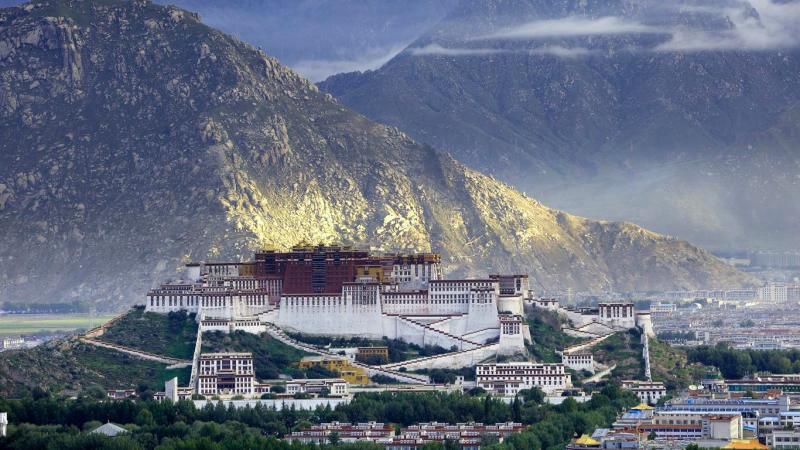
Above everything rises Potala Palace. Even before you see it clearly, you feel its presence. Built atop Marpo Ri hill, Potala does not sit on the landscape. It asserts itself as landscape. Thirteen stories high, white and red walls climbing skyward, the palace resembles a mountain sculpted by devotion rather than geology. Once the winter residence of the Dalai Lamas, Potala remains a symbol of spiritual authority and architectural audacity. Approaching it on foot, lungs working harder with each step, you understand that reverence here is physical.
Inside, corridors darken. Altars glow faintly. Murals whisper history. The palace is less about grandeur than gravity. You move slowly, partly from altitude, partly from instinct. Potala demands attention without asking for it.
Nearby, Jokhang Temple anchors Lhasa’s spiritual life with quieter insistence. Recognized as a World Heritage site, Jokhang is not impressive in scale compared to Potala, yet it eclipses it in human energy. Pilgrims arrive constantly. Some walk. Some prostrate themselves fully, bodies meeting stone, rising, advancing, repeating. Prayer wheels spin. Incense thickens the air. Faith here is not symbolic. It is practiced relentlessly.
Drepung Monastery expands the notion of religious architecture even further. Once home to thousands of monks, it functions less like a monastery and more like a self contained town. Paths weave between halls, courtyards, residences. Learning was once relentless here. Debate courtyards still echo with disciplined argument, claps punctuating philosophical exchange. Drepung reminds visitors that Tibetan Buddhism values inquiry alongside devotion.
Outside Lhasa, Tibet opens into scale that defies comprehension. The plateau stretches in every direction, swept by wind and shadow. Grasslands ripple beneath skies too vast to ignore. Mountains rise abruptly, serrated, unapologetic. This is not decorative nature. It is dominant.
Namtso Lake emerges suddenly from this immensity. Sacred and severe, it lies beneath the Nyenchen Tanglha range, whose snowbound peaks climb toward seven thousand meters. Namtso feels less like a lake than an inland sea. The water glows deep blue, almost metallic, reflecting glaciers and sky with unsettling clarity. The horizon bends. Silence amplifies.
Local legend speaks of strange creatures inhabiting Namtso’s depths. Whether believed or not, the mythology suits the setting. The lake resists familiarity. Pilgrims still circle its frozen surface in winter, crossing ice to reach small islands where they remain for months, waiting out seasons in devotion. Watching this, you realize Tibet’s spirituality is not metaphorical. It is logistical.
Travel in Tibet is inseparable from physical adjustment. Altitude demands respect. Acclimatization is not optional. Professional tour operators structure itineraries carefully, pacing ascent, incorporating rest, hydration, oxygen access. Quality hotels in Lhasa and beyond understand this intimately. Rooms are often equipped with oxygen systems. Heating is constant. Design blends Tibetan motifs with modern restraint. Staff are trained not just in hospitality but in care.
Staying in Tibet is not about indulgence. It is about support. Good hotels offer quiet, clean air filtration, nourishing cuisine adapted to altitude, and locations that reduce unnecessary exertion. Many overlook monasteries or valleys, allowing contemplation without effort. These are not luxuries. They are essential benefits that make deep travel possible.
Food here is functional and symbolic. Butter tea fortifies. Tsampa sustains. Meals are warm, deliberate, designed for climate rather than fashion. Dining becomes grounding. You eat to continue, not to distract.
The people of Tibet move with a calm shaped by environment. You see prayer beads everywhere. In hands. On wrists. On dashboards. Devotion here is not reserved for temples. It spills into streets, markets, doorways. Pilgrims appear along roads, sometimes poorly dressed, advancing toward sacred sites through prostration. Their journeys recall legendary pilgrimages of Buddhist history, covering thousands of kilometers with nothing but belief for propulsion.
Tibet’s appeal is not comfort. It is clarity. The land strips away excess. The air thins thought until only essential questions remain. Why am I here. What do I believe. What do I carry.
Nature reinforces this interrogation. Winds howl across passes. Yaks graze with prehistoric patience. Clouds cast moving shadows over plains that appear infinite. Photography feels inadequate. Memory struggles to keep up.
Yet travelers continue to come. Not for entertainment. For alignment. Tibet offers something increasingly rare in global travel. Resistance. It resists consumption. It resists speed. It resists shallow engagement. In doing so, it offers depth.
Professional Tibet tours understand this responsibility. They are curated not to conquer distance but to interpret it. Guides explain ritual, history, etiquette. They manage permits, logistics, safety. They allow visitors to encounter Tibet without violating it. This is travel as stewardship.
You leave Tibet quieter than you arrived. Not because there is nothing to say, but because there is more to consider. The mountains do not follow you home. The altitude recedes. But the sensation lingers. A thinness. A clarity. A persistent desire to return.
Tibet travel guide, Lhasa cultural tour, Tibet spiritual journey, Potala Palace visit, Jokhang Temple pilgrimage, Drepung Monastery tour, Namtso Lake travel, Himalaya plateau adventure, Tibet railway experience, Tibet high altitude travel, Tibet monastery tour, sacred lakes Tibet, Tibet luxury hotels, Tibet pilgrimage routes, roof of the world travel
