Vietnam stretches like a dragon from north to south, its spine formed not by highways or cities, but by mountains. These peaks are not merely elevations on a map. They are witnesses. They have seen kingdoms rise, wars grind past, pilgrims climb in silence, lovers carve promises into stone. To travel Vietnam without touching its mountains is to read the first chapter of a book and stop halfway through the sentence.
This is a journey upward. Sometimes slowly. Sometimes with lungs burning and legs protesting. Always rewarding.
Mount Fansipan, Lao Cai Province
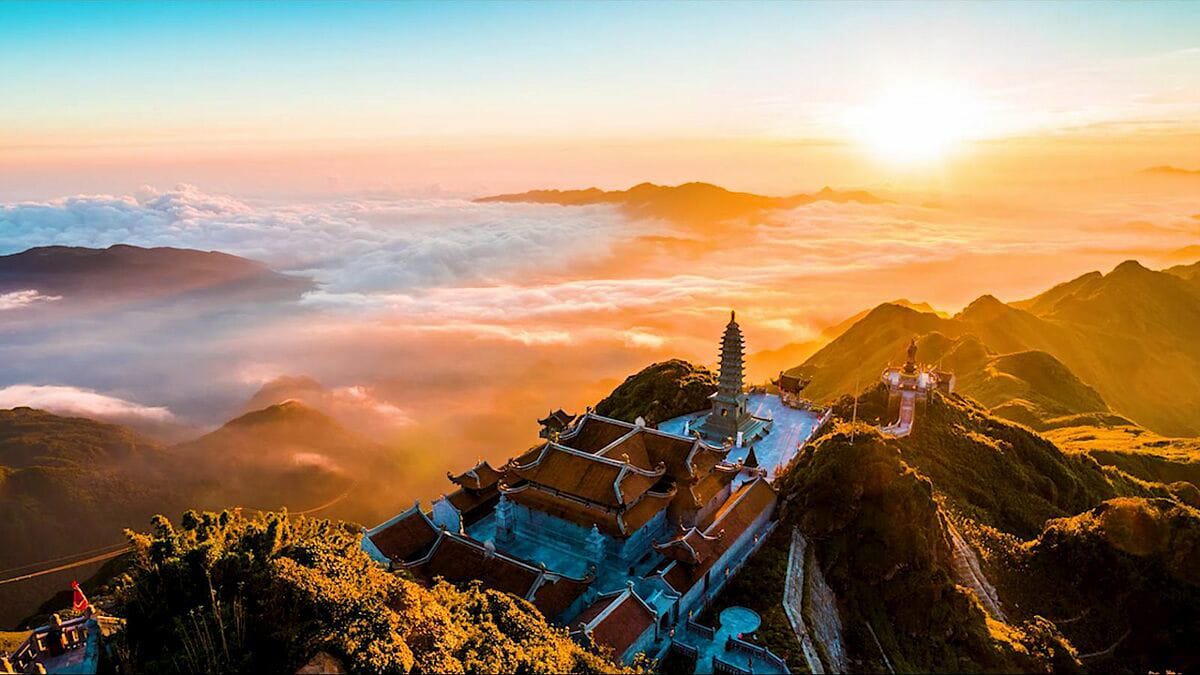
Fansipan rises from the Hoang Lien Son range like a deliberate challenge. At 3,143 meters, it is the highest point in Indochina, often called the Roof of Indochina, though that phrase does not quite capture the experience of standing there. You do not feel above the world. You feel folded into it.
The classic trek begins near Cat Cat Village, a route many hikers still choose for its gradual immersion into landscape and culture. Four days. Three nights. Forests shift beneath your boots. At lower altitudes, jackfruit trees, cardamom plants, and wild gingers scent the air. Higher up, primary forest takes over. Vines knot together like old arguments. Moss softens every surface. Past 2,000 meters, clouds begin to move horizontally, brushing your face, erasing distance.
Then something changes. Climb another few hundred meters and the sky clears, as if granting permission. The temperature drops. The wind sharpens. Near the summit, a steel marker recalls early explorers, including a French ascent in 1905 and a stainless steel pyramid left by Russian and German climbers in 1984. Today, a cable car offers an easier ascent, but the old trails remain for those who want the mountain to introduce itself properly.
Sapa is the natural base, with hotels ranging from simple lodges to refined retreats offering heated rooms, mountain views, early breakfasts, and guides who know when to speak and when to let silence do the work.
Hong Linh Mountains, Ha Tinh Province
If Fansipan is physical drama, Hong Linh is poetry. This range of ninety nine peaks rises quietly beside the Lam River, its presence stitched deeply into Vietnamese memory. Songs have been written about it. Wars have passed beneath it. It remains.
Hong Linh is less about conquest than contemplation. Hundreds of temples, pagodas, and shrines dot the slopes, each carrying a story. Huong Tich Pagoda is the most revered, reached by paths that wind through forest and legend. There are rocks here said to bear the imprint of celestial visitors, hoof marks frozen in stone. Whether you believe the stories is irrelevant. The mountains believe them for you.
Travel here is gentle. Trails are forgiving. Locals greet visitors with curiosity rather than commerce. Ha Tinh town offers modest but comfortable hotels, often family run, where evenings are quiet and mornings begin with strong coffee and local conversation.
Bach Ma Mountain, Thua Thien Hue Province
Bach Ma stands south of Hue, rising to over 1,500 meters and creating its own weather. In winter, temperatures rarely fall below four degrees Celsius. In summer, they rarely exceed twenty six. This climatic grace once attracted French colonists, who built villas whose ruins still peer through the forest like forgotten witnesses.
Bach Ma National Park is lush beyond expectation. Waterfalls spill from hidden heights. Rare plants cling to ravines. Trails have names that feel like invitations. The Five Lakes trail leads through a sequence of natural pools, each quieter than the last. The Rhododendron Trail explodes with color in March and April, when entire hillsides seem to blush. The Hai Vong Dai trail climbs to a viewpoint where mountains roll toward the East Sea in long, patient waves.
Hue provides the perfect counterpoint. After a day on the mountain, return to the city’s elegant calm. Hotels here understand rest. Good beds. Courtyards. Breakfasts that linger.
Langbiang Mountain, Lam Dong Province
Just north of Da Lat, Langbiang rises to 2,163 meters, a mountain shaped as much by legend as by geology. The story of Lang and Biang, star crossed lovers turned into peaks, still circulates among guides and grandparents alike.
Langbiang is accessible, yet expansive. You can hike. You can drive partway. You can paraglide if courage outweighs caution. From the summit, the Dankia Lake glints below, its streams looping gently around the mountain’s feet. Pine forests stretch outward. Houses appear and disappear between trees, as if shy.
This is a place for both action and observation. Birdwatchers come with notebooks. Botanists with patience. Couples with cameras and shared silences. Da Lat’s hotels, from colonial era properties to modern hideaways, offer fireplaces, balconies, and that peculiar mountain air that makes sleep deeper.
Chua Chan Mountain, Dong Nai Province
Chua Chan Mountain, also known as Gia Ray Mountain, rises to 837 meters, making it the second highest peak in southeastern Vietnam. It does not dominate the skyline. It invites you in.
From a distance, the mountain resembles an inverted bowl, often capped with small, drifting clouds at dawn and dusk. The ascent is manageable, popular with weekend hikers from Ho Chi Minh City. Yet the reward feels disproportionate to the effort.
At the summit sits Buu Quang Pagoda, established in the early twentieth century, its main hall nestled within a cave shaped like a dragon’s mouth. The architecture follows the mountain’s contours, creating a sense of humility rather than conquest. Nearby stands an ancient banyan tree, formed from three merged trunks, rising fifty meters and surrounded by whispered stories.
Accommodation nearby is simple but sufficient. Many travelers choose to return to the city the same day. Others stay, letting the mountain’s calm extend into evening.
Why These Mountains Matter
These peaks are not isolated experiences. They connect to each other, to cities, to villages, to the rhythm of Vietnam itself. Tours linking Fansipan with Sapa markets, Langbiang with Da Lat coffee culture, Bach Ma with Hue’s imperial heritage create journeys that feel complete rather than rushed.
Hotels play a quiet but crucial role. Early breakfasts. Packed lunches. Gear storage. Local guides. Fair pricing. Discounts for longer stays. These details matter when your day begins before sunrise and ends with tired legs and a full heart.
I once stood on Langbiang as clouds lifted briefly, revealing Da Lat below. A guide beside me said nothing. He did not need to. The mountain had already spoken.
Vietnam’s mountains are ready. Go now. They do not wait forever.
Vietnam mountain travel, Fansipan trekking tour, highest mountains Vietnam, Langbiang Mountain Da Lat travel, Bach Ma National Park tour, Hong Linh Mountains Ha Tinh, Chua Chan Mountain hiking, Vietnam adventure travel, mountain tours Vietnam, Vietnam peak climbing, Vietnam nature exploration, travel Vietnam mountains, best mountains in Vietnam, Vietnam hiking destinations, Vietnam eco adventure