
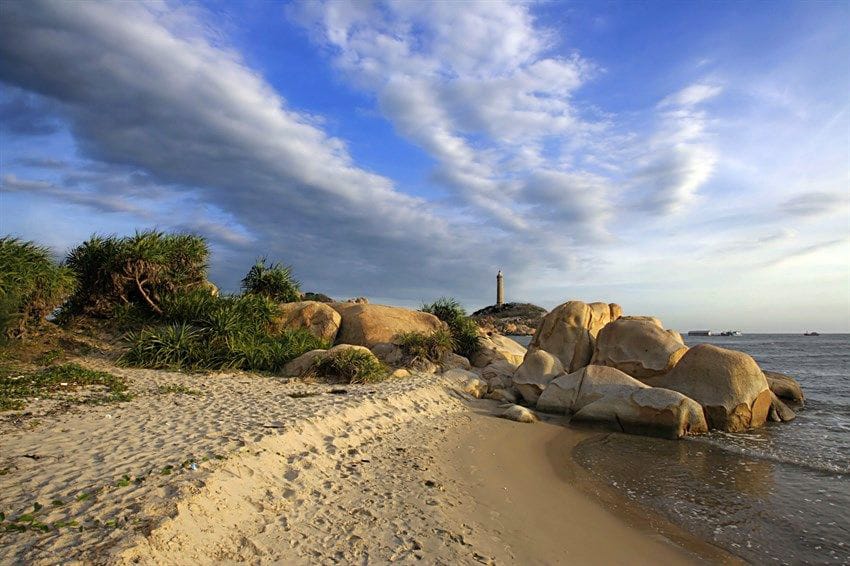
Vietnam’s coastline is famously generous. It offers beaches with loungers and cocktails, bays choreographed for postcards, islands polished by promotion. But if you drive a little farther, listen a little harder, and accept roads that narrow into uncertainty, another Vietnam reveals itself. This is the country of rock shelves and tidal scars, of granite sculpted by centuries of insistence. These are places where the sea has done the architecture and left before tourism could catch up.
Rocky headlands are not designed for comfort. They are made for contemplation. They demand balance, patience, respect. And they reward those qualities with something increasingly rare in modern travel. Solitude.
Binh Chau Rock Coast sits quietly along the coastal road leading from Ba To toward the Binh Chau Hot Springs in southern Vietnam. This is a stretch of shoreline that developers have noticed but not yet mastered. Resorts and casinos rise nearby, but the rocks themselves remain stubbornly untamed. Massive stone blocks push out of deep blue water, framed by wide sweeps of soft yellow sand. The contrast is arresting. Stone and silk. Weight and light.
Standing here, you feel the sea’s authority. Waves arrive with force, folding themselves around the rocks before retreating. Swimming is prohibited for good reason. The water drops quickly, currents pull without warning, and the rocks are unforgiving. Yet people come anyway, not to swim, but to stand. To balance on a stone ledge and let the spray catch their legs. To talk in lowered voices. To photograph nothing in particular and everything at once.
This is not a beach for sunbathing. It is a place for watching. For understanding why the coast once frightened sailors and inspired poets. Nearby hotels in the Vung Tau region offer a useful contrast, soft beds, thermal pools, polished breakfasts. The benefit of staying close is simple. You can return to the rocks early, before the light hardens and before anyone else thinks to come.
Farther north, in Binh Dinh Province, Lo Dieu Rock Coast feels almost ceremonial. Seen from above, the bay curves like a drawn bow, mountains behind it, sea ahead, farmland breathing quietly in between. From a distance, the rocks appear arranged, as if placed deliberately to frame the golden sand of Bang Bang Beach. Up close, they tell a different story. They are irregular, patient, full of suggestion.
The most striking formation is Hon Trong, a rock shaped uncannily like a woman holding a child, gazing out to sea. Locals will tell you it represents a wife waiting for her husband’s fishing boat to return. Whether or not you believe the legend hardly matters. The shape lodges in your mind. It humanizes the coast.
Travel here is slow and deliberate. A motorbike ride from Bong Son Bridge, along the coastal DT639 road, then over a narrow mountain pass clinging to rock and sky. When you arrive, there are no ticket booths. No slogans. Just fishermen mending nets and the sound of water folding itself against stone.
Nearby stands the Whale Temple, where the bones of five whales rest, honored by generations of fishermen. Food here is not optional. It is part of the visit. Fried termites with scallion oil appear in July, unexpectedly delicate. Tamarind crab, or crab cooked into a sour noodle soup, tastes of tide and smoke. Local guesthouses offer simple rooms and sincere hospitality. You sleep deeply. The sea works on you all night.
Hon La Island in Quang Binh is not officially a tourist destination, which may be its greatest qualification. Its rocky shorelines are known mainly to serious sea anglers who arrive with patience and equipment. The rock formations are limestone, carved by wave and wind into shapes that resist naming. Some lie flat, barely breaking the surface. Others rise abruptly, jagged and theatrical, like submerged creatures pausing mid ascent.
The water here is deep. Immediately deep. In places, it drops from five meters to dozens, then into channels hundreds of meters down. Currents run fast, especially through the narrow strait separating the island’s twin masses. Swimming is dangerous and discouraged. This is a place for watching the water rather than entering it.
There is something bracing about such honesty. Hon La does not pretend to be safe or accessible. It asks you to keep your distance. And in doing so, it preserves its dignity. Hotels in Quang Binh city provide a comfortable base, offering guided excursions for those who want to visit responsibly. The benefit is clear. You experience something rare without leaving a mark.
Ban Than Rock Coast, in Quang Nam Province, may be the most visually startling of all. Rising forty two meters above the sea, it presents two entirely different personalities depending on where you stand. At Nom Beach, the rocks are dark, sharp, animalistic. They resemble whales, sea monsters, creatures from a myth unfinished. At Bac Beach, the same geological force has smoothed them into rounded forms, seals and turtles basking in stone.
Below the surface lies a coral reef stretching more than ten kilometers. Local divers know it well. So do lobster fishermen and shell collectors who move carefully among the rocks at low tide. The coast here feels alive, not scenic. It participates.
Reaching Ban Than is part of the experience. From Da Nang, you follow Highway 1A to Nui Thanh, then turn toward the sea at the kilometer marker. A ferry crosses to Tam Hai Island, where coconut trees line narrow roads and life proceeds without urgency. The rock coast waits at the edge, indifferent to your arrival.
Accommodation on the island is modest but thoughtful. Small hotels and homestays focus on clean rooms, local meals, and advice rather than amenities. The benefit is immersion. You wake to wind and water rather than air conditioning.
What connects these four rock coasts is not their appearance, though each is memorable. It is their refusal to be simplified. They do not offer easy swimming or curated experiences. They offer perspective. They remind you that Vietnam’s coast is not only about pleasure but about endurance.
A professional Vietnam coastal tour that includes these sites is not about speed. It is about sequencing. Pairing wild mornings with comfortable evenings. Choosing hotels that understand proximity over prestige. Guides who know when to speak and when to step back.
These rock coasts will not stay unknown forever. Roads improve. Photos circulate. But for now, they remain what travel once was. A little inconvenient. Slightly risky. Completely worth it.
You will stand on stone. You will feel small. And you will want to stay longer than planned.
Vietnam hidden beaches, Vietnam rock coast travel, Vietnam coastal adventure, secret Vietnam travel spots, Vietnam nature travel blog, Vietnam off the beaten path, Vietnam rocky shoreline, coastal Vietnam tour, Vietnam adventure travel, Vietnam seaside destinations, Vietnam travel experience, Vietnam nature tour, Vietnam unexplored coast, Vietnam scenic coastline, Vietnam travel guide
