
Maldives Is Calling. A Journey Into The World’s Most Mesmerizing Island Maze
You do not simply visit the Maldives. You drift into it.
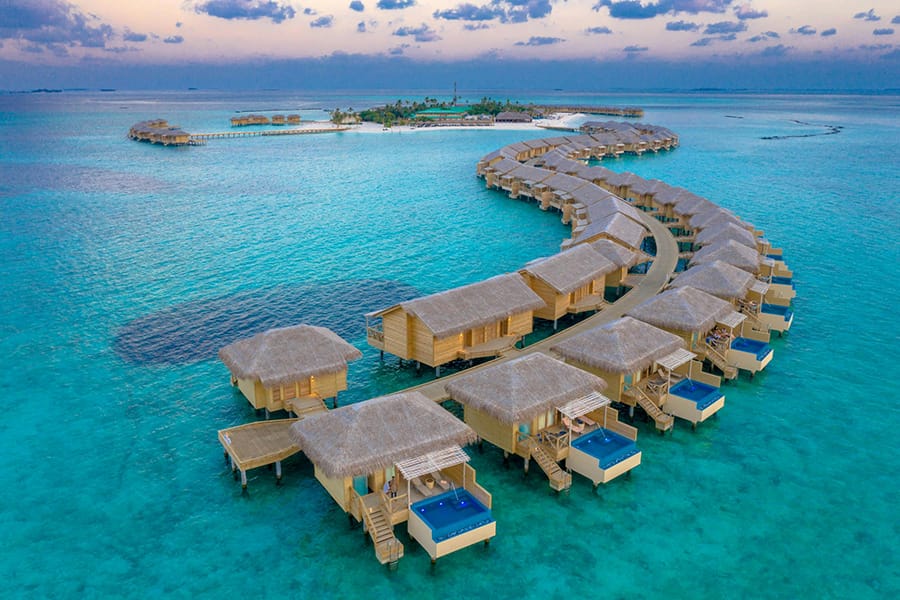
From above, the atolls look like scattered emerald beads tossed across a sheet of blue silk. From the ground, they feel even more unreal. Coconut palms sway lazily in the wind. Water glows in impossible shades of turquoise. Sand slips through your fingers like powder. And everywhere you turn, there is the quiet understanding that you are standing in one of the lowest, smallest, and most extraordinary nations on Earth.
Welcome to the Maldives — a place often called a “resort paradise,” where many islands are themselves entire resorts, and where nature and design have been carefully shaped into something that feels almost too perfect to be true.
A Nation Barely Above The Sea
The Maldives lies southwest in the Indian Ocean, made up of 1,190 islands scattered across coral atolls. Of those, around 200 are inhabited. The total land area is just about 600 square kilometers. The population hovers around 309,000 people.
In Asia, it is considered the smallest country by both land area and population. And perhaps even more astonishing — most of it rises only about two meters above sea level.
Stand on the beach and you are nearly level with the ocean itself. There are no dramatic cliffs. No towering mountains. Just horizon. Endless horizon. The simplicity is the luxury.
It feels fragile. It feels precious. And maybe that is part of its magic.
From Sandbanks To World-Class Resorts
Few visitors realize how much work went into turning these islands into global icons of leisure. Decades ago, many were little more than sandbanks and coral formations. Over nearly 40 years, careful land shaping and thoughtful development transformed them into some of the most beautiful resort destinations in the world.
This wasn’t accidental. It was vision, patience, and meticulous design.
Resorts were built to blend with the environment — villas perched above the lagoon, pathways winding under palm trees, lights that glow softly at night like fallen stars. The goal was not to conquer nature but to cooperate with it.
Today, millions of travelers arrive every year. They come seeking stillness, romance, adventure, or simply a pause from their crowded cities in Europe, the United States, and beyond. They leave with something else entirely — a quiet astonishment at how seamless the experience feels.
Service here is often described as nearly flawless. You sense it in small gestures. A drink appears before you realize you are thirsty. A boat is waiting just as you step onto the jetty. A smile that feels genuine, not rehearsed.
Yes, a holiday here requires commitment. But when you depart, you rarely feel regret. You feel gratitude.
Four Seasons Guided By The Wind
Unlike the rigid seasonal changes of Europe or North America, life in the Maldives moves with the wind. The year divides into four subtle seasons, each with its own character. The transitions are short, almost whispered, rather than announced.
Summer. January To March
Summer begins in January and lasts until March. The skies are bright, the rainfall minimal, the sun generous but softened by a cool sea breeze. Locals sometimes say that when dragonflies appear gliding overhead, summer has arrived.
This is the season of love stories.
Couples from around the world arrive for honeymoons or destination weddings. With blue skies above and water so clear it looks filtered, ceremonies unfold barefoot on the sand. Sunsets linger. Nights are warm and calm. It is easy to understand why so many begin their marriages here.
The atmosphere is festive but never crowded. Space is abundant. Silence is respected.
Autumn Heat. April To May
Then comes autumn, stretching from April into May. Oddly enough, this is often the hottest time of year. Travelers frequently ask, “Why is autumn hotter than summer?” The answer is simple and almost playful — because that is how the Maldives likes it.
The sea breeze still blows, but the air holds more warmth. The light becomes sharper. For photographers, this is a dream. Colors intensify. Shadows lengthen. The ocean reflects the sky in high definition.
Travel magazines love this season. It offers drama. Texture. Contrast.
You may find yourself waking early just to watch the first light spill over the lagoon.
Winter Rains. June To October
From June to October comes the longest season — winter, driven by strong southwest winds. This is also the rainy period. It can feel as though the pent-up heat of autumn releases itself in dramatic showers.
But rain here is rarely a nuisance. It is theatrical. Sudden downpours followed by silver skies and glowing sunsets.
And for those who crave activity, this is prime time. Sea levels are at their lowest. Waves are gentle but consistent. It is an ideal period for diving and surfing.
Slip beneath the surface and you enter another universe — coral gardens, darting fish, shafts of sunlight cutting through blue water. For surfers, the swells offer smooth, satisfying rides without overwhelming chaos.
Winter in the Maldives is not about retreating indoors. It is about engaging with the sea on its own terms.
Spring Renewal. November To December
After the long winter rains, spring arrives in November and December. The skies clear again. Breezes soften. The islands breathe.
It is also mango harvest season. Gardens fill with golden fruit hanging like lanterns among green leaves. There is something deeply satisfying about tasting mango grown just steps from the ocean.
The mood shifts. Lighter. Fresher. The air smells faintly sweet.
You begin to notice how seamlessly daily life flows between land and sea. Fishing boats return in the early morning. Children play near the shoreline. Resort lights begin to glow as dusk settles, sparkling like a constellation along the water’s edge.
A Paradise That Feels Personal
Despite the global attention, the Maldives never feels overwhelming. Because the islands are scattered, guests disperse naturally. You rarely encounter the congestion common in other tropical hotspots.
Each island is its own small world.
One may specialize in romance. Another in diving. Another in family retreats. The result is a kind of gentle “maze” — not confusing, but mesmerizing. You hop from island to island by boat or seaplane, discovering different moods within the same nation.
In the evening, as resort lights shimmer against the dark ocean, the horizon disappears. Sea and sky blend into one. You might sit alone on your deck, listening to nothing but the quiet rhythm of waves.
Time behaves differently here. It slows. It softens.
Why You Should Go Now
There is a subtle urgency to visiting a place like this. With most of the country just two meters above sea level, the Maldives is both resilient and vulnerable. Its beauty feels timeless, yet fragile.
But perhaps that fragility deepens the experience.
You are not simply consuming a destination. You are witnessing a delicate balance between human ambition and natural wonder. Forty years of careful development have shaped islands into sanctuaries without stripping them of soul.
If you crave mountain peaks or urban rush, look elsewhere. But if what you want is horizon, water, light, and a feeling of being gently untethered from the world — this is it.
Millions have already made the journey. They come for honeymoon dreams, underwater adventures, or simply to reset their internal compass. They leave with salt in their hair, sun on their skin, and a memory that feels almost cinematic.
The Maldives does not shout for attention. It whispers.
And once you hear it, you will want to go now.
Maldives island resorts, Maldives travel guide, Indian Ocean paradise, Maldives honeymoon destination, Maldives diving season, Maldives surfing winter, Maldives island seasons, Maldives mango harvest, Maldives atolls, Maldives beach escape, Maldives romantic getaway, Maldives coral islands, Maldives weather guide, Maldives luxury retreat, Maldives island hopping
