
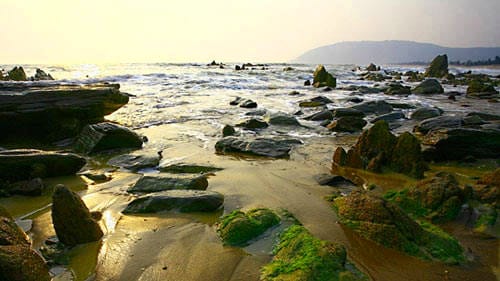
Hoanh Son Beach at the Foot of Ngang Pass A Secret Shore Between Ha Tinh and Quang Binh
There are places that feel like punctuation marks in a journey. Not the grand finale. Not the headline attraction. But a pause — deliberate, contemplative, almost sacred. Hoanh Son Beach is one of those places.
I had planned to end my journey through the north-central provinces at Ngang Pass, the final threshold of Ha Tinh before the land gives way to Quang Binh. For centuries, this pass was more than a road; it was a frontier. Once the boundary between Dai Viet and Champa, it has long carried the weight of separation, defense, and poetry. Travelers passed here not casually but deliberately, aware they were crossing something larger than geography.
And just before ascending that historic spine of rock and wind, I found myself turning off National Highway 1A toward a modest fork in the road. One branch climbed the old mountain pass, a route worn smooth by a thousand years of footsteps and caravans. The other slipped quietly into the Ngang Pass Tunnel, a modern incision through ancient stone. But between those two options — between past and present — lies Hoanh Son Beach.
It is easy to miss. And that is precisely its charm.
At the Edge of History and Sea
Hoanh Son Beach belongs to Ky Nam Commune, Ky Anh District, Ha Tinh Province, less than two kilometers from the foot of Ngang Pass along the north–south highway. Cross over the invisible line and you are in Quang Binh. This is the very edge of Ha Tinh — a geographical afterthought perhaps, but spiritually it feels like the last quiet sentence before a new chapter begins.
Ngang Pass itself crosses the Hoanh Son Range, a spur of the Truong Son Mountains that thrusts dramatically into the East Sea. It has long been considered a strategic stronghold along the ancient north–south route. At the summit stands Hoanh Son Quan, built during the reign of Emperor Minh Mang of the Nguyen Dynasty. The stone gate still stands today, weathered but dignified, its arches framing sky and memory. This is not just infrastructure; it is architecture with intent — defensive, ceremonial, symbolic.
The pass has entered Vietnamese literature and poetry as legend. Even if you do not know the verses, you feel the cadence of them in the wind.
And below that solemn crest, tucked discreetly away, the beach waits.
A Beach Protected by Mountains
Hoanh Son Beach is small. Narrow. Certainly not a vast expanse of commercial tourism like Sam Son in Thanh Hoa or Cua Lo in Nghe An. You will not find sprawling resorts or neon-lit seafood promenades here. Instead, the beach is embraced by mountains, shielded from harsh winds, and blessed with water so clear and green it seems to hold its breath.
The Hoanh Son Range wraps around the shoreline like a natural amphitheater. From the sand, you can see the mountains stretch from the Truong Son chain and run straight out into the East Sea, as if the earth itself were diving headfirst into blue infinity.
Scattered along the shore are stones — some buried deep in sand, others exposed and slick with green moss. When the tide recedes, the rocks emerge like ancient relics. They glisten in the soft afternoon light. The textures are astonishing: coarse granite, velvety algae, the whisper of retreating water.
It feels elemental. Untouched. Authentic.
Here, the vocabulary of the place is simple: stone, sea, mountain, sky.
The Quiet Drama of an Afternoon
In the late afternoon, Hoanh Son Beach becomes almost theatrical in its restraint. The waves soften. The light turns honeyed and melancholic. The sea grows calmer — not sleepy, but reflective.
A solitary boat rests on the sand, its hull tilted slightly, as if pausing between conversations with the ocean. Fishermen appear only as silhouettes, distant and unhurried. There is no urgency here. Life unfolds in small gestures — a net folded, a rope coiled, a glance toward the horizon.
And sometimes, unexpectedly, a small herd of cows wanders across the beach.
You blink. You wonder if it is a mirage. But no — they move slowly, confidently, as if the shoreline belongs to them as much as it does to the tide. This juxtaposition — cattle against sea spray, mountains dissolving into mist behind them — is quietly surreal. It is not staged for visitors. It simply happens.
That is the gift of Hoanh Son Beach: authenticity without performance.
Where Nature Refuses to Be Industrialized
Central Vietnam is known for its dramatic coastline. Yet many beaches have been transformed into large-scale tourism hubs, efficient and impressive but curated. Hoanh Son resists that trajectory.
Its scale prohibits industrial tourism. Its geography discourages excess. The result is an atmosphere that appeals deeply to those who crave exploration rather than consumption.
The beach inherits both the marine climate and the mountain temperament. You feel salt in the air and cool breath descending from forested slopes. Waves crash against rock formations that extend from mountain to sea, reminiscent of the “jumping rock” landscapes found elsewhere along the central coast. But here, they feel more intimate, less photographed, more personal.
This is a destination for travelers who measure experience not by amenities but by sensation.
The sensation of wind shifting direction.
Of standing alone on wet sand as the tide pulls back.
Of hearing nothing but waves and distant livestock bells.
The Ascent to Ngang Pass
And then there is the road upward.
To visit Hoanh Son Beach without ascending Ngang Pass would be like reading only half a poem. The old pass road coils upward in gentle but determined curves. As you climb, the sea recedes into a widening canvas of blue. The air thins. The wind strengthens.
At the summit, Hoanh Son Quan stands sentinel. Its stone arch frames both history and horizon. Built during the Nguyen Dynasty, it once functioned as a military checkpoint. Today it functions as something else entirely: a reminder.
A reminder that borders shift. That empires rise and fade. That mountains endure.
Standing there at dusk, you may recall the lines of the poet Ba Huyen Thanh Quan, who once gazed upon this same pass and wrote of solitude and longing: “A private fragment of feeling, I keep for myself.” The words linger like mist.
Descending the pass as evening approaches is equally powerful. The light dims. The coastline below turns silver. Hoanh Son Beach becomes a quiet shadow, barely visible yet deeply present.
For Those Who Seek the In-Between
Hoanh Son Beach will not shout for your attention. It will not appear on glossy brochures as the centerpiece of a package tour. And that is precisely why you should go.
It sits in the in-between — between provinces, between mountain and sea, between history and modernity. It offers a rare combination of geographic drama and human simplicity.
You come here not for spectacle, but for intimacy.
To feel the Hoanh Son Range plunge into the East Sea.
To watch waves climb stubbornly onto moss-covered rocks.
To witness fishermen returning home beneath a violet sky.
To stand where ancient Dai Viet once met Champa and realize that the only border now is the horizon.
In an age when travel is often about movement, Hoanh Son Beach invites stillness. And in that stillness, something profound happens: you begin to notice.
The texture of sand beneath your feet.
The way mountains soften at dusk.
The quiet dignity of a stone gate built centuries ago.
You realize you are not simply passing through. You are part of the landscape for a moment — a brief, grateful witness.
And when you leave, climbing Ngang Pass or slipping through the tunnel beneath it, you carry with you more than photographs. You carry a mood. A whisper. A sense that you have discovered a secret stretch of coast where Vietnam feels both vast and deeply personal.
If you crave a place where history meets horizon, where mountains lean into the sea, and where silence speaks louder than crowds, then do not rush past that modest fork off National Highway 1A.
Turn.
Hoanh Son Beach is waiting.
From National Highway 1A to Hoanh Son Beach A Hidden Turn Worth Taking
Hoanh Son Beach, Ngang Pass Vietnam, Hoanh Son Range, Ha Tinh coast, Ky Nam Commune, Ky Anh District, Hoanh Son Quan, Minh Mang era, East Sea Vietnam, Central Vietnam beach, hidden Vietnam beach, Truong Son Mountains, Ha Tinh travel guide, Quang Binh border, untouched Vietnam coast
