
Hong Kong is not a city that courts affection gently. It dazzles first, questions later, and somehow persuades you to return before you have fully unpacked at home. This is not a destination defined by untouched wilderness or postcard tranquility. It is a city shaped by ambition, compression, and imagination, a place where human will has been stacked skyward and folded neatly between mountains and sea. Visitors do not come here seeking emptiness. They come for immersion.
Mention Hong Kong to seasoned travelers and their expressions change. They remember light. Movement. Elevation. The feeling of standing somewhere impossibly high while ferries stitch the harbor below. Hotels rise vertically, efficiently, offering not only rooms but observation posts from which to understand the city’s logic. Stay a few nights and the city begins to feel navigable, even intimate, despite its scale.
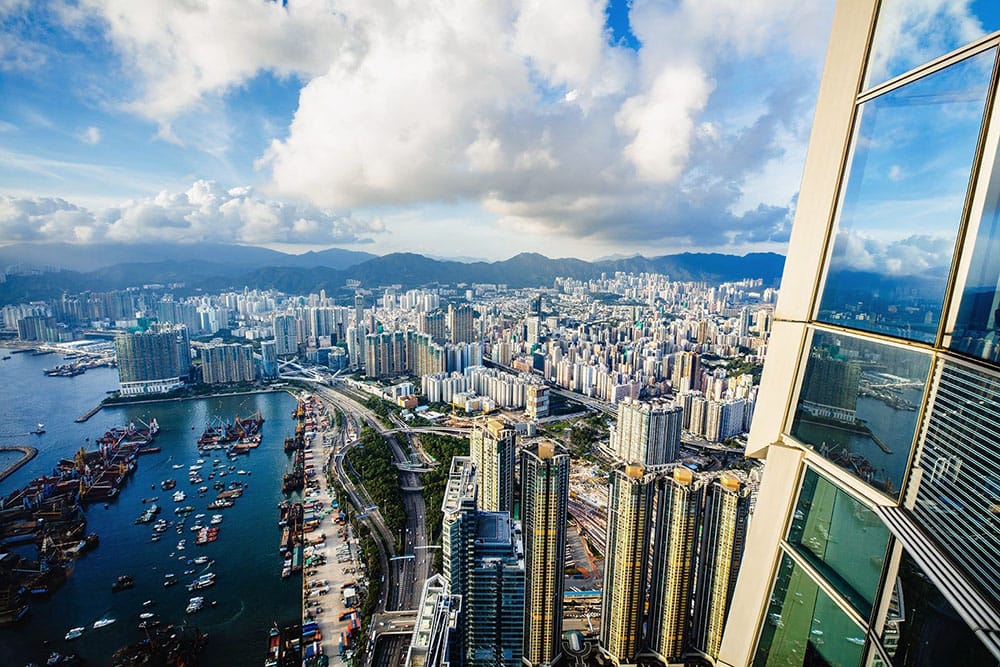
Sky 100 provides the most immediate orientation. Perched atop one of the tallest buildings in the city, it delivers Hong Kong in a single, sweeping gesture. In less than a minute, a high speed elevator lifts you into a space where the city arranges itself around you. Towers become patterns. Roads become veins. The harbor gleams with intent. From here, Hong Kong feels coherent. The exhibition areas within Sky 100 quietly contextualize what you see, adding layers of history and cultural insight that enrich the view rather than distract from it.
Descending back to street level, the city resumes its pace, but the memory of that height lingers. Hotels nearby capitalize on this perspective, offering rooms with panoramic windows that keep the skyline present even at rest. The benefit is continuity. The city does not vanish when you close the door.
The Peak offers a different ascent, one rooted in ritual rather than speed. The historic Peak Tram climbs steadily, creaking upward through dense urban foliage toward a vantage point that has framed love stories and first impressions for generations. At nearly four hundred meters above sea level, the city reveals a softer side. Sky Terrace 428 extends the view even further, allowing visitors to circle the horizon slowly, deliberately. Shopping and dining options here feel secondary, almost decorative. The real attraction is the pause. Couples linger. Conversations quiet. The city hums below, unbothered.
Lantau Island shifts the narrative entirely. Ngong Ping 360 transports visitors not just across distance but across mood. The cable car ride from Tung Chung floats above water and hillside, cabins occasionally turning transparent beneath your feet. The sensation is both exhilarating and calming. Arrival at Ngong Ping Village introduces a slower tempo. Shops and eateries line a compact square, designed for wandering rather than conquest. Nearby, the presence of the Tian Tan Buddha anchors the experience. Participating in the Walk with Buddha program adds structure to contemplation, blending physical movement with spiritual symbolism. The benefit here is contrast. Hong Kong proves it can be quiet without losing relevance.
Back in the city, the Avenue of Stars celebrates motion of another kind. Cinema. Performance. Memory. Along the waterfront, handprints and plaques commemorate figures who carried Hong Kong’s stories far beyond its borders. Bruce Lee’s statue stands poised, eternally mid gesture, embodying both discipline and charisma. Monthly performances animate the promenade, blurring the line between spectator and participant. Hotels in Tsim Sha Tsui capitalize on this energy, placing guests within walking distance of both cultural landmarks and evening light shows across the harbor.
For a complete shift in tone, Hong Kong Disneyland offers an unapologetic return to wonder. This is not nostalgia alone. It is precision engineered delight. Exclusive attractions like Toy Story Land, designed specifically for the Asian audience, elevate the experience beyond replication. Visitors move through oversized environments that distort scale and expectation. Rides oscillate between thrill and whimsy. Families find common ground here. Adults rediscover it. Nearby hotels are designed with logistics in mind, simplifying transport and maximizing rest so the day unfolds smoothly.
Victoria Harbour remains the city’s most eloquent pause. By day, ferries glide methodically. By night, the skyline performs. Harbor cruises offer a perspective that land cannot, allowing the city to approach you instead. Dining aboard these vessels adds a layer of indulgence, transforming sightseeing into ritual. Morning reveals another facet. Along the promenade, residents gather for Tai Chi, movements slow and deliberate against the restless city backdrop. Visitors are welcome to join. No fee. No barrier. Just presence.
Ocean Park broadens the city’s appeal by combining education and entertainment. Since its opening in the late seventies, it has evolved into a world class attraction that balances spectacle with substance. Exhibits range from polar ecosystems to rare Asian wildlife, presented with care rather than excess. Historical zones recreate mid twentieth century Hong Kong, allowing visitors to step briefly into the city’s recent past. The benefit is narrative continuity. You do not merely observe. You understand.
As daylight fades, Lan Kwai Fong awakens. This compact district condenses global cuisine and nightlife into a walkable maze of sound and scent. Restaurants represent nearly every culinary tradition imaginable. Bars pulse with conversation in multiple languages. This is Hong Kong after hours, social and unapologetic. Hotels nearby serve as strategic retreats, allowing guests to immerse fully, then withdraw comfortably.
Finally, the Star Ferry offers the city in miniature. Since the late nineteenth century, it has carried passengers between Hong Kong Island and Kowloon with unassuming reliability. Modern transit options exist, yet millions still choose this crossing. The reason becomes clear the moment you step aboard. The journey is brief but resonant. Wind off the water. City lights at eye level. The sense of moving through history without ceremony. National Geographic’s recognition of the Star Ferry as one of the world’s most compelling travel experiences feels less like praise and more like acknowledgment.
Hong Kong’s hotels understand their role in this urban choreography. Rooms are designed for efficiency without austerity. Views are treated as amenities. Locations prioritize access over isolation. Concierge services act as cultural translators, aligning itineraries with personal interests. The benefit is momentum. You spend less time navigating and more time absorbing.
This is why Hong Kong endures. It does not promise escape. It offers engagement. It challenges you to keep up, then rewards you when you do. And somewhere between a harbor crossing and a skyline viewed from impossible height, you realize the city has already claimed you.
Hong Kong travel blog, Hong Kong tour guide, best places to visit Hong Kong, Hong Kong city travel experience, Hong Kong luxury hotels, Hong Kong skyline attractions, Hong Kong sightseeing tour, Hong Kong harbor cruise, Hong Kong Disneyland travel, Hong Kong nightlife travel, Hong Kong cultural attractions, Hong Kong urban travel, Hong Kong ferry experience, Hong Kong observation deck, Hong Kong vacation guide
